Ambassador Program
Updated July 2026
An ambassador program is a structured, ongoing initiative in which a brand recruits loyal creators or customers to represent it over time, rewarding them with commissions, product, or perks for sustained promotion.
Ambassador programs formalize long-term advocacy: rather than one-off deals, brands enroll a cohort of ambassadors who consistently promote the product, often with tracked links or codes so their impact is measurable.
Rewards commonly blend affiliate commissions with free product, early access, and status perks, keeping ambassadors motivated and their incentives tied to real results. Done well, an ambassador program turns a brand's most enthusiastic fans into a durable, trusted growth channel.
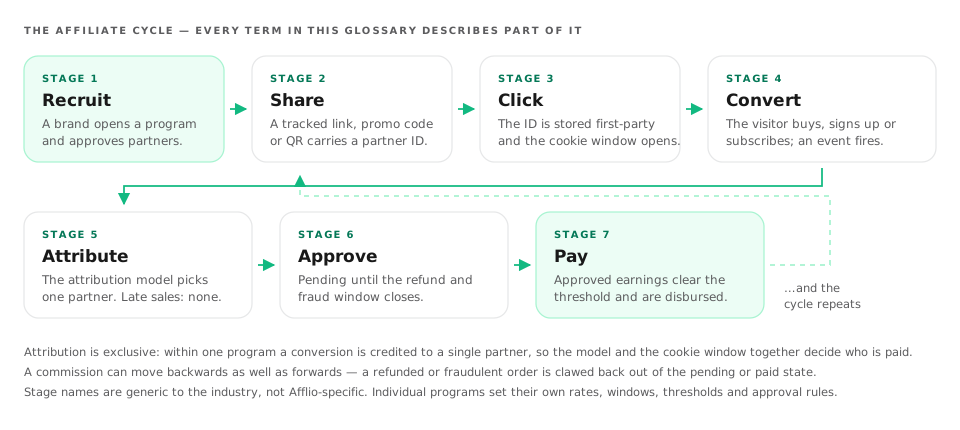
Where Ambassador Program sits in the affiliate cycle
An ambassador program is the recruit-stage operation a brand runs to select, equip and measure many ambassadors at once.
How Ambassador Program actually works
Where a single ambassador is a relationship, a program is a system: an application or nomination route, selection criteria, a tier structure, a supply chain for product and assets, a communication cadence, and a measurement framework that works across everyone in it.
Most programs are tiered because the population is not uniform. An entry tier receives product and a personal code; a middle tier adds a modest retainer or performance bonuses; a top tier looks like an individual ambassador arrangement. The tiers exist to make the logistics survivable at volume.
What Ambassador Program means for a creator
Joining a program is a different proposition from being appointed an ambassador. Programs are usually non-exclusive at the lower tiers, obligations are lighter, and compensation often starts as product plus commission rather than a retainer.
The thing worth checking is whether the tiers are actually reachable and what moves you between them. A program with an invisible promotion mechanism is a gifting scheme with a nicer name.
What Ambassador Program means for a brand
A program scales the ambassador idea past the handful of people a relationship-based approach can support, and it is usually far cheaper per participant. What it costs is logistics: product fulfilment, asset distribution and communication at volume are the parts that fail first.
Measure it per tier rather than in aggregate. A blended figure hides the common pattern where a small top tier produces almost all of the value and a large entry tier consumes almost all of the product budget.
Common mistakes with Ambassador Program
Recruiting faster than the program can supply
Ambassadors who wait weeks for product or assets disengage before they post. Fulfilment capacity is the real constraint on program size.
Publishing tiers with no stated promotion criteria
If nobody can see how to move up, the tiers motivate nothing and read as an arbitrary ranking.
Measuring the program in aggregate
Blended numbers hide the usual distribution, where a small minority produce most of the output. Per-tier measurement is what shows where the budget should go.
Ambassador Program: common questions
What is the difference between an ambassador program and an affiliate program?
An affiliate program pays on outcomes and asks for nothing else. An ambassador program adds obligations and benefits — product, a cadence, tiers, sometimes a retainer — and selects participants rather than approving all applicants.
Are ambassador programs paid?
Varies by tier. Entry tiers are commonly product plus a commission or personal code; higher tiers add bonuses or a retainer. A program that offers only product should say so plainly rather than implying compensation.
How do brands choose ambassadors at scale?
Usually on audience fit and existing genuine use of the product rather than on reach, because the association only works if the audience finds it plausible. Published criteria make the program easier to run and easier to trust.
See also
- Brand Ambassador
A brand ambassador is a creator or customer who represents a brand over an ongoing period, regularly promoting it in exchange for pay, product, commissions, or perks, forming a longer-term association than a one-off post.
- Referral Marketing
Referral marketing is a strategy that encourages existing customers to recommend a product to others, usually with a two-sided reward, leveraging personal trust to acquire new customers at low cost.
- Influencer Affiliate (Hybrid)
An influencer affiliate blends influencer marketing with affiliate pay: a creator promotes a brand to their audience and earns commissions on tracked sales, often alongside or instead of a flat sponsorship fee.
- Affiliate Marketing
Affiliate marketing is a performance-based marketing model in which a business pays external partners a commission for each customer or sale they refer.
- Brand Partnership
A brand partnership is a collaborative arrangement between a brand and a creator or another brand to work together on content, campaigns, or ongoing promotion, spanning one-off deals to long-term ambassador and affiliate relationships.
Turn the theory into a live program
Afflio handles tracking, commissions, and payouts so you can run the program these terms describe — start free in an afternoon.