Referral Marketing
Updated July 2026
Referral marketing is a strategy that encourages existing customers to recommend a product to others, usually with a two-sided reward, leveraging personal trust to acquire new customers at low cost.
Unlike affiliate programs aimed at professional publishers, referral marketing targets a brand's own happy customers, giving both the referrer and the new customer an incentive — a credit, discount, or cash reward — to spread the word.
Referral programs convert well because recommendations arrive with built-in trust, and they scale acquisition efficiently since the cost is paid only on a successful referral. They are tracked with unique links or codes much like affiliate programs.
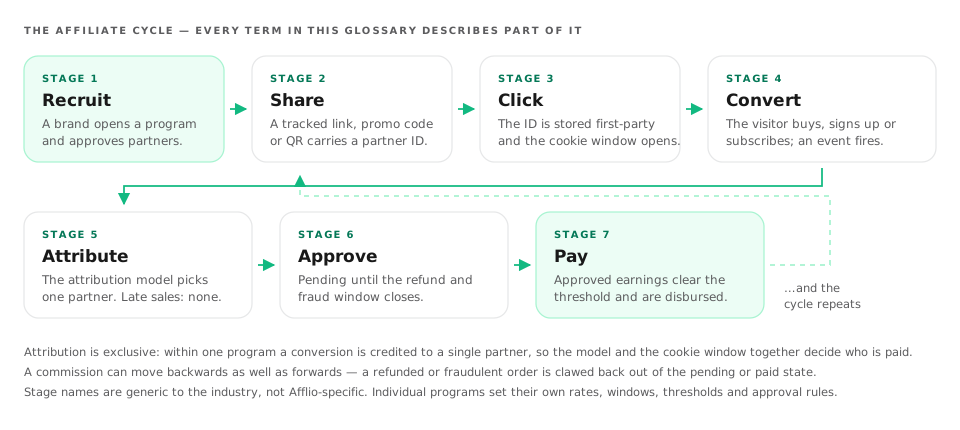
Where Referral Marketing sits in the affiliate cycle
Referral marketing recruits from an audience a brand already has: its own customers, rewarded for introducing people they know.
How Referral Marketing is calculated
referral coefficient = invitations sent per customer × conversion rate per invitation
- invitations per customer
- how many people an average customer actually invites
- conversion rate
- share of invitations that become customers
- above 1
- each cohort more than replaces itself from referrals alone
- reality
- most programmes sit well below 1 and are a cost reducer, not a growth engine
Worked example (illustrative)
Customers sending an average of 1.2 invitations that convert at 15 percent gives a coefficient of 0.18 — meaningful, because it cuts blended acquisition cost, and nowhere near self-sustaining growth.
The figures above are a chosen illustration of the arithmetic. They are not a measured result, a typical result, or a projection of what any program pays.
What Referral Marketing means for a creator
Referral programmes are usually aimed at customers rather than creators, and the reward reflects that: account credit or a discount rather than cash. A creator with an audience is normally better served by the brand's affiliate programme, which pays in money and scales with reach.
Where both exist, check whether they can be combined. Some brands allow a creator to be both a customer referrer and an affiliate; others explicitly do not, and stacking them where it is barred risks both.
What Referral Marketing means for a brand
The mechanism works because the recommendation carries trust the brand cannot manufacture. Double-sided rewards — something for the referrer and something for the friend — consistently outperform one-sided ones, because they give the referrer a reason that is not purely self-interested.
The honest expectation is cost reduction rather than viral growth. Very few programmes achieve a coefficient near one, and designing around the assumption that yours will is the most common way they disappoint.
Common mistakes with Referral Marketing
Expecting viral growth from a referral programme
A coefficient above one is rare. Most programmes usefully lower blended acquisition cost and do not grow the business by themselves.
Rewarding only the referrer
One-sided rewards make the ask feel self-serving. Giving the friend something too is what makes the recommendation comfortable to send.
Burying the referral prompt
The programme only works if customers meet it at a moment of satisfaction. A link in account settings is a programme almost nobody will find.
Referral Marketing: common questions
How is referral marketing different from affiliate marketing?
Referral marketing rewards existing customers for introducing people they personally know, usually with credit or a discount. Affiliate marketing pays external partners cash for reaching an audience with no prior relationship to the brand.
Should referral rewards be double-sided?
Usually yes. Rewarding both the referrer and the friend consistently outperforms a one-sided reward, because it removes the awkwardness of an ask that benefits only the sender.
When should a referral programme be triggered?
At a moment of demonstrated satisfaction — after a successful outcome in the product, not at signup. Prompting before the customer has anything to recommend produces low-quality invitations.
How do I stop a referral programme being gamed?
Trigger the reward on a real outcome rather than on a signup, cap how many rewards one account can earn in a period, and check for referrals that share a device, address or payment instrument with the referrer. Signup-triggered rewards with no cap are the version that reliably attracts abuse.
See also
- Referral
A referral is a new customer or lead brought to a business by an existing customer or partner, typically tracked so the referrer can be rewarded.
- Affiliate Marketing
Affiliate marketing is a performance-based marketing model in which a business pays external partners a commission for each customer or sale they refer.
- Partner Marketing
Partner marketing is a broad discipline of growing revenue through external partners — affiliates, referrers, resellers, ambassadors, and integration partners — encompassing affiliate marketing and extending into strategic and channel partnerships.
- Ambassador Program
An ambassador program is a structured, ongoing initiative in which a brand recruits loyal creators or customers to represent it over time, rewarding them with commissions, product, or perks for sustained promotion.
Turn the theory into a live program
Afflio handles tracking, commissions, and payouts so you can run the program these terms describe — start free in an afternoon.