Affiliate Marketing
Updated July 2026
Affiliate marketing is a performance-based marketing model in which a business pays external partners a commission for each customer or sale they refer.
Affiliate marketing aligns incentives by paying only for results. A merchant defines what counts as a conversion (a sale, lead, signup, or subscription) and the commission for each, then recruits affiliates who promote the offer to their audiences using tracked links and codes.
Because spend is tied directly to outcomes, affiliate marketing typically has a predictable, measurable return on investment compared with channels billed by impressions or clicks. It powers everything from creator-driven e-commerce to large B2B SaaS partner programs.
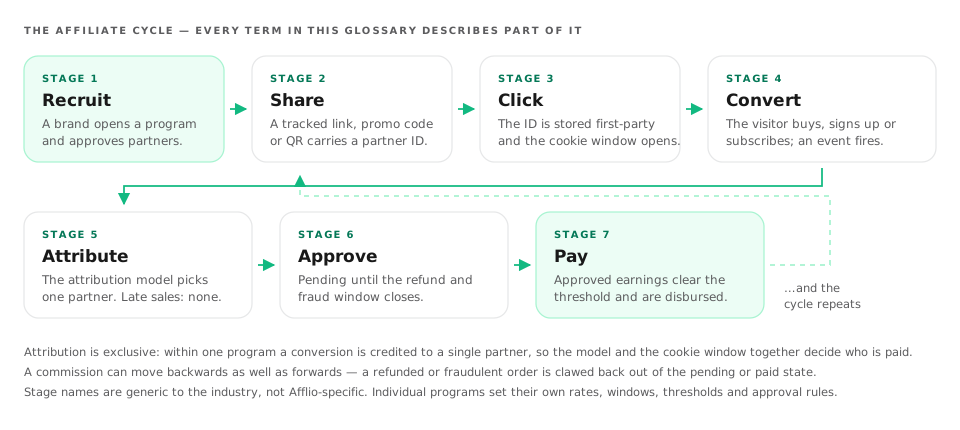
Where Affiliate Marketing sits in the affiliate cycle
Affiliate marketing names the whole model, so it is the container the other seventy-two terms describe parts of.
How Affiliate Marketing actually works
The model has exactly four moving parts: a merchant who defines a conversion, a partner who promotes it, a tracking layer that ties the conversion back to one partner, and a payout rail that moves the money. Remove any one and it stops being affiliate marketing — without the tracking layer it is word of mouth, and without the defined conversion it is sponsorship.
What makes it structurally different from advertising is the direction of risk. In a media buy the advertiser pays for delivery and carries the risk that nothing converts. In affiliate marketing the partner carries the production cost and is paid only on the outcome, which is why the rates look generous next to a media commission and why partner churn is the channel's characteristic failure mode rather than overspend.
What Affiliate Marketing means for a creator
For a creator, the model turns a back catalogue into an asset. A review published in March keeps earning in December if it still ranks, which is the opposite of sponsorship economics, where income stops the moment you stop shipping new posts.
It rewards a narrow audience more than a large one. A newsletter of four thousand engineers evaluating a tool converts at rates a general-interest channel of four hundred thousand cannot approach, because the recommendation arrives at the moment the reader is already deciding.
What Affiliate Marketing means for a brand
For a brand the appeal is that the customer acquisition cost is capped by construction: you set the commission, so you know the maximum you will pay for a sale before you pay it. That makes the channel unusually easy to approve internally compared with a media budget whose return is argued after the fact.
The corresponding work is incrementality. A large share of affiliate-attributed revenue in a mature program comes from partners who intercept buyers already on their way to checkout — coupon extensions especially — and separating that from genuinely new demand is the single hardest measurement problem the channel has.
Common mistakes with Affiliate Marketing
Judging the channel on attributed revenue alone
Attributed revenue counts every sale the tracking layer credits, including ones that would have happened anyway. Without an incrementality test the number flatters the channel and misdirects budget toward the partners who intercept rather than the ones who create demand.
Setting one rate for every partner type
A content partner who creates demand and a coupon extension that captures it at checkout are doing different work. A single flat rate overpays the second and underpays the first, and the first is the one who leaves.
Launching before tracking is verified end to end
A program that pays late or misses sales loses its best partners in the first month and rarely gets them back. Fire a test conversion and confirm it lands, attributes, and appears in the partner's dashboard before recruiting anyone.
Affiliate Marketing: common questions
How is affiliate marketing different from referral marketing?
Referral marketing rewards existing customers for introducing people they know, usually with credit or a discount. Affiliate marketing pays external partners a cash commission for reaching an audience that has no prior relationship with the brand.
Is affiliate marketing still worth it with third-party cookies restricted?
Yes, but the plumbing has changed. Programs increasingly track with first-party cookies, unique promo codes and server-to-server postbacks rather than relying on a third-party cookie surviving the browser, and those methods are unaffected by the restrictions.
What does a brand actually pay for?
A conversion the brand itself defines — most often a completed purchase, but sometimes a qualified lead, a free-trial signup, or a subscription that survives a minimum period. Impressions and clicks are not paid for in a pure affiliate model.
See also
- Affiliate
An affiliate is an individual or company that promotes another business's products in exchange for a commission on the sales or actions they generate.
- Merchant
A merchant is the business that owns the product and runs an affiliate program, paying partners a commission for the customers they refer.
- Conversion
A conversion is the qualifying action — such as a sale, signup, lead, or subscription — that triggers an affiliate commission.
- Commission
A commission is the payment an affiliate earns for each qualifying conversion they drive, set as a percentage of the sale or a fixed amount per action.
Turn the theory into a live program
Afflio handles tracking, commissions, and payouts so you can run the program these terms describe — start free in an afternoon.