Brand Partnership
Updated July 2026
A brand partnership is a collaborative arrangement between a brand and a creator or another brand to work together on content, campaigns, or ongoing promotion, spanning one-off deals to long-term ambassador and affiliate relationships.
The term covers a wide spectrum: a single sponsored collaboration, a co-marketing campaign between two brands, or a sustained creator partnership with an affiliate or ambassador structure. What unites them is a mutual arrangement to create value together rather than a simple ad buy.
In the creator economy, brand partnerships are the umbrella under which sponsored posts, brand deals, and affiliate collaborations sit, and the strongest ones evolve from single deals into ongoing, performance-linked relationships.
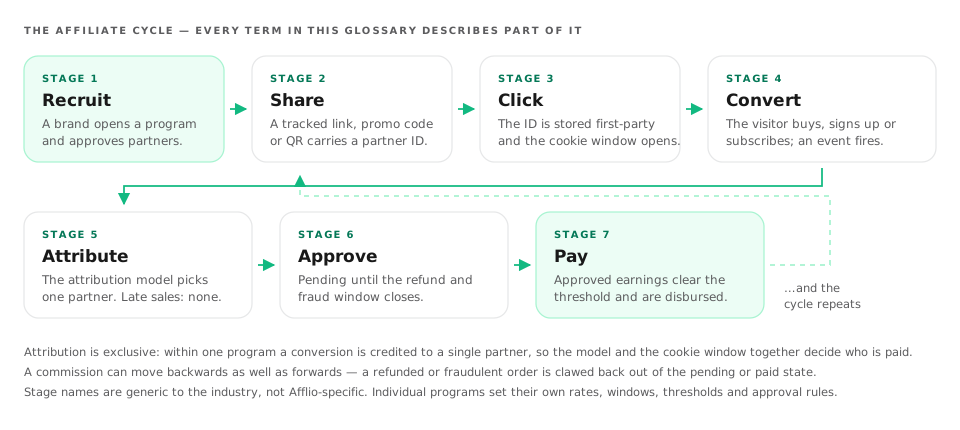
Where Brand Partnership sits in the affiliate cycle
A brand partnership is a recruit-stage structure rather than a transaction: an ongoing commercial relationship with its own operating rhythm.
How Brand Partnership actually works
Where a brand deal is one bounded transaction, a partnership is a standing arrangement with a shared objective, and it usually carries mechanics a single deal does not: a defined term, a cadence of activity, named contacts on both sides, agreed success measures, and a review point where it is renewed or ended.
The commercial forms vary widely. Between a brand and a creator it often looks like a retainer with performance upside. Between two businesses it can be co-marketing, a referral arrangement, a revenue share, or a product integration promoted jointly — all of which sit under the same word and have very different economics.
What Brand Partnership means for a creator
A partnership is worth materially more than an equivalent series of one-off deals, because the production overhead falls, the audience stops treating each mention as a surprise, and the income becomes predictable enough to plan production against.
The trade is concentration risk and exclusivity. A partnership that occupies a category for a year removes every competitor from the calendar, so the term and the exit conditions deserve as much attention as the fee.
What Brand Partnership means for a brand
Partnerships outperform one-off placements because repetition from a trusted source compounds, and because the partner eventually understands the product well enough to describe it accurately without a brief.
They need an owner and a review point. A partnership without a named contact and an agreed measure of success drifts into a recurring invoice that nobody can defend at the next budget round.
Common mistakes with Brand Partnership
Running a partnership with no defined success measure
Without an agreed metric it is renewed on sentiment and cancelled on sentiment. Both sides need to know what good looks like before the term starts.
Confusing a partnership with a long brand deal
A partnership has a shared objective and a review cadence. A long deal is still one transaction, and structuring one as the other disappoints both sides.
Letting exclusivity outlive the activity
A category lock that continues after the work has stopped costs the creator real income for no return. Tie it to the active term.
Brand Partnership: common questions
How is a brand partnership different from a brand deal?
A deal is one bounded transaction with defined deliverables. A partnership is an ongoing relationship with a term, a cadence, named owners and agreed success measures, and it is renewed or ended at a review point.
What forms do brand partnerships take between businesses?
Co-marketing, referral arrangements, revenue shares and jointly promoted product integrations are the common ones. They sit under the same word and have very different economics, so the structure should be named explicitly.
Should a partnership include exclusivity?
Only where it is genuinely needed, scoped to specific categories, and limited to the active term. Unbounded exclusivity is the clause most likely to make a partnership unprofitable for the creator.
See also
- Brand Deal
A brand deal is a paid agreement between a brand and a creator to promote the brand's product, defined by deliverables, usage rights, exclusivity, timing, and a fee or commission.
- Brand Ambassador
A brand ambassador is a creator or customer who represents a brand over an ongoing period, regularly promoting it in exchange for pay, product, commissions, or perks, forming a longer-term association than a one-off post.
- Partner Marketing
Partner marketing is a broad discipline of growing revenue through external partners — affiliates, referrers, resellers, ambassadors, and integration partners — encompassing affiliate marketing and extending into strategic and channel partnerships.
- Influencer Marketing
Influencer marketing is a strategy in which brands partner with creators who have engaged social audiences to promote products, paying through flat fees, free product, affiliate commissions, or a combination.
- Sponsored Post
A sponsored post is social or blog content a creator is paid to publish promoting a brand, which must be clearly disclosed as an ad under FTC and comparable rules.
Turn the theory into a live program
Afflio handles tracking, commissions, and payouts so you can run the program these terms describe — start free in an afternoon.