AOV (Average Order Value)
Updated July 2026
AOV, or average order value, is the average amount spent each time a customer places an order, calculated as total revenue divided by number of orders.
AOV = total revenue ÷ number of orders. In affiliate marketing it directly affects payouts: on a percentage-based commission, a higher AOV means a larger commission per sale, so affiliates often prefer promoting higher-AOV offers.
Merchants raise AOV with bundles, upsells, and free-shipping thresholds. Pairing a strong AOV with a good conversion rate is what produces a high earnings-per-click figure that attracts quality partners.
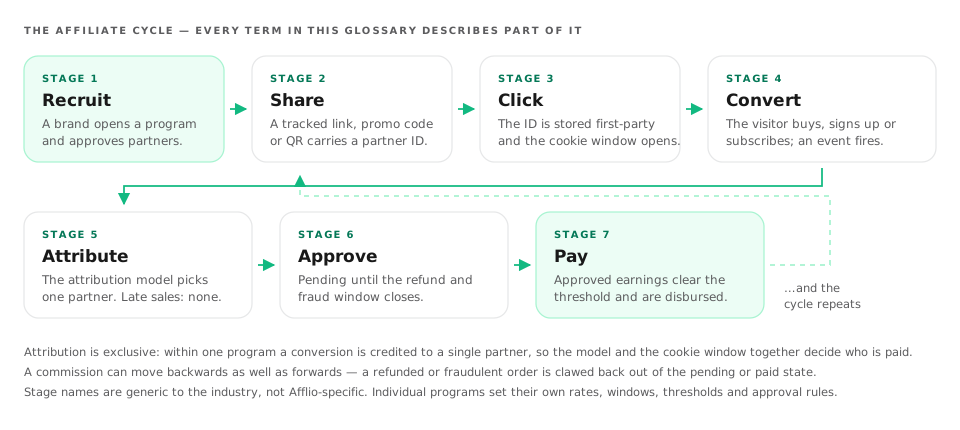
Where AOV (Average Order Value) sits in the affiliate cycle
Average order value is measured at the convert stage and is the multiplier that turns a modest commission rate into a meaningful one.
How AOV (Average Order Value) is calculated
AOV = total revenue ÷ number of orders
- total revenue
- usually net of tax and shipping, and always net of discounts
- orders
- completed orders in the same period, excluding refunded ones
- segment first
- a blended AOV across new and returning buyers hides both
- why it matters
- commission = AOV × rate, so AOV moves earnings as hard as rate does
Worked example (illustrative)
Nine orders at 40 dollars and one at 900 average 126 dollars, which describes none of the ten. The median of 40 dollars is the honest summary, and this is why a single outlier can make a program look far more lucrative than it is.
The figures above are a chosen illustration of the arithmetic. They are not a measured result, a typical result, or a projection of what any program pays.
What AOV (Average Order Value) means for a creator
AOV is why a 6 percent commission can beat a 30 percent one. Six percent of a 900 dollar order is 54 dollars; thirty percent of a 25 dollar order is 7.50. Comparing rates without comparing order values is the most common way partners pick the worse program.
It also tells you which content to make. If a brand's AOV is driven by bundles or annual plans, content that frames the bundle rather than the entry product raises your earnings without needing a single extra click.
What AOV (Average Order Value) means for a brand
Raising AOV is usually cheaper than raising traffic, and it lifts affiliate earnings and brand margin simultaneously — one of the few levers in the channel where both sides gain from the same change.
Publishing a realistic AOV in the program's terms is a recruitment tool, because it lets a partner compute expected earnings per click instead of guessing from the rate alone. Publishing a mean inflated by enterprise orders is the opposite, and partners notice within a month.
Common mistakes with AOV (Average Order Value)
Quoting a mean when the distribution is skewed
A handful of very large orders drags the mean far above what a typical buyer spends. Where the two diverge, the median is the number that actually describes the program.
Blending new and returning customers
Returning buyers usually spend more. A blended figure overstates what a partner sending first-time buyers can expect to earn.
Measuring gross of refunds
Large orders are refunded more often in several categories. AOV computed before refunds overstates both the brand's revenue and the partner's realistic earnings.
AOV (Average Order Value): common questions
Does affiliate commission get paid on the full order value?
Usually on the net product value — after discounts, and excluding tax and shipping. Two programs quoting the same rate can pay noticeably different amounts because they define this base differently.
Should I use mean or median order value?
Median when the distribution is skewed by a few large orders, which it usually is. The mean is fine only when order sizes cluster tightly.
How do I raise AOV as an affiliate?
Promote the bundle, the annual plan or the higher tier rather than the cheapest entry point, and link to the configuration you are recommending rather than to a generic category page.
See also
- EPC (Earnings Per Click)
EPC, or earnings per click, is the average commission an affiliate earns per click on their tracking links, calculated as total commissions divided by total clicks.
- Conversion Rate
Conversion rate is the percentage of referred clicks or visitors that complete a qualifying action, calculated as conversions divided by clicks.
- LTV (Customer Lifetime Value)
LTV, or customer lifetime value, is the total revenue a business expects to earn from a customer over the entire relationship.
- Commission
A commission is the payment an affiliate earns for each qualifying conversion they drive, set as a percentage of the sale or a fixed amount per action.
Turn the theory into a live program
Afflio handles tracking, commissions, and payouts so you can run the program these terms describe — start free in an afternoon.