LTV (Customer Lifetime Value)
Updated July 2026
LTV, or customer lifetime value, is the total revenue a business expects to earn from a customer over the entire relationship.
LTV estimates how much a customer is worth across all their purchases or subscription renewals, not just the first sale. It helps merchants decide how much they can afford to pay affiliates: a program can offer generous recurring commissions when each referred customer has a high LTV.
In subscription and SaaS programs, LTV is the natural anchor for recurring and MRR-based commissions, since those models pay partners in proportion to the long-term value their referrals create.
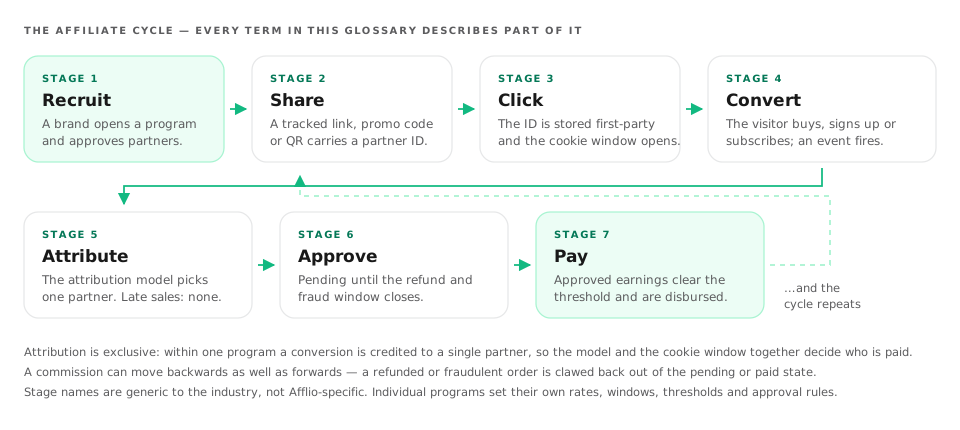
Where LTV (Customer Lifetime Value) sits in the affiliate cycle
Lifetime value is the ceiling every pay-stage decision sits under: it is what a customer is ultimately worth, and therefore what can be spent to acquire one.
How LTV (Customer Lifetime Value) is calculated
LTV ≈ average revenue per customer per period × gross margin ÷ churn rate
- gross margin
- include it — revenue-based LTV overstates what can be spent
- churn rate
- per period; 1 ÷ churn is the expected number of periods retained
- LTV:CAC
- the ratio businesses steer by; a commission is part of CAC
- payback period
- how long until the customer has repaid acquisition — the cash-flow constraint
Worked example (illustrative)
A 50 dollar monthly subscription at 80 percent gross margin and 4 percent monthly churn implies an LTV near 1,000 dollars. That is what makes a 150 dollar first-year commission affordable — and it is affordable only if the churn assumption holds.
The figures above are a chosen illustration of the arithmetic. They are not a measured result, a typical result, or a projection of what any program pays.
What LTV (Customer Lifetime Value) means for a creator
LTV is the number that explains why some programs can pay commissions that look impossible. A SaaS product with high margin and low churn can pay the whole first year of revenue away and still profit, which a physical product with a 30 percent margin can never do.
It is also why recurring commissions exist at all. A program paying for the lifetime of a customer is sharing an LTV it expects to be long, and the size of the recurring rate is a fair signal of how confident it is.
What LTV (Customer Lifetime Value) means for a brand
LTV sets the ceiling on what the program can pay, and it has to be computed on gross margin rather than revenue. A commission set against revenue LTV can quietly exceed the customer's actual contribution.
Payback period is the constraint that bites before the ratio does. An LTV:CAC ratio of four to one is irrelevant if the payback takes three years and the business cannot fund the gap.
Common mistakes with LTV (Customer Lifetime Value)
Calculating LTV on revenue rather than margin
It overstates what can be spent on acquisition by the whole cost of goods, which is how commissions end up exceeding contribution.
Using a churn assumption the business has never measured
LTV is extremely sensitive to churn. Halving the assumed churn rate doubles the LTV and doubles the commission it appears to justify.
Ignoring payback period
A healthy LTV:CAC ratio with a multi-year payback is a cash-flow problem wearing a good ratio. Both numbers have to work.
LTV (Customer Lifetime Value): common questions
How does LTV affect affiliate commission rates?
It sets the ceiling. A high-margin, low-churn product can afford a large commission because the customer keeps paying; a thin-margin one-time product cannot, regardless of how attractive a higher rate would be to partners.
Should LTV use revenue or gross profit?
Gross profit. Revenue-based LTV overstates what is available to spend on acquisition by the entire cost of goods, and commissions set against it can exceed the customer's real contribution.
What is a healthy LTV to CAC ratio?
Businesses commonly target somewhere around three or more to one, but the ratio alone is not sufficient — payback period has to be fundable too, and a good ratio with a very long payback is still a cash-flow problem.
See also
- Recurring Commission
A recurring commission pays the affiliate a share of every renewal payment a referred customer makes, not just the first sale.
- MRR Commission
An MRR commission ties an affiliate's earnings to the monthly recurring revenue a referred customer generates, paying a percentage of that MRR over time.
- AOV (Average Order Value)
AOV, or average order value, is the average amount spent each time a customer places an order, calculated as total revenue divided by number of orders.
- SaaS Partner Program
A SaaS partner program is a structured program through which a software company rewards external partners — affiliates, referrers, and resellers — for driving new subscriptions.
Turn the theory into a live program
Afflio handles tracking, commissions, and payouts so you can run the program these terms describe — start free in an afternoon.