Conversion Rate
Updated July 2026
Conversion rate is the percentage of referred clicks or visitors that complete a qualifying action, calculated as conversions divided by clicks.
Conversion rate = conversions ÷ clicks × 100. It measures how effectively referral traffic turns into sales or signups. A 2% conversion rate means two of every hundred referred visitors converted.
For affiliates, conversion rate signals offer quality and audience fit; for merchants, it reveals how well the landing page, pricing, and offer perform for partner-driven traffic. It combines with average order value to produce earnings per click (EPC).
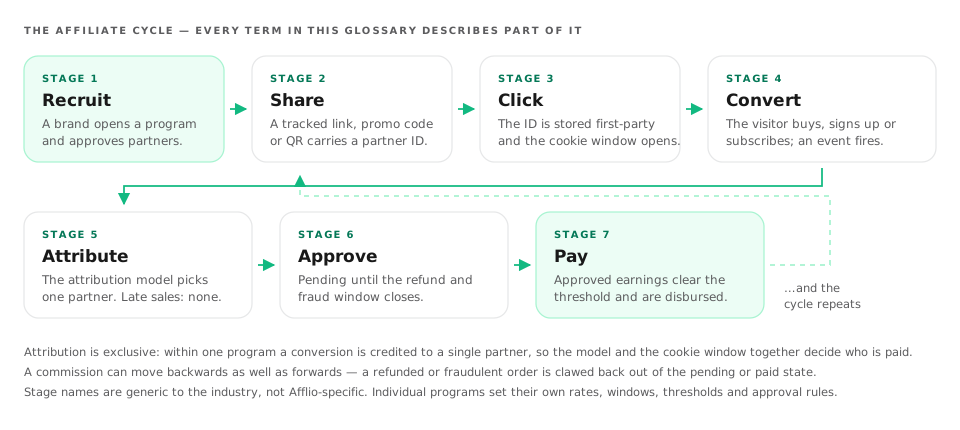
Where Conversion Rate sits in the affiliate cycle
Conversion rate measures the convert stage itself: what share of the clicks a partner sent actually became the action the program pays for.
How Conversion Rate is calculated
conversion rate = conversions ÷ clicks × 100
- conversions
- actions that met the program's definition, after reversals
- clicks
- tracked clicks on the partner's links in the same period
- period
- must match on both sides, or a long cookie window skews it
- typical use
- compares offers and placements, not partners of different sizes
Worked example (illustrative)
820 tracked clicks producing 23 net conversions is a 2.8 percent conversion rate. Counting the 27 gross conversions before four refunds were deducted would have reported 3.3 percent — a fifth higher, and wrong.
The figures above are a chosen illustration of the arithmetic. They are not a measured result, a typical result, or a projection of what any program pays.
What Conversion Rate means for a creator
Conversion rate is the fastest diagnostic a partner has. A high click-through rate with a low conversion rate means the audience is interested and the offer, the landing page or the price is not matching what the content promised.
It is also the lever that is cheapest to move. Sending the click to the specific product page rather than the home page, and matching the content's framing to the landing page's framing, routinely moves conversion rate more than doubling traffic would.
What Conversion Rate means for a brand
For a brand, the partner-level conversion rate is the clearest signal of traffic quality, and it is the number worth examining before removing a partner for low revenue. A partner sending a small volume at a high conversion rate is usually worth more attention than one sending ten times the clicks at a tenth of the rate.
An unusually high rate deserves the same scrutiny as an unusually low one. Rates far above the program norm often indicate a partner intercepting buyers at checkout rather than creating demand, which is an incrementality question rather than a performance one.
Common mistakes with Conversion Rate
Measuring gross conversions instead of net
Counting conversions before refunds and reversals inflates the rate by exactly the reversal rate, and the inflation is largest in the categories where returns are highest.
Mismatching the click period and the conversion period
With a 90-day cookie window, this month's conversions include clicks from two months ago. Comparing them against this month's clicks alone produces a number that means nothing.
Comparing rates across different conversion definitions
A program paying on a free-trial signup will always show a higher rate than one paying on a retained subscription. The rates are not comparable, and treating them as such misprices the offer.
Conversion Rate: common questions
What is a good affiliate conversion rate?
There is no universal figure worth quoting — it varies enormously by category, price point and how the program defines a conversion. The only useful benchmark is the same offer's own rate over time, and the rate of other placements you run.
Why is my conversion rate zero despite lots of clicks?
Check tracking before content. A stripped query parameter, a checkout on a different domain, or a blocked conversion pixel all produce exactly this pattern, and each is a plumbing failure rather than an audience failure.
Should I optimise conversion rate or click-through rate?
Whichever is further from the offer's norm. They multiply, so the same proportional gain in either produces the same revenue, and the cheaper one to move is usually the one that is currently worse.
See also
- EPC (Earnings Per Click)
EPC, or earnings per click, is the average commission an affiliate earns per click on their tracking links, calculated as total commissions divided by total clicks.
- Conversion
A conversion is the qualifying action — such as a sale, signup, lead, or subscription — that triggers an affiliate commission.
- AOV (Average Order Value)
AOV, or average order value, is the average amount spent each time a customer places an order, calculated as total revenue divided by number of orders.
- Affiliate
An affiliate is an individual or company that promotes another business's products in exchange for a commission on the sales or actions they generate.
Turn the theory into a live program
Afflio handles tracking, commissions, and payouts so you can run the program these terms describe — start free in an afternoon.