Commission
Updated July 2026
A commission is the payment an affiliate earns for each qualifying conversion they drive, set as a percentage of the sale or a fixed amount per action.
Commission structures vary: a percentage of order value (e.g. 20% of the sale), a flat fee per action (e.g. $50 per signup), tiered rates that increase with volume, or recurring commission paid for the lifetime of a subscription. The structure defines how affiliates are motivated.
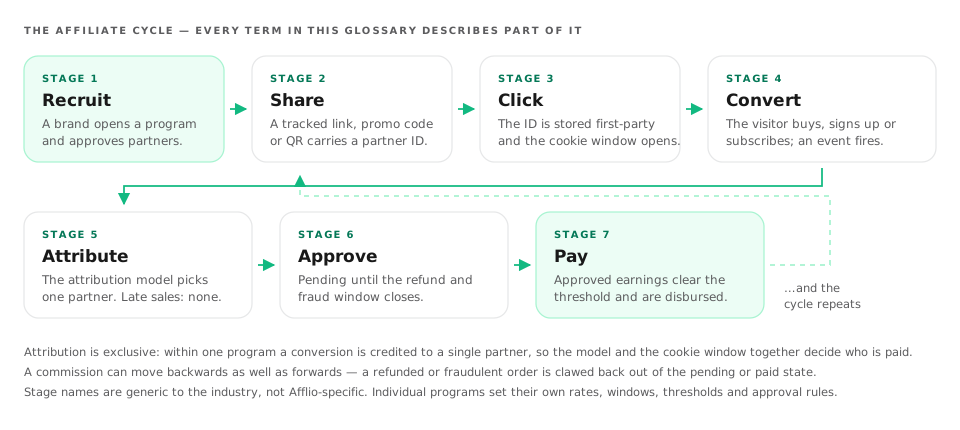
Commissions are usually created when a conversion is attributed, then move through states — pending, approved, paid — as they clear a refund or attribution window and are reviewed before payout.
Where Commission sits in the affiliate cycle
A commission is created the moment a conversion is attributed, but it only becomes money at the approve stage, after the brand's review window closes.
How Commission is calculated
commission = qualifying order value × rate, or a flat amount per action
- qualifying order value
- the part of the order the program pays on — often excluding tax, shipping and discounts
- rate
- the percentage the program pays, sometimes tiered by volume
- flat amount
- used instead of a percentage for leads, signups and trials
- state
- pending, approved, paid or reversed — money only moves in the third
Worked example (illustrative)
A 120 dollar order with 10 dollars of shipping and 8 dollars of tax, on a program paying 15 percent of net product value, commissions on 120 dollars rather than 138 — so 18 dollars, not 20.70.
The figures above are a chosen illustration of the arithmetic. They are not a measured result, a typical result, or a projection of what any program pays.
What Commission means for a creator
The rate is the number partners compare and the least informative one. What actually lands in your account is the rate applied to a qualifying base you did not choose, multiplied by a conversion rate you cannot see in advance, minus everything reversed during the pending window.
Two questions separate a good commission from a bad one. Is it calculated on gross or net order value, and does it recur? A 12 percent recurring commission on a subscription overtakes a 40 percent one-time commission before the customer's fourth month.
What Commission means for a brand
A commission is a customer acquisition cost the brand sets in advance, which is what makes the channel easy to budget. The discipline is to set it against contribution margin rather than revenue: a 20 percent commission on a product with a 25 percent gross margin leaves almost nothing once payment processing and returns are counted.
Tiering is the usual answer to the fact that one rate cannot be right for every partner. Rates that rise with volume reward partners who scale, and a separate lower rate for partners who intercept buyers at checkout keeps the budget with the partners creating demand.
Common mistakes with Commission
Quoting a rate without saying what it applies to
Gross order value, net of discounts, and net of tax and shipping produce materially different payments from the same rate. Programs that leave this ambiguous generate disputes on every large order.
Comparing rates across different products
A rate is only comparable within a price point. Earnings per click folds in order value and conversion rate and is the only figure that compares two programs honestly.
Treating an approved commission as final
A refund after approval triggers a clawback in most programs, and the amount is usually deducted from the next payout rather than invoiced back.
Commission: common questions
When does a commission actually get paid?
After it clears three gates: the attribution window closes, the brand approves it once the refund window has passed, and the partner's accumulated balance reaches the program's payout threshold. Any one of the three can delay a payment by a full cycle.
Are commissions paid on tax and shipping?
Usually not. Most programs commission on the net product value, excluding tax, shipping and any discount applied, though the terms are the only authority for a given program.
Can a brand change the rate on sales already made?
Reputable programs apply rate changes to future conversions only. Retroactive changes are legally murky and commercially fatal, because they remove any basis for a partner to plan.
See also
- Conversion
A conversion is the qualifying action — such as a sale, signup, lead, or subscription — that triggers an affiliate commission.
- Recurring Commission
A recurring commission pays the affiliate a share of every renewal payment a referred customer makes, not just the first sale.
- Payout Threshold
A payout threshold is the minimum balance an affiliate must accumulate before the program will release a payment.
- Clawback (Chargeback)
A clawback is the reversal of a previously credited affiliate commission when the underlying sale is refunded, cancelled, or charged back.
Turn the theory into a live program
Afflio handles tracking, commissions, and payouts so you can run the program these terms describe — start free in an afternoon.