Content Affiliate
Updated July 2026
A content affiliate earns commissions by creating articles, reviews, tutorials, or videos that naturally recommend products with tracked links, driving conversions through helpful, search- or audience-driven content.
Content affiliates include bloggers, review sites, comparison sites, and YouTubers who build organic audiences and monetize recommendations. Their strength is trust and intent: readers arrive already researching a purchase.
Because their traffic is often top- and mid-funnel, content affiliates value longer attribution windows and fair credit for the awareness they create. They contrast with PPC affiliates who buy traffic and coupon affiliates who capture bottom-of-funnel intent.
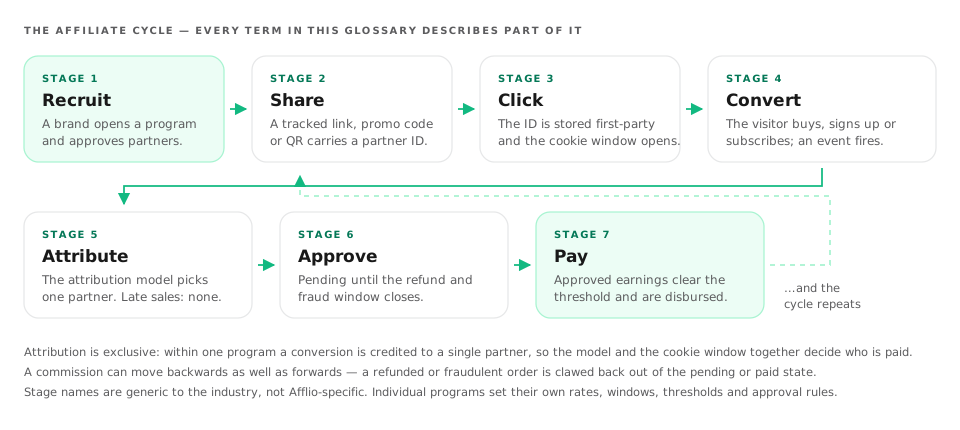
Where Content Affiliate sits in the affiliate cycle
A content affiliate operates at the share stage by creating the material that makes someone want the product in the first place.
How Content Affiliate actually works
A content affiliate earns by publishing something with independent value — a review, a tutorial, a comparison, a buying guide — and placing tracked links inside it. The traffic is usually organic and arrives because the reader was already researching, which is why this partner type converts well and scales slowly.
The economics are back-loaded. A piece of content costs time up front and earns nothing for weeks while it accumulates search visibility, then earns continuously for as long as it ranks. That shape is the opposite of a paid-traffic affiliate, whose earnings start immediately and stop the moment spend stops.
What Content Affiliate means for a creator
The asset a content affiliate builds is the ranking, not the post. That makes the attribution model and the cookie window unusually important, because a reader who researches for three weeks before buying is exactly the reader this partner type attracts.
It also makes program stability matter. A brand that cuts its rate or closes its program leaves months of ranked content pointing at nothing, which is why established content affiliates favour programs with a track record over programs with the highest rate.
What Content Affiliate means for a brand
Content affiliates are the partner type that creates demand rather than intercepting it, and they are also the type most penalised by last-click attribution — the reader they convinced frequently searches for a code before checkout and the coupon site takes the commission.
If a program wants more of this partner type, the levers are a longer cookie window, a first-click or content-specific attribution rule, and a rate that is not undercut by the interception partners sitting downstream of them.
Common mistakes with Content Affiliate
Judging content partners on last-click revenue
Their contribution is systematically routed to whoever the buyer clicks last. Ranking them on last-click alone removes exactly the partners generating the demand.
Building a catalogue around one program
A single rate change or programme closure can devalue years of ranked content. Spreading across programs costs some efficiency and removes the single point of failure.
Optimising for search without matching intent
Traffic arriving on a comparison query converts; traffic arriving on a definition query usually does not. Volume without intent produces clicks and no earnings.
Content Affiliate: common questions
How long before a content affiliate site earns anything?
Longer than most people expect, because earnings depend on search visibility that accumulates rather than on traffic that can be bought. The trade is that the earnings continue without further spend once it arrives.
Why do content affiliates dislike last-click attribution?
Because the reader they convinced often searches for a discount code before checking out, and under last-click the coupon site that supplies it takes the whole commission.
Is a content affiliate the same as a blogger?
Not necessarily. The defining feature is content with independent value carrying tracked links — that includes newsletters, YouTube channels, podcasts and comparison sites, not only written blogs.
See also
- Affiliate
An affiliate is an individual or company that promotes another business's products in exchange for a commission on the sales or actions they generate.
- PPC Affiliate
A PPC affiliate promotes a merchant's offers by buying paid search or display ads and routing that traffic to affiliate links, profiting from the gap between ad cost and commissions earned.
- Influencer Affiliate (Hybrid)
An influencer affiliate blends influencer marketing with affiliate pay: a creator promotes a brand to their audience and earns commissions on tracked sales, often alongside or instead of a flat sponsorship fee.
- Deep Link
A deep link is an affiliate tracking link that sends the customer to a specific product or page on the merchant's site rather than just the homepage.
- Affiliate Marketing
Affiliate marketing is a performance-based marketing model in which a business pays external partners a commission for each customer or sale they refer.
Turn the theory into a live program
Afflio handles tracking, commissions, and payouts so you can run the program these terms describe — start free in an afternoon.