Affiliate
Updated July 2026
An affiliate is an individual or company that promotes another business's products in exchange for a commission on the sales or actions they generate.
An affiliate (also called a partner or publisher) earns money by referring customers to a merchant. They share a unique tracking link or promo code, and when someone they refer completes a qualifying action — a signup, a purchase, a subscription — the affiliate is paid a commission defined by the program's rules.
Affiliates range from individual content creators, bloggers, and YouTubers to coupon and review sites, agencies, and B2B SaaS partners. The defining trait is performance-based pay: affiliates are compensated for results they drive, not for ad impressions or a flat retainer.
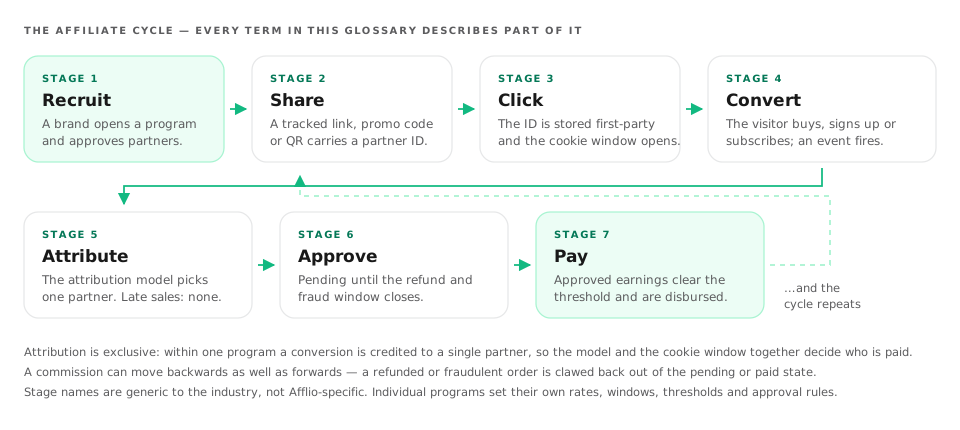
Where Affiliate sits in the affiliate cycle
An affiliate is the party a program recruits, so the term sits at the very start of the cycle — before a single link has been shared.
How Affiliate actually works
Becoming an affiliate is an application, not a purchase. You apply to a program, the brand approves or declines you, and on approval you are issued an identifier that is yours alone. Every link and code you are given carries that identifier, which is the only thing that ties a future sale back to you. Lose the identifier, share someone else's link, or promote through a channel the program has not approved, and the sale attributes elsewhere.
The status is non-exclusive by default. A creator can be an affiliate for a dozen brands at once, and a brand can have thousands of affiliates. What varies is the contract underneath: an open program approves almost everyone automatically, a managed program reviews each application by hand, and an invite-only program never publishes an application form at all.
What Affiliate means for a creator
Being an affiliate rather than a sponsored creator changes who carries the risk. A sponsorship pays a fixed fee whether the post performs or not; affiliate status pays nothing for a post that converts nothing, and keeps paying on a post that keeps converting two years later. For evergreen formats — tutorials, reviews, comparison articles — that trade is usually worth taking.
It also changes what you should negotiate for. Rate is the obvious lever, but the cookie window, whether the commission recurs, and whether the program allows the channels you actually publish on decide far more of your take-home than a few percentage points on the headline rate.
What Affiliate means for a brand
For a brand, affiliates are variable-cost distribution: you pay only on an outcome you have defined, so the channel cannot overspend the way a media buy can. The cost is governance. Every approved affiliate is publishing claims about your product under your brand name, and the program terms are the only thing standing between you and a partner promising something your product does not do.
The practical consequence is that approval is a real control, not a formality. Programs that auto-approve every applicant get volume plus coupon-scraping and brand-bidding they then have to police retroactively; programs that review applications get slower growth and far fewer takedowns.
Common mistakes with Affiliate
Assuming affiliate status is exclusive
Unless the agreement says so in writing, joining one program does not stop you joining a competitor's. Brands occasionally add an exclusivity clause; read for it before you assume either way.
Promoting through an unapproved channel
Many programs bar paid search on the brand name, coupon aggregation, or incentivised traffic. Sales from a barred channel are reversed even after they are approved, which is how affiliates lose a month of earnings in one review.
Treating the identifier as public
Your tracking identifier is how you get paid. Publishing a raw link on a site that strips query parameters, or letting a deal aggregator republish it, hands the attribution to whoever the visitor clicks next.
Affiliate: common questions
Do I need a website to become an affiliate?
Usually no. Most programs accept a YouTube channel, a newsletter, a podcast or a social account as the promotional surface. What they check is that the audience is real and that the content is relevant, not the format it lives in.
Is an affiliate the same as an influencer?
No. An influencer is defined by audience and reach; an affiliate is defined by how they are paid. Many creators are both, taking a flat fee for the post and a commission on the sales it drives, which the industry calls a hybrid deal.
Can a company be an affiliate, not just a person?
Yes, and in B2B most affiliates are companies — agencies, consultancies, review sites and integration partners all join programs under a business entity and are paid to a business account.
See also
- Affiliate Marketing
Affiliate marketing is a performance-based marketing model in which a business pays external partners a commission for each customer or sale they refer.
- Commission
A commission is the payment an affiliate earns for each qualifying conversion they drive, set as a percentage of the sale or a fixed amount per action.
- Merchant
A merchant is the business that owns the product and runs an affiliate program, paying partners a commission for the customers they refer.
- Deep Link
A deep link is an affiliate tracking link that sends the customer to a specific product or page on the merchant's site rather than just the homepage.
Turn the theory into a live program
Afflio handles tracking, commissions, and payouts so you can run the program these terms describe — start free in an afternoon.