Deep Link
Updated July 2026
A deep link is an affiliate tracking link that sends the customer to a specific product or page on the merchant's site rather than just the homepage.
Deep links let affiliates point traffic exactly where it is most likely to convert — a particular product, category, or landing page — while still carrying their tracking parameters. Sending someone straight to the item they read about converts far better than dropping them on the homepage.
A deep-linking tool typically takes any merchant URL and wraps it with the affiliate's tracking ID, so partners can promote any page without manually building links for each one.
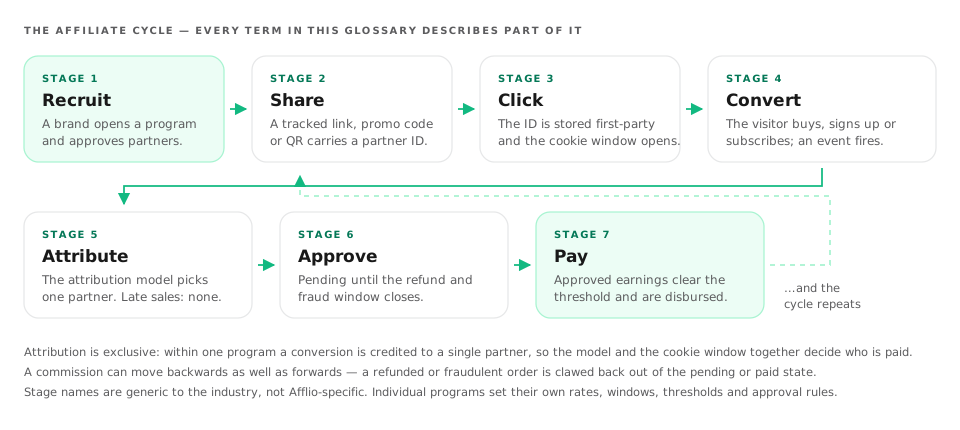
Where Deep Link sits in the affiliate cycle
A deep link is a share-stage decision: whether the click lands on the exact page the content was about, or on a home page the visitor then has to navigate.
How Deep Link actually works
A deep link carries the partner's tracking identifier while pointing at a specific destination inside the merchant's site — a product, a category, a pricing tier, a configured cart — rather than at the home page. Mechanically it is the ordinary tracking link with a destination parameter, which the redirect service reads and forwards to.
The reason it exists is that a redirect to the home page discards intent. A reader who has just finished an argument for one specific product and lands on a general storefront has to find that product again, and a measurable share of them do not.
What Deep Link means for a creator
Deep linking is the highest-return, lowest-effort change available to most partners. The click is already earned; landing it on the page the content described removes the only step between interest and checkout.
It also improves what you can learn. Deep links to different destinations let you see which products your audience actually buys, rather than seeing one undifferentiated pile of home-page clicks.
What Deep Link means for a brand
Supporting deep links properly is a conversion feature for the brand as much as a convenience for the partner. It should preserve the tracking identifier through any redirect, any locale switch and any login wall, which is where most implementations break.
Publishing a deep-link builder, or documenting the parameter, removes a support burden and materially raises partner conversion rates without changing a single commission rate.
Common mistakes with Deep Link
Losing the tracking parameter in a redirect chain
A locale redirect, a login wall or a canonical rewrite that strips query parameters silently unattributes the click. Test the full chain, not just the first hop.
Deep linking to a page that can 404
Discontinued products and expired campaign pages break the link. A deep link into a category survives a product going out of stock; one into a specific SKU does not.
Sending every click to the home page
The cheapest conversion loss in affiliate marketing. The reader was already convinced about one product and has just been asked to search for it.
Deep Link: common questions
What is the difference between a deep link and a normal affiliate link?
Both carry the same tracking identifier. A deep link additionally specifies which page inside the merchant site to land on, instead of defaulting to the home page.
Do deep links convert better?
Generally yes, because they remove a navigation step at the moment the reader is most convinced. The size of the gain depends on how hard the product is to find from the home page.
Why does my deep link lose its tracking?
Almost always a redirect that drops query parameters — a locale switch, a login wall, or a canonical rewrite. Test the entire chain from click to checkout rather than just the first response.
Should a deep link point at a product page or a category page?
A product page converts better where the intent is specific, because it removes a navigation step at the moment attention is highest. A category page survives the product going out of stock or being discontinued, which matters for evergreen content that will still be read in a year. For anything long-lived the category page is usually the safer target.
See also
- Affiliate
An affiliate is an individual or company that promotes another business's products in exchange for a commission on the sales or actions they generate.
- Promo Code (Coupon Tracking)
A promo code is a unique coupon assigned to an affiliate so that purchases using the code are attributed to them, even without a tracked link click.
- Attribution
Attribution is the process of determining which affiliate or marketing touchpoint should receive credit — and the commission — for a conversion.
- Conversion Rate
Conversion rate is the percentage of referred clicks or visitors that complete a qualifying action, calculated as conversions divided by clicks.
Turn the theory into a live program
Afflio handles tracking, commissions, and payouts so you can run the program these terms describe — start free in an afternoon.