Conversion
Updated July 2026
A conversion is the qualifying action — such as a sale, signup, lead, or subscription — that triggers an affiliate commission.
Each affiliate program defines what counts as a conversion. For e-commerce it is usually a completed purchase; for SaaS it might be a paid signup or a trial that converts; for lead-gen it could be a form submission. The definition determines exactly when a partner gets paid.
Conversions are recorded through tracking — a click cookie, a promo code, or a server-to-server event — and matched to the referring affiliate before a commission is generated.
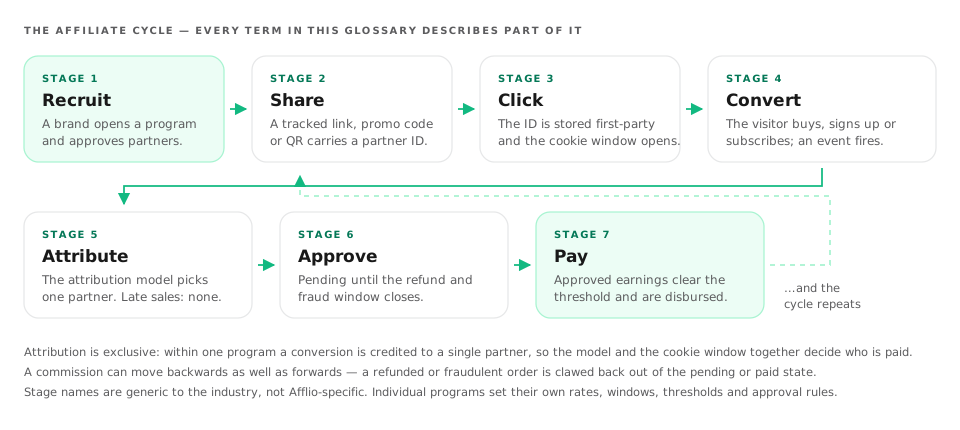
Where Conversion sits in the affiliate cycle
The conversion is the event the whole cycle is built to produce, and the only moment a commission can come into existence.
How Conversion actually works
A conversion is whatever the program says it is, which is why the word means different things in different programs. Retail programs almost always mean a completed purchase. Lead-generation programs mean a submitted form that passes a quality check. Subscription programs frequently mean a paid signup that survives a minimum period, so a trial that cancels in week one never becomes a conversion at all.
Technically it is a single event fired at the moment of the action, carrying an order identifier, a value, and whatever referral evidence exists — a click identifier from a first-party cookie, a promo code, or both. The order identifier is what makes the event idempotent: fire it twice and a correctly built program records one conversion, not two.
What Conversion means for a creator
The definition decides how much of your traffic can possibly pay. Sending highly qualified readers to a program that only counts an annual plan, when your audience buys monthly, produces clicks that convert in the ordinary sense and never convert in the program's sense.
It is worth reading the definition before the rate. A 30 percent commission on a conversion defined as a paid plan retained past day 30 can pay less in practice than a 15 percent commission on any completed checkout.
What Conversion means for a brand
Defining the conversion is where a brand controls quality. Paying on a trial signup buys volume and invites low-intent traffic; paying on a retained subscription buys quality and slows partner cash flow, which shrinks the pool of partners willing to work the program.
Whatever the definition, the event has to fire reliably from a place the partner cannot influence — server side, on the confirmed order — and it has to be deduplicated. Client-side conversion pixels are blocked often enough that a program relying on them alone systematically underpays and quietly loses its partners.
Common mistakes with Conversion
Firing the conversion event client-side only
Ad blockers, privacy browsers and network failures all drop it. Sales go unrecorded, partners see clicks with no earnings, and the program looks broken rather than blocked.
Omitting the order identifier
Without it, a page refresh or a webhook retry records the sale twice. Idempotency depends on a stable identifier travelling with the event.
Changing the definition without telling partners
Moving from paid signup to retained subscription can halve a partner's earnings overnight for identical work. Announce it before it takes effect.
Conversion: common questions
Does a conversion always mean a sale?
No. It means whichever action the program pays for — a purchase, a qualified lead, a demo booking, a free-trial signup, or a subscription that survives a minimum period. The program terms are the only definition that counts.
What stops one sale being counted twice?
An idempotency key, usually the order identifier. The program records the first event carrying that identifier and ignores any repeat, which is what makes webhook retries safe.
Can a conversion be removed after it is recorded?
Yes. Refunds, cancellations, failed payments and fraud review all reverse conversions, which is why commissions sit pending until the brand's review window has closed.
See also
- Conversion Rate
Conversion rate is the percentage of referred clicks or visitors that complete a qualifying action, calculated as conversions divided by clicks.
- Commission
A commission is the payment an affiliate earns for each qualifying conversion they drive, set as a percentage of the sale or a fixed amount per action.
- Attribution
Attribution is the process of determining which affiliate or marketing touchpoint should receive credit — and the commission — for a conversion.
- S2S / Postback Tracking
Server-to-server (S2S) postback tracking records conversions by sending an event directly from the merchant's backend to the affiliate platform, without relying on browser cookies.
Turn the theory into a live program
Afflio handles tracking, commissions, and payouts so you can run the program these terms describe — start free in an afternoon.