CPC (Cost Per Click)
Updated July 2026
CPC, or cost per click, is the amount an advertiser pays each time someone clicks their ad or link, a common pricing model in paid search and display and a key metric for PPC affiliates.
CPC = total spend ÷ total clicks. It ties cost to interest rather than mere exposure: the advertiser only pays when a user actively clicks through.
For PPC affiliates who buy ads and route the traffic to affiliate links, CPC is the cost side of the equation and earnings per click (EPC) is the revenue side — the affiliate profits when EPC exceeds CPC. CPC sits between awareness pricing (CPM) and action pricing (CPA).
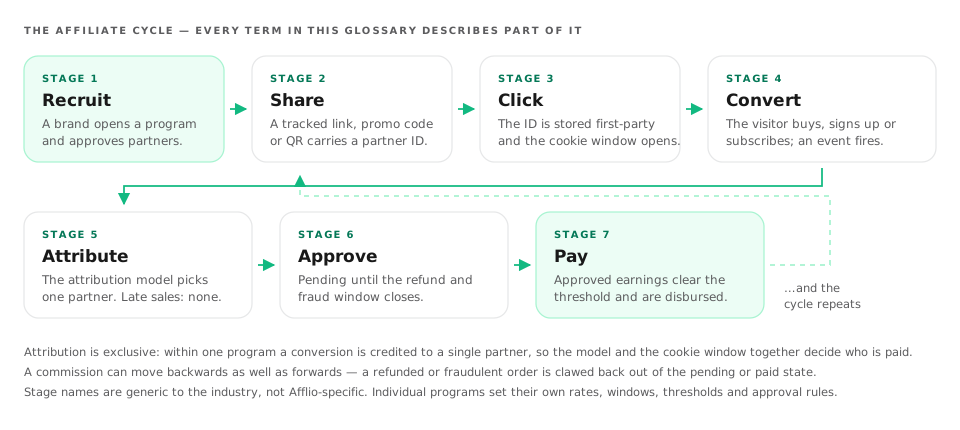
Where CPC (Cost Per Click) sits in the affiliate cycle
Cost per click prices the click stage directly, which is why it appears in paid media far more often than in affiliate programs.
How CPC (Cost Per Click) is calculated
CPC = total spend ÷ clicks
- spend
- what the advertiser paid, including auction premiums
- clicks
- billable clicks as counted by the platform, after invalid-click filtering
- relation to CPM
- CPC = CPM ÷ (CTR × 10), so a better CTR lowers CPC on identical spend
- in affiliate
- rare as a payment basis; common as the cost side of a PPC affiliate's margin
Worked example (illustrative)
Spending 600 dollars for 2,400 clicks is a CPC of 0.25. A PPC affiliate earning an EPC of 0.36 on that traffic clears 0.11 per click before any other cost — a margin thin enough that a small CPC rise erases it.
The figures above are a chosen illustration of the arithmetic. They are not a measured result, a typical result, or a projection of what any program pays.
What CPC (Cost Per Click) means for a creator
Most creators meet CPC only as the cost side of paid promotion. The rule is simple and unforgiving: promoting an affiliate offer with paid traffic is profitable only while earnings per click stay above cost per click, and both move.
It is also the number that makes brand-name bidding tempting and dangerous. The brand's own name is the cheapest keyword and the one most programs explicitly forbid, so the traffic that looks most profitable is usually the traffic that gets an account removed.
What CPC (Cost Per Click) means for a brand
A brand rarely pays affiliates per click, because a click is not an outcome and paying for it reintroduces exactly the risk the affiliate model removes. Where click payment exists it is usually a hybrid, capped tightly and reserved for a trusted partner.
CPC matters more as an enforcement signal. Partners bidding on the brand's own name raise the brand's own paid costs while claiming credit for buyers who were already searching for it, which is why the restriction exists in nearly every program's terms.
Common mistakes with CPC (Cost Per Click)
Paying affiliates per click
It rewards traffic volume rather than outcomes and attracts exactly the partners least interested in whether anything converts.
Bidding on the brand's trademark
Barred in most program terms. Commissions from it are reversed, usually along with the account, and the appeal is that it looks profitable right up until the review.
Ignoring invalid-click filtering when reconciling
Platforms retro-adjust click counts. A CPC computed before those adjustments will not match the invoice.
CPC (Cost Per Click): common questions
Do affiliate programs pay per click?
Almost never. Affiliate programs pay on outcomes; cost per click belongs to paid media, and appears in affiliate work mainly as the cost side of a PPC affiliate's margin.
How are CPC and CPM related?
CPC equals CPM divided by CTR times ten. The same impression cost produces a very different click cost once click-through rate changes, which is why creative quality shows up directly in CPC.
Can I run paid ads to affiliate links?
Only if the program allows it, and many do not. Check the terms for rules on paid search, brand-name bidding and direct linking before spending anything.
See also
- CPM (Cost Per Mille)
CPM, or cost per mille, is the price an advertiser pays per one thousand impressions of an ad or sponsored content, a standard way to price awareness-focused campaigns and influencer posts.
- CPA (Cost Per Action)
CPA, or cost per action (also cost per acquisition), is a pricing model where the advertiser pays only when a specific action — a sale, signup, or lead — is completed, aligning cost directly with results.
- CPL (Cost Per Lead)
CPL, or cost per lead, is a pricing model where the advertiser pays a fixed amount for each qualified lead — such as a form submission, quote request, or signup — generated, common in lead-generation affiliate programs.
- PPC Affiliate
A PPC affiliate promotes a merchant's offers by buying paid search or display ads and routing that traffic to affiliate links, profiting from the gap between ad cost and commissions earned.
- EPC (Earnings Per Click)
EPC, or earnings per click, is the average commission an affiliate earns per click on their tracking links, calculated as total commissions divided by total clicks.
Turn the theory into a live program
Afflio handles tracking, commissions, and payouts so you can run the program these terms describe — start free in an afternoon.