CPA (Cost Per Action)
Updated July 2026
CPA, or cost per action (also cost per acquisition), is a pricing model where the advertiser pays only when a specific action — a sale, signup, or lead — is completed, aligning cost directly with results.
CPA is the backbone of affiliate marketing: a merchant pays affiliates a set amount or percentage per qualifying action rather than per click or impression, so spend maps cleanly to outcomes.
Because the advertiser only pays for results, CPA carries less risk than CPM or CPC, which is why performance and affiliate channels favour it. The specific action — purchase, trial, subscription, or lead — is defined by the program as its conversion.
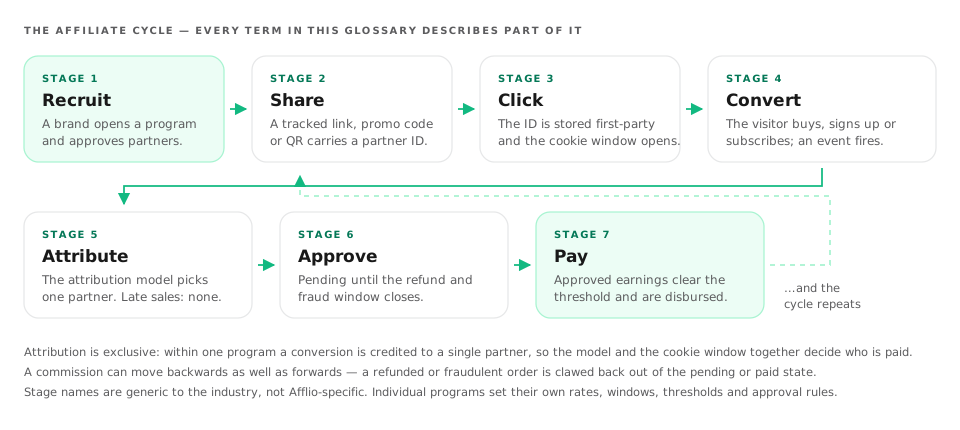
Where CPA (Cost Per Action) sits in the affiliate cycle
Cost per action is the brand's view of the convert stage: what the program paid to produce one of the actions it defined.
How CPA (Cost Per Action) is calculated
CPA = total spend ÷ actions acquired
- action
- whatever the program pays on — sale, lead, signup, install
- spend
- commission plus platform and network fees, not commission alone
- target CPA
- the ceiling a brand sets from contribution margin and payback period
- affiliate case
- CPA is fixed in advance by the commission, which is the model's appeal
Worked example (illustrative)
Paying 4,000 dollars in commission plus a 500 dollar platform fee for 90 sales is a CPA of 50 dollars, not the 44.44 the commission alone suggests — a 12 percent understatement that matters if the target is 48.
The figures above are a chosen illustration of the arithmetic. They are not a measured result, a typical result, or a projection of what any program pays.
What CPA (Cost Per Action) means for a creator
A partner sees CPA from the other side: it is the flat bounty a program pays per action, which makes earnings easy to forecast because it does not vary with order size.
Flat CPA suits audiences that convert on a cheap entry product and percentage rates suit audiences that buy expensive configurations. Knowing which describes your audience is worth more than the headline number.
What CPA (Cost Per Action) means for a brand
The reason affiliate marketing is easy to approve internally is that CPA is capped by construction: the commission is set in advance, so the channel cannot exceed its target the way a media buy can.
The number is only honest if it counts everything. Commission, platform fee, network percentage and the cost of the people running the program all belong in the numerator, and programs that exclude the last three consistently understate their true acquisition cost.
Common mistakes with CPA (Cost Per Action)
Excluding fees from spend
Platform fees, network percentages and payout costs are real acquisition spend. Leaving them out understates CPA by a margin that often decides whether the channel looks viable.
Setting target CPA from revenue rather than margin
A CPA below the sale price can still lose money once cost of goods, processing and returns are counted. Contribution margin is the only safe basis.
Comparing CPA across different action definitions
Cost per lead and cost per sale are not comparable numbers. Judge CPA only within one definition, or convert both to cost per retained customer.
CPA (Cost Per Action): common questions
Is CPA the same as CAC?
Related but not identical. CPA measures the cost of a defined action in one channel; customer acquisition cost usually measures blended cost across all marketing spend for a customer who actually paid.
Why do affiliate programs like CPA pricing?
Because it moves the risk. The brand pays only when the action happens, so an underperforming campaign costs the partner's production time rather than the brand's budget.
What is a good CPA?
Any figure comfortably below the contribution margin of the customer it buys, over whatever payback period the business can fund. There is no universal number, because the answer is a property of the business, not the channel.
See also
- CPL (Cost Per Lead)
CPL, or cost per lead, is a pricing model where the advertiser pays a fixed amount for each qualified lead — such as a form submission, quote request, or signup — generated, common in lead-generation affiliate programs.
- CPC (Cost Per Click)
CPC, or cost per click, is the amount an advertiser pays each time someone clicks their ad or link, a common pricing model in paid search and display and a key metric for PPC affiliates.
- CPM (Cost Per Mille)
CPM, or cost per mille, is the price an advertiser pays per one thousand impressions of an ad or sponsored content, a standard way to price awareness-focused campaigns and influencer posts.
- Affiliate Marketing
Affiliate marketing is a performance-based marketing model in which a business pays external partners a commission for each customer or sale they refer.
- Conversion
A conversion is the qualifying action — such as a sale, signup, lead, or subscription — that triggers an affiliate commission.
- Performance Marketing
Performance marketing is an umbrella term for digital marketing where advertisers pay based on measurable results — clicks, leads, or sales — rather than upfront for exposure, with affiliate marketing as a core channel.
Turn the theory into a live program
Afflio handles tracking, commissions, and payouts so you can run the program these terms describe — start free in an afternoon.