CPL (Cost Per Lead)
Updated July 2026
CPL, or cost per lead, is a pricing model where the advertiser pays a fixed amount for each qualified lead — such as a form submission, quote request, or signup — generated, common in lead-generation affiliate programs.
CPL is a specific form of CPA where the paid-for action is a lead rather than a sale. It suits businesses with longer sales cycles — insurance, finance, education, B2B — where the immediate goal is capturing interested prospects.
Programs define what makes a lead 'qualified' (for example a verified email or a completed application) to prevent low-value or fraudulent submissions from triggering payouts.
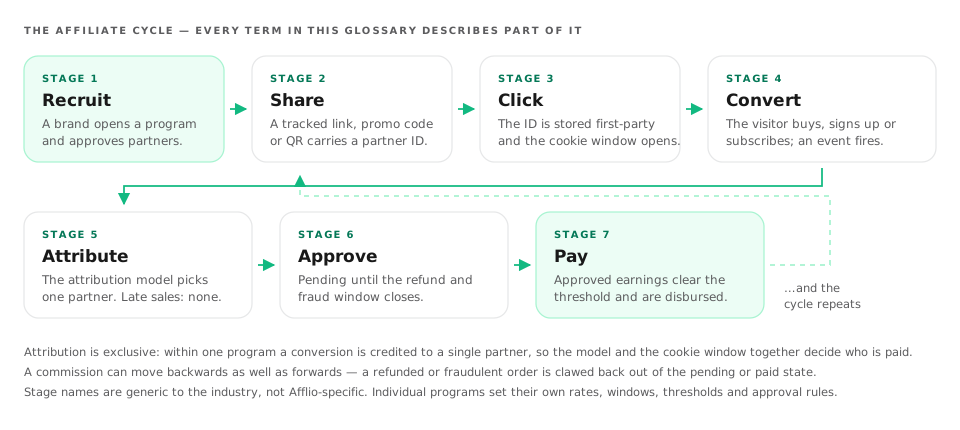
Where CPL (Cost Per Lead) sits in the affiliate cycle
Cost per lead prices a convert-stage action that stops short of a sale, which is what makes lead quality the whole problem.
How CPL (Cost Per Lead) is calculated
CPL = total spend ÷ qualified leads
- lead
- a form submission, demo request or trial signup — defined by the program
- qualified
- leads that passed validation; counting raw submissions inflates nothing but volume
- downstream
- CPL × leads-per-sale gives the real cost per customer
- in affiliate
- paid as a flat bounty, common in finance, insurance, education and B2B
Worked example (illustrative)
Paying 25 dollars per lead for 200 leads is 5,000 dollars. If 6 percent of them close, that is 12 customers at an effective 417 dollars each — the number that decides whether the 25 dollar bounty was cheap or ruinous.
The figures above are a chosen illustration of the arithmetic. They are not a measured result, a typical result, or a projection of what any program pays.
What CPL (Cost Per Lead) means for a creator
Lead bounties pay faster and more predictably than sale commissions, because the action is easier and the pending period is usually shorter. That makes them attractive for audiences that research before buying.
The trade is a validation step you do not control. Programs reject leads for duplicate contact details, invalid numbers or failing a qualification rule, so read what counts as qualified before assuming a submitted form is money.
What CPL (Cost Per Lead) means for a brand
Paying per lead moves risk back toward the brand, because a lead is not revenue. The defence is a qualification rule written into the program terms and applied consistently, so partners know in advance what will and will not be paid.
The honest measure is never CPL alone but cost per closed customer. A 15 dollar lead that closes at 1 percent is far more expensive than a 40 dollar lead that closes at 10 percent, and only the downstream number shows it.
Common mistakes with CPL (Cost Per Lead)
Optimising CPL instead of cost per customer
Driving CPL down almost always drives lead quality down with it, and the sales team absorbs the cost where the marketing report cannot see it.
Leaving qualification undefined
If the terms do not say what makes a lead payable, every rejection becomes a dispute and partners assume the rules are being invented after the fact.
Counting raw submissions
Duplicates, test entries and invalid contact details all submit successfully. CPL computed on raw form fills describes nothing the business can act on.
CPL (Cost Per Lead): common questions
Is a lead the same as a conversion?
It is a conversion only if the program defines it as one. In a lead-generation program the lead is the paid action; in a retail program it is an intermediate step that pays nothing.
Why do brands pay per lead instead of per sale?
Because the sale happens offline or over a long cycle they cannot attribute reliably — a mortgage, an enrolment, an enterprise contract. Paying at the last measurable step is the practical compromise.
Can a lead be rejected after it is submitted?
Yes, and most programs validate before paying. The reasons should be written in the terms; if they are not, that is worth resolving before you send traffic.
See also
- CPA (Cost Per Action)
CPA, or cost per action (also cost per acquisition), is a pricing model where the advertiser pays only when a specific action — a sale, signup, or lead — is completed, aligning cost directly with results.
- CPC (Cost Per Click)
CPC, or cost per click, is the amount an advertiser pays each time someone clicks their ad or link, a common pricing model in paid search and display and a key metric for PPC affiliates.
- Conversion
A conversion is the qualifying action — such as a sale, signup, lead, or subscription — that triggers an affiliate commission.
- Affiliate Marketing
Affiliate marketing is a performance-based marketing model in which a business pays external partners a commission for each customer or sale they refer.
- Performance Marketing
Performance marketing is an umbrella term for digital marketing where advertisers pay based on measurable results — clicks, leads, or sales — rather than upfront for exposure, with affiliate marketing as a core channel.
Turn the theory into a live program
Afflio handles tracking, commissions, and payouts so you can run the program these terms describe — start free in an afternoon.