CPM (Cost Per Mille)
Updated July 2026
CPM, or cost per mille, is the price an advertiser pays per one thousand impressions of an ad or sponsored content, a standard way to price awareness-focused campaigns and influencer posts.
CPM = (cost ÷ impressions) × 1,000. If a campaign costs $500 and delivers 250,000 impressions, the CPM is $2. It is the default currency of awareness advertising, where the goal is exposure rather than an immediate action.
In influencer marketing, brands sometimes benchmark a creator's flat fee against an implied CPM to judge whether the price is reasonable for the reach delivered. CPM contrasts with performance models like CPC and CPA that pay for actions rather than views.
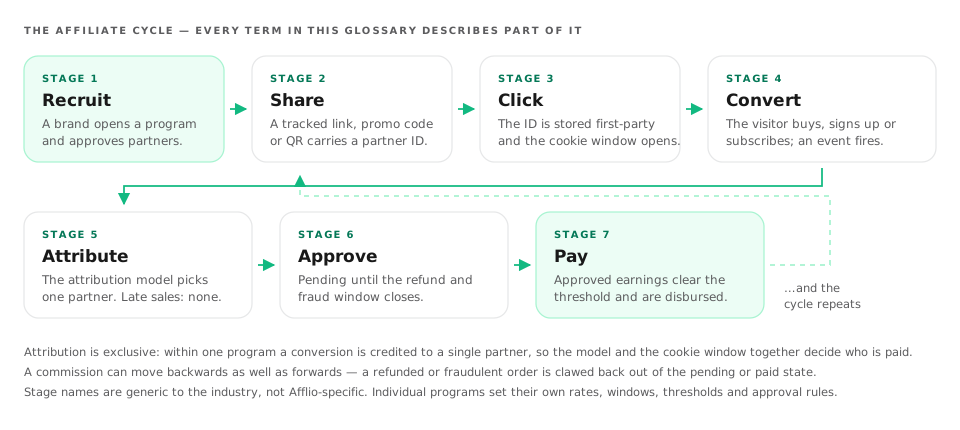
Where CPM (Cost Per Mille) sits in the affiliate cycle
Cost per mille prices the share stage by exposure alone, which is why it is the pricing model affiliate marketing exists as an alternative to.
How CPM (Cost Per Mille) is calculated
CPM = (spend ÷ impressions) × 1,000
- mille
- Latin for thousand — the price of one thousand impressions
- impressions
- times the creative was served, not people reached
- risk
- sits entirely with the advertiser; delivery is guaranteed, outcomes are not
- in creator deals
- the usual basis for a flat sponsorship fee, quoted against expected views
Worked example (illustrative)
A 25 dollar CPM across 80,000 impressions costs 2,000 dollars. At a 1 percent click-through rate that is 800 clicks, so an effective cost per click of 2.50 — which only pays if the offer's earnings per click clears it.
The figures above are a chosen illustration of the arithmetic. They are not a measured result, a typical result, or a projection of what any program pays.
What CPM (Cost Per Mille) means for a creator
CPM is how most flat sponsorship fees are actually priced, even when the contract states a lump sum: the brand divides its offer by your expected views and checks the result against what it pays elsewhere.
Knowing your effective CPM is the difference between negotiating from a number and negotiating from a feeling. It is also the honest way to decide between a flat fee and a commission: below a certain audience size the flat fee usually wins, and above it the commission usually does.
What CPM (Cost Per Mille) means for a brand
A brand pays CPM when the goal is exposure it cannot attribute — a launch, a category-education campaign — and accepts that the return will be argued rather than measured.
It is the model affiliate marketing is defined against. Where a CPM buy pays for delivery, an affiliate program pays for an outcome, which is why the two are usually budgeted by different teams with different tolerance for uncertainty.
Common mistakes with CPM (Cost Per Mille)
Treating impressions as people
Impressions count deliveries, not humans. A campaign with a high frequency reaches far fewer people than its impression count implies.
Comparing CPM across platforms without adjusting
Platforms differ on what counts as a viewable impression. Two CPMs measured under different definitions are not comparable prices.
Buying CPM for a performance goal
If the objective is sales, paying for delivery leaves every outcome risk with the buyer. That is exactly the trade the affiliate model reverses.
CPM (Cost Per Mille): common questions
What does the M in CPM stand for?
Mille — Latin for thousand. CPM is the price of one thousand impressions, not cost per million, which is the most common misreading.
Is CPM used in affiliate marketing?
Rarely as a payment basis, because it pays for exposure rather than an outcome. It appears mainly when a creator's flat fee is being priced, or in hybrid deals that pair a fee with a commission.
Which is better for a creator, CPM or commission?
A flat fee priced on CPM pays regardless of performance and caps your upside; a commission risks paying nothing and has no ceiling. Hybrid deals exist precisely because the answer depends on how well the product fits the audience.
See also
- Reach vs Impressions
Reach is the number of unique people who saw a piece of content, while impressions count the total times it was displayed including repeat views — so impressions are always equal to or greater than reach.
- CPC (Cost Per Click)
CPC, or cost per click, is the amount an advertiser pays each time someone clicks their ad or link, a common pricing model in paid search and display and a key metric for PPC affiliates.
- CPA (Cost Per Action)
CPA, or cost per action (also cost per acquisition), is a pricing model where the advertiser pays only when a specific action — a sale, signup, or lead — is completed, aligning cost directly with results.
- Sponsored Post
A sponsored post is social or blog content a creator is paid to publish promoting a brand, which must be clearly disclosed as an ad under FTC and comparable rules.
- Rate Card
A rate card is a creator's published pricing sheet listing what they charge for each type of deliverable — an Instagram Reel, a YouTube integration, a story, or a bundle — used as a starting point for brand-deal negotiations.
Turn the theory into a live program
Afflio handles tracking, commissions, and payouts so you can run the program these terms describe — start free in an afternoon.