Deal Registration
Updated July 2026
Deal registration is a process that lets a partner formally claim a sales opportunity so they receive credit and protection if the deal closes.
Common in B2B channel programs, deal registration lets a reseller or referral partner submit a prospect they are working before anyone else does. Once approved, the deal is reserved to that partner for a set period, preventing channel conflict where two partners — or the vendor's own sales team — chase the same account.
Registered deals usually carry better margins or commissions as an incentive for partners to bring new opportunities to the vendor rather than competitors.
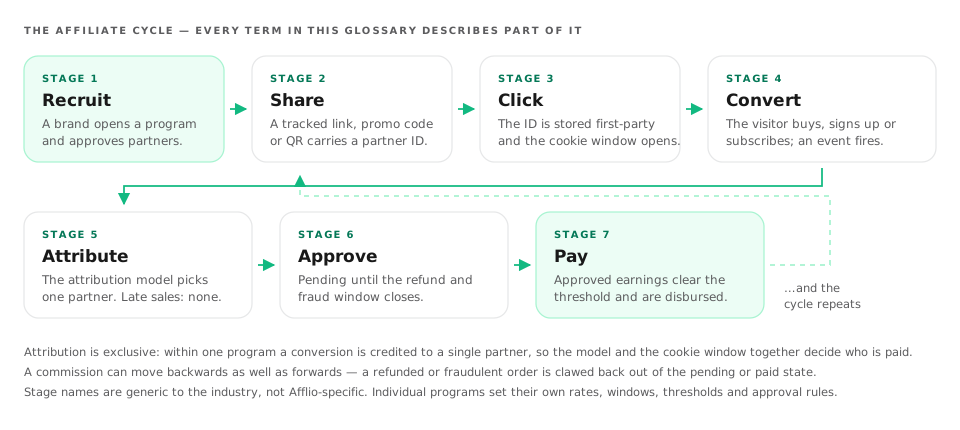
Where Deal Registration sits in the affiliate cycle
Deal registration attributes before the conversion rather than after it: a partner claims an account up front, and the claim is what protects the commission.
How Deal Registration actually works
A partner submits the account they are working on — company name, contact, opportunity size, expected timing — and the vendor either approves the registration or rejects it because the account is already in play. An approved registration reserves the partner's claim for a stated period, commonly a few months, and usually locks the commission or margin for that opportunity.
It exists because B2B sales cycles are long and involve the vendor's own sales team. Without a registration step, a partner who spends three months educating an account can watch the vendor's direct team close it and take the credit, and no post-hoc attribution rule can resolve that fairly.
What Deal Registration means for a creator
Registration is rare in creator-facing affiliate work and standard in B2B partner programmes. Where a creator does consulting or implementation alongside content, it is the mechanism that protects the accounts they are actively working.
The two terms to check are the protection period and what happens when it expires. A ninety-day window on a sales cycle that routinely runs six months protects nothing, and silent expiry is how partners lose deals they were still working.
What Deal Registration means for a brand
Deal registration is the main defence against channel conflict, and channel conflict is what stops partners bringing opportunities. Partners who lose one registered account to the direct team stop registering, and then stop sourcing.
It has to be fast and it has to be transparent. A registration that takes a week to approve is useless in a competitive deal, and a rejection with no stated reason reads as the vendor protecting its own team.
Common mistakes with Deal Registration
Approving registrations slowly
Partners register at the start of a sales cycle, when speed matters. A multi-day approval makes the mechanism useless in exactly the deals it was built for.
Rejecting without a reason
An unexplained rejection is indistinguishable from the vendor protecting its own pipeline. State whether the account was already registered or already in direct engagement.
Setting the protection period shorter than the sales cycle
A registration that expires mid-cycle protects nothing, and expiring it silently is how a partner discovers the loss at closing.
Deal Registration: common questions
What does deal registration protect?
The partner's claim to an opportunity they sourced, for a stated period, including the commission or margin on it. It is agreed before the sale rather than argued after it.
Why do B2B programmes need it when affiliate programmes do not?
Because B2B sales cycles are long and the vendor's own sales team is working the same market. Post-hoc attribution cannot fairly resolve a three-month collaborative sale, so the claim is made up front.
What happens if two partners register the same account?
The first approved registration normally holds for its protection period. Programmes should publish the rule, because a partner who loses an account to an unstated tie-break usually stops registering altogether.
See also
- PRM (Partner Relationship Management)
PRM, or partner relationship management, is the software and process used to recruit, onboard, manage, and grow a company's network of business partners.
- SaaS Partner Program
A SaaS partner program is a structured program through which a software company rewards external partners — affiliates, referrers, and resellers — for driving new subscriptions.
- Commission
A commission is the payment an affiliate earns for each qualifying conversion they drive, set as a percentage of the sale or a fixed amount per action.
- Multi-Tier Affiliate (Sub-Affiliate)
A multi-tier affiliate program lets affiliates earn a commission not only on their own sales but also on sales made by the sub-affiliates they recruit.
Turn the theory into a live program
Afflio handles tracking, commissions, and payouts so you can run the program these terms describe — start free in an afternoon.