Multi-Tier Affiliate (Sub-Affiliate)
Updated July 2026
A multi-tier affiliate program lets affiliates earn a commission not only on their own sales but also on sales made by the sub-affiliates they recruit.
In a multi-tier (or two-tier) program, a partner earns their normal commission on direct referrals plus a smaller override on the activity of affiliates they introduced to the program. The recruited partners are called sub-affiliates.
This incentivizes affiliates to grow the program for the merchant by bringing in other partners. It should not be confused with pyramid schemes: legitimate multi-tier programs pay on real sales generated, not on recruitment fees.
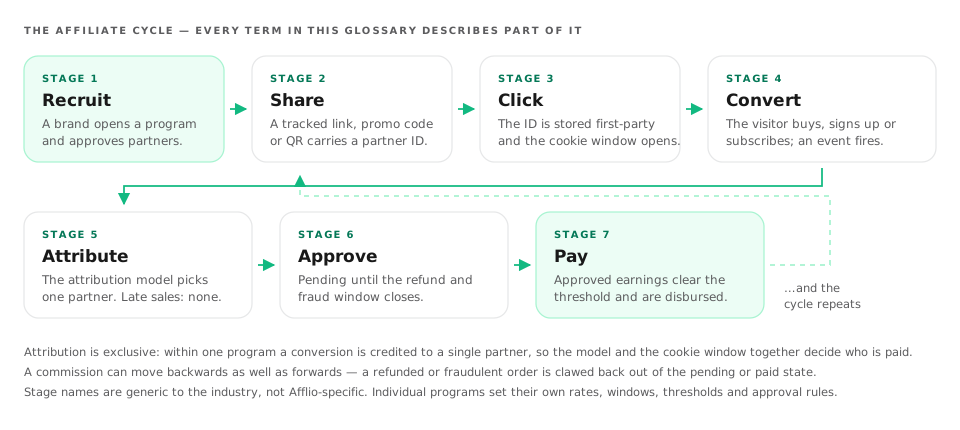
Where Multi-Tier Affiliate (Sub-Affiliate) sits in the affiliate cycle
Multi-tier changes the recruit stage: partners are paid for bringing in other partners, not only for bringing in customers.
How Multi-Tier Affiliate (Sub-Affiliate) is calculated
tier-2 earnings = referred partner's commissions × override rate
- override rate
- a small percentage, commonly in the low single digits
- paid by
- the program, on top of the sub-affiliate's own full commission
- depth
- legitimate programs stop at two levels; deeper structures are a warning sign
- what distinguishes it
- income must come from real sales, never from recruitment itself
Worked example (illustrative)
A partner who recruits five sub-affiliates each earning 400 dollars a month, at a 5 percent override, earns 100 dollars a month from the second tier — real but secondary to their own selling.
The figures above are a chosen illustration of the arithmetic. They are not a measured result, a typical result, or a projection of what any program pays.
What Multi-Tier Affiliate (Sub-Affiliate) means for a creator
The honest version of this is small. A two-percent override on a handful of genuinely productive sub-affiliates is a modest supplement, not a business model, and any program presenting it as the main opportunity is describing something else.
The clearest test is where the money originates. If income can only grow by recruiting more people rather than by selling more product, the structure has stopped being affiliate marketing regardless of what it is called.
What Multi-Tier Affiliate (Sub-Affiliate) means for a brand
A shallow override can genuinely accelerate recruitment by turning productive partners into recruiters, and it costs the program only a small percentage on revenue it would not otherwise have had.
The risks are regulatory and reputational. Deep structures, recruitment-driven messaging, and any joining fee move the program toward territory regulators treat very differently, so capping at two tiers and paying only on real sales is the conventional boundary.
Common mistakes with Multi-Tier Affiliate (Sub-Affiliate)
Paying for recruitment rather than for sales
Override earnings must derive from a sub-affiliate's actual commissions. Paying a bounty for signing someone up is the line that separates this from a scheme.
Building structures deeper than two levels
Depth adds administrative complexity, dilutes the rate available for actual selling, and attracts exactly the regulatory attention the program does not want.
Deducting the override from the sub-affiliate
The override should be paid by the program on top. Taking it out of the recruited partner's commission makes joining through a referrer strictly worse for them.
Multi-Tier Affiliate (Sub-Affiliate): common questions
Is multi-tier affiliate marketing the same as MLM?
No, when it is done properly. The distinction is where the money comes from: legitimate override income derives from real product sales, is usually capped at two levels, and never involves a joining fee.
How much does a second tier typically pay?
A small percentage of the recruited partner's commissions, often in the low single digits. It is a supplement to your own selling, not a substitute for it.
Does the override reduce the sub-affiliate's commission?
It should not. In a well-designed program the override is an additional cost the program absorbs, so joining through a referrer leaves the new partner no worse off.
Do I keep override earnings if the sub-affiliate stops working with me?
In most programmes the override is tied to the recruitment record rather than to any ongoing relationship, so it continues as long as the sub-affiliate keeps earning and the programme keeps the structure. Some add an inactivity clause on the recruiting partner, which is the term worth checking before you treat override income as durable.
See also
- Affiliate
An affiliate is an individual or company that promotes another business's products in exchange for a commission on the sales or actions they generate.
- Commission
A commission is the payment an affiliate earns for each qualifying conversion they drive, set as a percentage of the sale or a fixed amount per action.
- Referral
A referral is a new customer or lead brought to a business by an existing customer or partner, typically tracked so the referrer can be rewarded.
- Deal Registration
Deal registration is a process that lets a partner formally claim a sales opportunity so they receive credit and protection if the deal closes.
Turn the theory into a live program
Afflio handles tracking, commissions, and payouts so you can run the program these terms describe — start free in an afternoon.