MRR Commission
Updated July 2026
An MRR commission ties an affiliate's earnings to the monthly recurring revenue a referred customer generates, paying a percentage of that MRR over time.
MRR (monthly recurring revenue) commission is a SaaS-specific form of recurring commission. Rather than a flat per-sale fee, the partner earns a share of the recurring revenue their referral produces each month, so larger plans and upsells increase the partner's payout.
Because earnings scale with the value the customer pays, MRR commissions reward partners who bring in serious, high-spend accounts and who help reduce churn — a tight alignment between partner and merchant incentives.
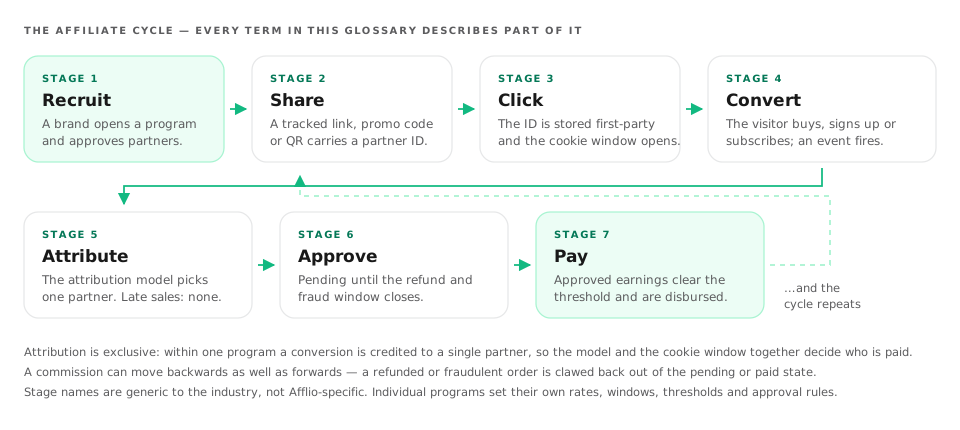
Where MRR Commission sits in the affiliate cycle
An MRR commission ties the pay stage to a subscription's monthly recurring revenue, so the payment moves as the customer's plan does.
How MRR Commission is calculated
monthly commission = customer MRR × rate, for as long as the terms allow
- MRR
- the normalised monthly value of the subscription, annual plans divided by twelve
- rate
- applied to current MRR, so it usually follows upgrades and downgrades
- duration
- capped at 12 or 24 months in many programs, uncapped in some
- expansion
- seat growth raises MRR and, in most implementations, the commission with it
Worked example (illustrative)
A 20 percent rate on a customer starting at 200 dollars MRR pays 40 dollars a month. If the account grows to 500 dollars MRR by month nine, the commission grows to 100 — which is why B2B partners care more about expansion than about the initial deal size.
The figures above are a chosen illustration of the arithmetic. They are not a measured result, a typical result, or a projection of what any program pays.
What MRR Commission means for a creator
MRR commissions are the reason B2B software referrals can outearn much larger consumer audiences. One referred account that grows from five seats to fifty pays ten times as much, from a single piece of content.
The details that decide whether that upside is real are the cap and the expansion rule. A rate pinned to the originally referred plan captures none of the growth, and a twelve-month cap turns a compounding asset into a one-year bonus.
What MRR Commission means for a brand
Paying on MRR aligns partners with retention and expansion, which are the two metrics a subscription business is actually run on. A partner paid on current MRR has a direct reason to refer accounts that grow rather than accounts that sign.
It has to be modelled against payback. A commission on expansion revenue is a claim on the part of the account that funds growth, so the rate and the cap need to be set from the payback period rather than from what sounds attractive in recruitment.
Common mistakes with MRR Commission
Pinning the commission to the originally referred plan
It removes the entire expansion upside, which in B2B is usually where most of the value is. Partners notice within a year and stop referring accounts that grow.
Ignoring downgrades
If the rate follows upgrades it should follow downgrades too. A one-directional rule is a dispute waiting to happen at the first plan change.
Advertising recurring without stating the cap
Twelve-month recurring and lifetime recurring are advertised in near-identical language and are very different offers.
MRR Commission: common questions
Does an MRR commission grow if the customer upgrades?
In most implementations yes, because the rate applies to current MRR. Some programs pin it to the originally referred plan, which removes the expansion upside entirely, so it is worth confirming which applies.
What happens if the customer downgrades?
The commission normally falls with the MRR. A program whose rate follows upgrades but not downgrades is unusual and should be read carefully.
How long does an MRR commission last?
Whatever the terms cap it at — twelve or twenty-four months is common, and a minority of programs run uncapped. The cap matters more than the rate for any product customers keep for years.
See also
- Recurring Commission
A recurring commission pays the affiliate a share of every renewal payment a referred customer makes, not just the first sale.
- SaaS Partner Program
A SaaS partner program is a structured program through which a software company rewards external partners — affiliates, referrers, and resellers — for driving new subscriptions.
- LTV (Customer Lifetime Value)
LTV, or customer lifetime value, is the total revenue a business expects to earn from a customer over the entire relationship.
- Commission
A commission is the payment an affiliate earns for each qualifying conversion they drive, set as a percentage of the sale or a fixed amount per action.
Turn the theory into a live program
Afflio handles tracking, commissions, and payouts so you can run the program these terms describe — start free in an afternoon.