Recurring Commission
Updated July 2026
A recurring commission pays the affiliate a share of every renewal payment a referred customer makes, not just the first sale.
Recurring commissions are common in SaaS and subscription businesses, where the value of a customer accrues over many billing cycles. Instead of a one-time payout, the affiliate earns — for example — 20% of every monthly invoice for as long as the customer stays, or for a capped period such as 12 months.
This model strongly motivates partners to refer high-quality, long-retaining customers, since their earnings track customer lifetime value rather than a single transaction.
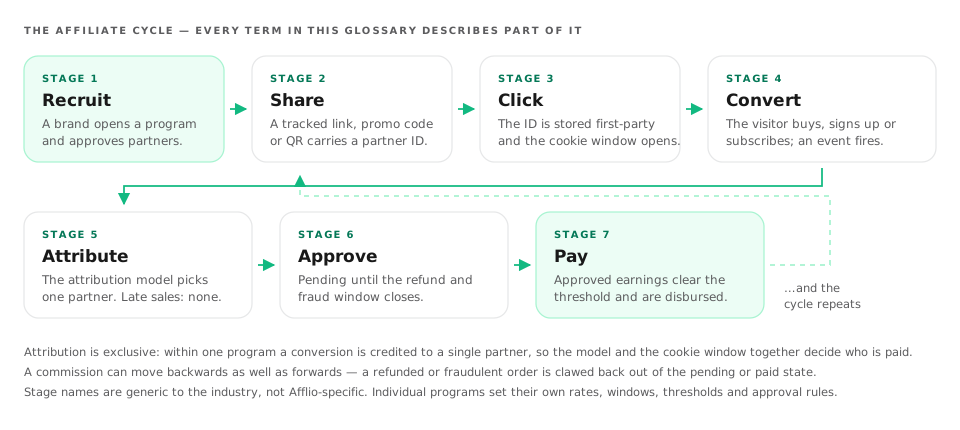
Where Recurring Commission sits in the affiliate cycle
A recurring commission turns the pay stage from a single event into a repeating one for as long as the referred customer keeps paying.
How Recurring Commission is calculated
total = monthly subscription value × rate × months retained
- rate
- the recurring percentage, usually lower than a comparable one-time rate
- months retained
- capped in many programs at 12 or 24, uncapped in some
- churn
- the customer's churn rate decides the realistic average, not the cap
- break-even
- against a one-time rate, it is one-time rate ÷ recurring rate months
Worked example (illustrative)
20 percent recurring on a 50 dollar plan pays 10 dollars a month. Against a 50 percent one-time commission worth 25 dollars, the recurring deal draws level in month three and is ahead of it every month after.
The figures above are a chosen illustration of the arithmetic. They are not a measured result, a typical result, or a projection of what any program pays.
What Recurring Commission means for a creator
Recurring commission is what turns affiliate income from project work into something closer to a portfolio. Each referral adds to a base that keeps paying, so the same monthly effort compounds instead of resetting.
The two questions that decide whether it is genuinely better are the cap and the churn. A 12-month cap on a product people keep for four years is a one-year annuity, and a generous uncapped rate on a product with heavy churn is worth less than it reads.
What Recurring Commission means for a brand
Recurring aligns the partner with retention, which is the metric a subscription business actually lives on. A partner paid for the lifetime of a customer has a direct reason to send customers who stay rather than customers who sign up.
The cost side is a commitment on future revenue, so the rate has to be set against lifetime value and payback rather than first-month revenue. Programs that copy a one-time rate into a recurring structure usually discover the mistake at renewal.
Common mistakes with Recurring Commission
Comparing a recurring rate against a one-time rate directly
They are not comparable numbers. Divide the one-time rate by the recurring rate to get the break-even month, then judge it against how long customers actually stay.
Missing the cap in the terms
Lifetime and twelve-month recurring are advertised in almost identical language. The cap is the difference between an annuity and a one-year bonus.
Setting a recurring rate from first-month revenue
A recurring commission is a claim on the whole customer relationship. Priced against month one, it can exceed the customer's contribution margin outright.
Recurring Commission: common questions
Is recurring commission better than a one-time payout?
It depends on the break-even month and how long customers stay. Divide the one-time rate by the recurring rate: if customers typically stay longer than that many months, recurring wins.
Does recurring commission continue if the customer upgrades?
In most programs yes, and the commission scales with the new plan value. Some cap it at the originally referred plan, so the terms are worth reading on this point specifically.
What ends a recurring commission?
Cancellation, a cap in the program terms, a downgrade to a free plan, and in some programs a period of partner inactivity. The last one is the clause most often missed.
See also
- Commission
A commission is the payment an affiliate earns for each qualifying conversion they drive, set as a percentage of the sale or a fixed amount per action.
- MRR Commission
An MRR commission ties an affiliate's earnings to the monthly recurring revenue a referred customer generates, paying a percentage of that MRR over time.
- LTV (Customer Lifetime Value)
LTV, or customer lifetime value, is the total revenue a business expects to earn from a customer over the entire relationship.
- SaaS Partner Program
A SaaS partner program is a structured program through which a software company rewards external partners — affiliates, referrers, and resellers — for driving new subscriptions.
Turn the theory into a live program
Afflio handles tracking, commissions, and payouts so you can run the program these terms describe — start free in an afternoon.