RPM (Revenue Per Mille)
Updated July 2026
RPM, or revenue per mille, is the estimated revenue a creator or publisher earns per one thousand content views, combining all monetization sources into a single per-thousand figure.
RPM = (total revenue ÷ total views) × 1,000. Where CPM is an advertiser's cost, RPM is the creator's earnings view, and it blends every income source — ads, affiliate commissions, sponsorships, memberships — into one comparable number.
RPM helps creators understand how efficiently their content monetizes and compare formats or platforms. A rising RPM means each thousand views is worth more, whether from better ad rates, stronger affiliate performance, or added revenue streams.
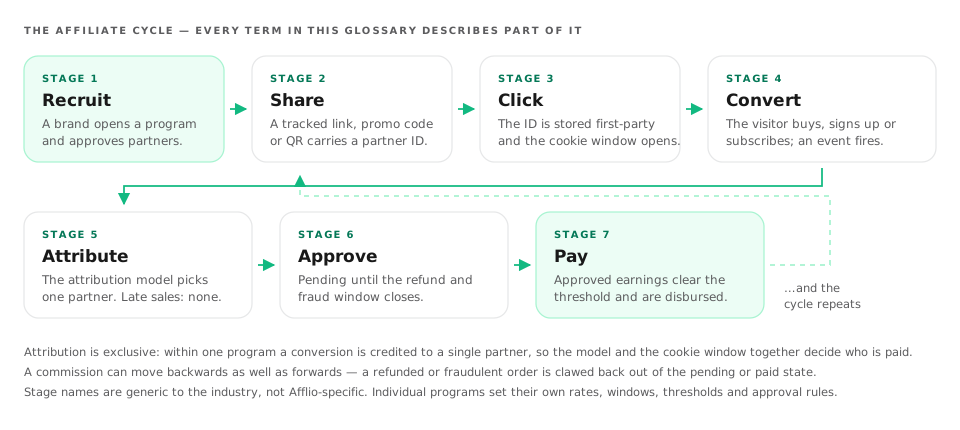
Where RPM (Revenue Per Mille) sits in the affiliate cycle
Revenue per mille is the creator's own pay-stage yardstick: what a thousand views of their content actually returned across every income source.
How RPM (Revenue Per Mille) is calculated
RPM = (total revenue ÷ impressions) × 1,000
- total revenue
- everything the content earned — ads, affiliate, sponsorship, products
- impressions
- views or page views of the content in the same period
- versus CPM
- CPM is what an advertiser pays; RPM is what the creator keeps
- use
- compares formats and topics on the same channel, not channels against each other
Worked example (illustrative)
Content earning 900 dollars across 300,000 views has an RPM of 3. If the affiliate share of that is 500 dollars, the affiliate RPM alone is 1.67 — and comparing that figure across topics shows which subjects are worth making more of.
The figures above are a chosen illustration of the arithmetic. They are not a measured result, a typical result, or a projection of what any program pays.
What RPM (Revenue Per Mille) means for a creator
RPM is the number that ends the argument about whether to chase reach or relevance. A tutorial on a paid tool can carry an RPM many times that of a general-interest video with ten times the views, and only RPM makes that visible.
Split it by source before drawing conclusions. Ad RPM, affiliate RPM and sponsorship RPM move for completely different reasons, and a blended figure hides which of the three a change actually affected.
What RPM (Revenue Per Mille) means for a brand
For a brand, a partner's affiliate RPM is a sharper recruitment signal than follower count. It shows the audience converts, which is the only property that matters, and it is unaffected by how large the channel is.
It is also the honest frame for a negotiation. A creator who can state the affiliate RPM their content produces is proposing a price based on measured value rather than on reach, and that is a conversation a brand can actually evaluate.
Common mistakes with RPM (Revenue Per Mille)
Confusing RPM with CPM
CPM is an advertiser's cost, RPM is a creator's revenue, and platform revenue share sits between them. They are never the same number.
Comparing RPM across platforms
A view means something different on each platform, and monetisation differs too. The comparison is only meaningful within one channel and format.
Blending every revenue source into one figure
A rising blended RPM can hide collapsing affiliate income masked by one large sponsorship. Track the components.
RPM (Revenue Per Mille): common questions
What is the difference between RPM and CPM?
CPM is what an advertiser pays for a thousand impressions. RPM is what the creator actually receives per thousand views, after the platform's share and across every revenue source rather than ads alone.
Does affiliate income count in RPM?
It should. RPM is only useful as a total-revenue figure; excluding affiliate earnings makes content with strong commercial intent look worse than content that merely collects ad impressions.
How do I raise RPM without more views?
Shift the mix toward topics with commercial intent, place affiliate links where the reader has already decided, and replace low-paying ad inventory with a relevant program on the pages that attract buyers.
See also
- CPM (Cost Per Mille)
CPM, or cost per mille, is the price an advertiser pays per one thousand impressions of an ad or sponsored content, a standard way to price awareness-focused campaigns and influencer posts.
- EPC (Earnings Per Click)
EPC, or earnings per click, is the average commission an affiliate earns per click on their tracking links, calculated as total commissions divided by total clicks.
- Creator Economy
The creator economy is the ecosystem of independent creators — writers, video makers, streamers, and educators — who earn a living directly from their audiences and brand partnerships, supported by platforms and tools for content, monetization, and payments.
- Affiliate Marketing
Affiliate marketing is a performance-based marketing model in which a business pays external partners a commission for each customer or sale they refer.
Turn the theory into a live program
Afflio handles tracking, commissions, and payouts so you can run the program these terms describe — start free in an afternoon.