Creator Economy
Updated July 2026
The creator economy is the ecosystem of independent creators — writers, video makers, streamers, and educators — who earn a living directly from their audiences and brand partnerships, supported by platforms and tools for content, monetization, and payments.
The creator economy describes the millions of individuals who build audiences on platforms like YouTube, Instagram, TikTok, and Substack and monetize through a mix of ad revenue, subscriptions, sponsorships, affiliate commissions, digital products, and fan support. It has grown into a market estimated in the hundreds of billions of dollars.
For brands, the creator economy is a distribution channel: partnering with creators through sponsored posts, brand deals, or affiliate programs reaches engaged, trusting audiences that traditional advertising struggles to match. Affiliate and ambassador programs let brands work with creators on a performance basis, paying for the sales they actually drive.
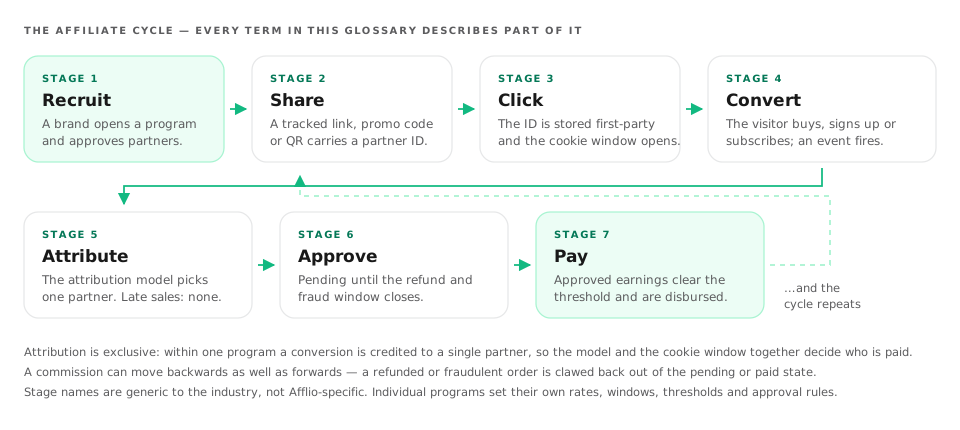
Where Creator Economy sits in the affiliate cycle
The creator economy is the labour market the recruit stage draws from: independent people monetising an audience directly.
How Creator Economy actually works
The defining structural feature is disintermediation. A creator reaches an audience without a publisher, a network or a broadcaster deciding whether they may, and monetises through a stack of channels — platform ad revenue, sponsorships, affiliate commissions, subscriptions, digital products, and increasingly their own storefronts.
The income distribution is extremely uneven and the individual income is volatile, because most of the channels depend on platform decisions the creator does not control. That volatility is the main reason the affiliate and product layers matter: they are the parts of the stack least dependent on an algorithm continuing to favour the account.
What Creator Economy means for a creator
The practical lesson of the last decade is diversification across income types, not across platforms. Four platforms all paying ad revenue is one income source with four points of failure; ad revenue plus affiliate plus a product is three genuinely different ones.
Affiliate income is usually the most durable of the three, because it depends on content continuing to be findable rather than on a platform continuing to pay a given rate.
What Creator Economy means for a brand
For brands this is a distribution channel that did not exist at scale twenty years ago, and its advantage is trust rather than reach. Buying it like media — on impressions, at scale, with a script — reliably underperforms.
It also means the counterparty is usually a single person running a small business. Payment terms, brief clarity and prompt approval matter more here than they do with an agency, because the creator is funding production personally.
Common mistakes with Creator Economy
Depending on one platform for most of your income
Algorithm and policy changes have removed large fractions of creator income overnight, repeatedly. The concentration is the risk, not any particular platform.
Diversifying across platforms but not across income types
Four platforms paying the same kind of revenue is one income source with four failure points that often move together.
Treating creators as media inventory
The mechanism is trust in a person. Buying it at scale with a script removes the property that made it work.
Creator Economy: common questions
How do creators actually make money?
Through a stack rather than a single source: platform ad revenue, sponsorships, affiliate commissions, subscriptions, digital products and storefronts. Most established creators run several at once precisely because each is individually fragile.
Why does affiliate income matter to creators?
Because it is the part of the stack least dependent on a platform continuing to favour the account. It scales with intent rather than reach, and back-catalogue content keeps earning while it stays findable.
Is the creator economy only about large accounts?
No, and commercially the opposite is often true. Small, specific audiences convert at rates broad ones do not, which is why a niche newsletter can out-earn a general-interest channel many times its size.
See also
- Influencer Marketing
Influencer marketing is a strategy in which brands partner with creators who have engaged social audiences to promote products, paying through flat fees, free product, affiliate commissions, or a combination.
- UGC (User-Generated Content)
User-generated content (UGC) is content — photos, videos, reviews, and posts — created by customers or creators rather than the brand itself, valued in marketing because it feels authentic and trustworthy.
- Brand Deal
A brand deal is a paid agreement between a brand and a creator to promote the brand's product, defined by deliverables, usage rights, exclusivity, timing, and a fee or commission.
- Affiliate Marketing
Affiliate marketing is a performance-based marketing model in which a business pays external partners a commission for each customer or sale they refer.
- Creator Storefront
A creator storefront is a personalized shop page where a creator curates and links the products they recommend — often earning affiliate commissions on sales — turning their recommendations into a shoppable, trackable destination.
Turn the theory into a live program
Afflio handles tracking, commissions, and payouts so you can run the program these terms describe — start free in an afternoon.