Tiered Commission
Updated July 2026
A tiered commission structure raises an affiliate's commission rate as they reach higher sales or volume thresholds — for example 10% up to ten sales, then 15% beyond — rewarding top performers with better rates.
Tiered commissions motivate affiliates to push for the next threshold, since crossing it lifts the rate on subsequent (or sometimes all) sales in the period. It concentrates higher payouts on the partners who deliver the most volume.
This differs from a multi-tier (sub-affiliate) program, where a partner earns overrides on the affiliates they recruit. Tiered commission scales with the affiliate's own performance, not with a downline they build.
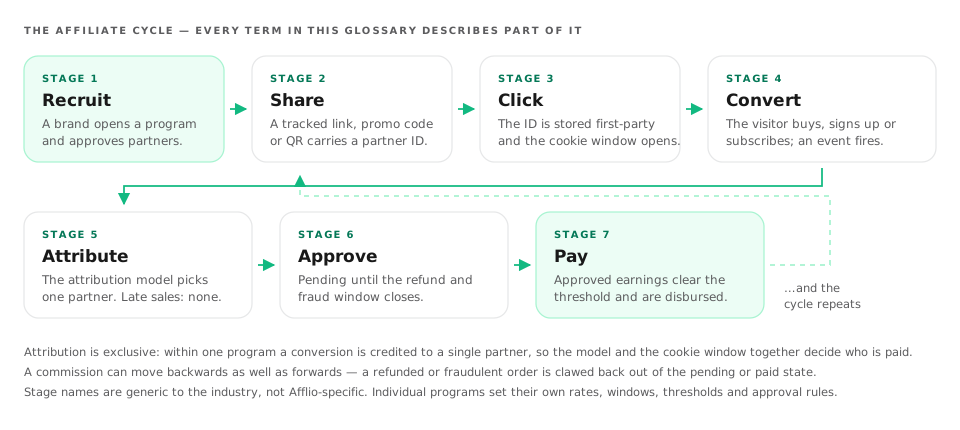
Where Tiered Commission sits in the affiliate cycle
A tiered commission changes the rate applied at the approve stage according to how much the partner has produced in the period.
How Tiered Commission is calculated
rate = the band the partner's period volume falls into
- band
- a volume or revenue range with its own rate
- marginal vs retroactive
- does the higher rate apply to all sales, or only those above the line?
- reset period
- monthly, quarterly or lifetime — decides whether tiers are reachable
- purpose
- buys incremental volume from partners already producing
Worked example (illustrative)
Bands of 10 percent to 50 sales, 15 percent from 51 to 200, and 20 percent above that. A partner at 60 sales earns 15 percent on all 60 under a retroactive scheme, and 10 percent on the first 50 plus 15 percent on the next 10 under a marginal one — a difference of a third on the same performance.
The figures above are a chosen illustration of the arithmetic. They are not a measured result, a typical result, or a projection of what any program pays.
What Tiered Commission means for a creator
The single question worth asking is whether the higher rate is retroactive or marginal, because the same published bands can pay very differently. Program pages rarely make it explicit, and it is a reasonable thing to ask before committing a campaign to it.
The second is the reset period. Monthly-resetting tiers reward a concentrated push; quarterly ones reward consistency; lifetime tiers are effectively a permanent promotion once earned.
What Tiered Commission means for a brand
Tiering is how a program buys incremental volume from partners who are already producing, which is usually cheaper than recruiting an equivalent amount of new partner capacity.
Set the bands from real distribution data. Thresholds placed above almost every partner's actual volume motivate nobody and read as decoration; thresholds most partners clear automatically are just a rate rise with extra steps.
Common mistakes with Tiered Commission
Leaving marginal versus retroactive unstated
It changes the payment on identical performance by a large margin, and a partner who assumed the generous reading will dispute the first statement.
Setting bands without looking at the distribution
A tier nobody reaches is not an incentive. Place the first band just above where most active partners currently sit.
Resetting tiers without warning
A partner who has earned a higher rate and finds it silently reset reads it as a rate cut, which is exactly what it is from their side.
Tiered Commission: common questions
Does a higher tier apply to all my sales or only the ones above the threshold?
It depends entirely on the program. Retroactive tiers reprice the whole period at the higher rate; marginal tiers apply it only to sales above the line. Ask which, because the difference is large.
How often do tiers reset?
Monthly and quarterly are both common, and some programs make an earned tier permanent. The reset period decides whether the structure rewards a burst or sustained output.
Can I negotiate a custom tier?
Often, once you are producing consistently. Direct programs have far more flexibility here than network-run ones, where the bands are usually fixed platform-wide.
What happens to my tier if a sale is refunded after it pushed me over a threshold?
Most programmes recalculate qualifying volume net of refunds, so a clawback can drop you back below a threshold and reprice sales that had already been credited at the higher rate. Whether that recalculation reaches backwards or only applies from the next period is the part worth asking about before a period closes, because the two produce very different statements.
See also
- Commission
A commission is the payment an affiliate earns for each qualifying conversion they drive, set as a percentage of the sale or a fixed amount per action.
- Multi-Tier Affiliate (Sub-Affiliate)
A multi-tier affiliate program lets affiliates earn a commission not only on their own sales but also on sales made by the sub-affiliates they recruit.
- Lifetime Commission
A lifetime commission pays an affiliate on every future purchase a referred customer makes, for the life of that customer, not just the first sale, strongly rewarding partners who bring loyal, repeat buyers.
- Recurring Commission
A recurring commission pays the affiliate a share of every renewal payment a referred customer makes, not just the first sale.
Turn the theory into a live program
Afflio handles tracking, commissions, and payouts so you can run the program these terms describe — start free in an afternoon.