Merchant
Updated July 2026
A merchant is the business that owns the product and runs an affiliate program, paying partners a commission for the customers they refer.
The merchant (also called the advertiser or brand) sets the program's terms: which conversions are eligible, the commission rates, the cookie window, the payout threshold, and any restrictions on how affiliates may promote. They supply the creative assets, links, and reporting affiliates need.
In a self-hosted program the merchant runs everything in-house using affiliate software; in a network model, an affiliate network sits between the merchant and its affiliates to handle tracking, recruitment, and payments.
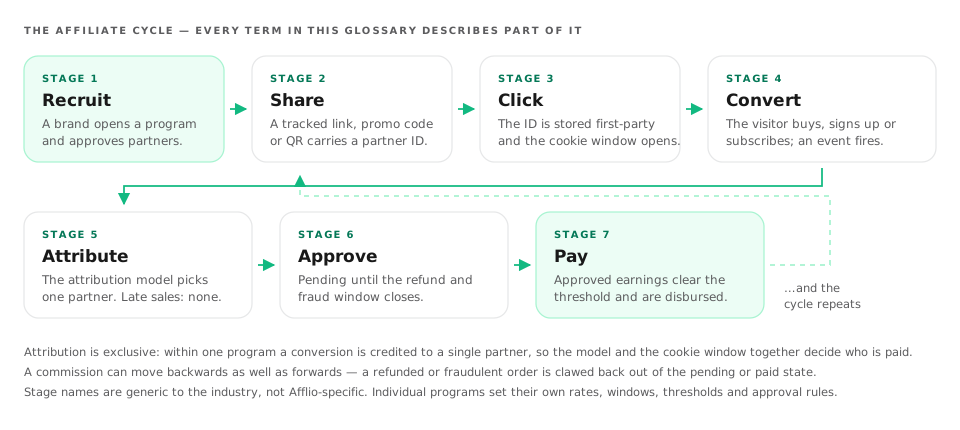
Where Merchant sits in the affiliate cycle
The merchant is the party that defines what counts as a conversion, so every later stage of the cycle runs on rules this one party writes.
How Merchant actually works
A merchant's program is, in practice, six decisions written down: which actions are commissionable, what each pays, how long a click stays valid, how long a commission sits pending, which rails pay it out, and which promotional methods are barred. Everything a partner experiences downstream is a consequence of those six.
The merchant also decides where the program lives. Self-hosted means the merchant runs the software and holds the partner relationships directly; joining a network means the network supplies tracking, a partner marketplace and payment handling in exchange for a fee and, usually, a share of the relationship.
What Merchant means for a creator
For a partner, the merchant is the counterparty risk. The merchant approves or reverses every commission, sets the threshold you must reach before money moves, and can change the rate on notice. Reading the program terms before you build a piece of content around a brand is the cheapest risk control available.
Merchant behaviour is also the most reliable signal of whether a program is worth the effort: how quickly pending commissions are approved, whether reversals come with a reason, and whether rate changes are announced in advance tell you more than the headline rate does.
What Merchant means for a brand
Running the program in-house keeps the partner relationships and the margin, but it means owning the tracking, fraud review, tax-form collection and payout operations yourself. A network absorbs that work and brings a partner marketplace, at the cost of a fee and a relationship that is partly the network's.
Whichever route, the obligation the merchant cannot delegate is approval discipline. Commissions that sit pending for months, or reverse without explanation, cost more in partner churn than the disputed amounts are worth.
Common mistakes with Merchant
Changing the rate without notice
Partners plan content calendars around a rate. Cutting it retroactively, or applying a new rate to sales already in flight, is the fastest way to lose the partners who were producing.
Leaving commissions pending indefinitely
Pending exists to cover the refund window. A pending period materially longer than the actual return policy reads to partners as a cash-flow decision at their expense.
Publishing terms that contradict the tracking setup
A ninety-day cookie window in the terms and a thirty-day one in the software produces disputes the merchant always loses. Verify the configured value matches the published one.
Merchant: common questions
Is a merchant the same as an advertiser?
In affiliate marketing they are used interchangeably: both mean the business whose product is being promoted and which pays the commission. Advertiser is the more common word inside networks, merchant the more common one in e-commerce.
Can a merchant run a program without a network?
Yes. Self-hosted programs are common, especially in SaaS, and are run on affiliate software the merchant controls directly. The trade is that partner discovery becomes the merchant's own job.
Who is liable if an affiliate makes a false claim?
Regulators have pursued both. Merchants are generally expected to set clear promotional rules and to monitor partners, which is why program terms almost always bar specific claims and require disclosure.
See also
- Affiliate
An affiliate is an individual or company that promotes another business's products in exchange for a commission on the sales or actions they generate.
- Affiliate Marketing
Affiliate marketing is a performance-based marketing model in which a business pays external partners a commission for each customer or sale they refer.
- Commission
A commission is the payment an affiliate earns for each qualifying conversion they drive, set as a percentage of the sale or a fixed amount per action.
- Cookie Window
A cookie window (or cookie duration) is the length of time after a referral click during which a resulting conversion will still be credited to that affiliate.
Turn the theory into a live program
Afflio handles tracking, commissions, and payouts so you can run the program these terms describe — start free in an afternoon.