Affiliate Network
Updated July 2026
An affiliate network is an intermediary platform that connects merchants with a large pool of affiliates, handling tracking, reporting, and consolidated payments in exchange for fees, and giving both sides an established marketplace.
Networks such as CJ, Awin, and ShareASale sit between merchants and affiliates. The merchant gains access to a ready base of publishers and offloads tracking and payment logistics; affiliates get a single account to discover and promote many programs.
The trade-off is cost and control: networks typically charge setup and ongoing fees plus a percentage override on activity, and the merchant operates within the network's structure. The alternative is a self-hosted or in-house program run on affiliate software, where the merchant owns the direct relationship and avoids network overrides.
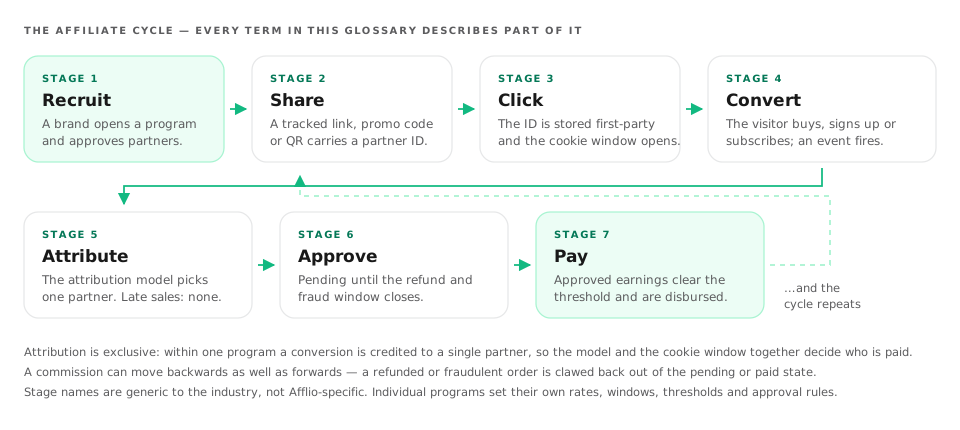
Where Affiliate Network sits in the affiliate cycle
A network sits at the recruit stage as an intermediary, supplying partners a brand has not met and tracking the brand did not build.
How Affiliate Network actually works
A network holds two sides. On one it signs merchants, who publish their offer, rate and terms into the network's catalogue. On the other it signs publishers, who browse that catalogue and apply. The network owns the tracking domain, so every link routes through it, and it owns the money flow: the merchant funds a balance, the network deducts its fee, and publishers are paid from the network rather than by the brand.
That intermediation is what a network charges for. It also means the merchant does not hold the publisher relationship directly — contact details, payment terms and often the ability to talk to a partner at all are mediated by the network, which is the trade brands weigh when they consider going self-hosted.
What Affiliate Network means for a creator
Networks are the fastest way for a partner to find programs, because the catalogue is the product. One application, one dashboard and one payment cycle can cover dozens of brands, which removes most of the administrative friction of running many direct relationships.
The cost is control and margin. Network payment terms are usually slower than a direct program's, minimum thresholds are set by the network rather than the brand, and a brand that leaves the network takes its program with it — including, sometimes, your accumulated performance history.
What Affiliate Network means for a brand
For a brand, a network solves the cold-start problem: a new program with no partners can be in front of thousands of publishers on day one. It also absorbs tracking, tax-form collection and international payouts, which are the three operational jobs most likely to sink a self-hosted launch.
What the brand gives up is the direct relationship and a slice of every sale. Mature programs frequently run both — a network for discovery and reach, a self-hosted program for the partners that matter enough to manage directly — and deduplicate between them on the order identifier.
Common mistakes with Affiliate Network
Running a network and an in-house program without deduplication
The same sale can be claimed by both, and both will be paid. A shared order identifier plus an idempotency key on the conversion event is the only reliable fix.
Assuming the network's fee is the whole cost
Network economics usually include a percentage of payouts on top of a platform fee, and sometimes a minimum monthly spend. Model the total on realistic volume before comparing it with self-hosting.
Treating catalogue presence as recruitment
Being listed is not being chosen. Programs that publish an offer and wait typically attract coupon and deal publishers first, because those are the publishers who browse catalogues systematically.
Affiliate Network: common questions
Is an affiliate network the same as an affiliate platform?
No. A network brings its own publisher marketplace and handles the money in the middle. A platform is software a brand runs for its own program, with partners it recruits itself. Some products do both, which is where the confusion comes from.
Do networks pay affiliates faster than direct programs?
Usually the opposite. A network adds its own approval and consolidation cycle on top of the merchant's, so net-60 is common where a direct program might pay monthly.
Can I join the same brand through two networks?
Occasionally the same brand runs on more than one network, but promoting it twice rarely helps: the sale attributes once, and some programs treat duplicate enrolment as grounds for removal.
See also
- Merchant
A merchant is the business that owns the product and runs an affiliate program, paying partners a commission for the customers they refer.
- Affiliate
An affiliate is an individual or company that promotes another business's products in exchange for a commission on the sales or actions they generate.
- Affiliate Marketing
Affiliate marketing is a performance-based marketing model in which a business pays external partners a commission for each customer or sale they refer.
- Partner Marketing
Partner marketing is a broad discipline of growing revenue through external partners — affiliates, referrers, resellers, ambassadors, and integration partners — encompassing affiliate marketing and extending into strategic and channel partnerships.
- SaaS Partner Program
A SaaS partner program is a structured program through which a software company rewards external partners — affiliates, referrers, and resellers — for driving new subscriptions.
Turn the theory into a live program
Afflio handles tracking, commissions, and payouts so you can run the program these terms describe — start free in an afternoon.