Partner Marketing
Updated July 2026
Partner marketing is a broad discipline of growing revenue through external partners — affiliates, referrers, resellers, ambassadors, and integration partners — encompassing affiliate marketing and extending into strategic and channel partnerships.
Partner marketing treats every external relationship that can drive growth as part of one program family. It includes classic affiliates, customer referrals, resellers who sell on the brand's behalf, technology partners with product integrations, and ambassadors.
Because these relationships vary in touch and value, partner marketing often combines affiliate software with partner relationship management (PRM) and deal registration for the higher-touch channel and B2B side. Affiliate marketing is one important slice of the wider partner-marketing whole.
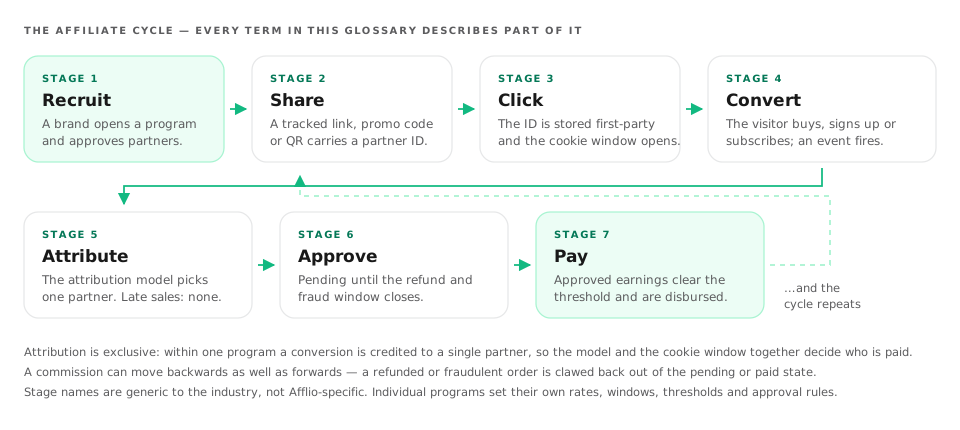
Where Partner Marketing sits in the affiliate cycle
Partner marketing is the recruit stage widened: every external party that can bring customers, not only the ones paid per sale.
How Partner Marketing actually works
Partner marketing is the umbrella over several distinct partner types, and the distinction is what makes it useful rather than a synonym for affiliate. Affiliate partners promote for a commission. Referral partners pass warm introductions. Reseller partners sell and often support the product under their own commercial relationship. Technology partners integrate with it. Agency and consulting partners implement it for clients.
Each type needs different mechanics. A commission and a tracking link serve an affiliate; a reseller needs margin, pricing authority and support terms; a technology partner needs documentation and a joint go-to-market motion. Running all five on affiliate mechanics is the most common way partner programmes stall.
What Partner Marketing means for a creator
For a creator the relevant question is which type you actually are. Most creators are affiliate or referral partners, and asking for reseller economics, or being offered them, usually signals a mismatch on one side.
Where a creator does implementation work — building templates, running setups, consulting — agency partner terms can be materially better than affiliate terms, and the two are often available from the same company under different programmes.
What Partner Marketing means for a brand
The value of the category framing is that it stops one set of mechanics being applied to everyone. Partner types differ in what they need, what they contribute and how long they take to produce anything, and a single programme design serves at most one of them well.
Sequence matters too. Technology and agency partnerships take far longer to produce revenue than affiliate partnerships and produce larger, stickier deals when they do, so they need to be funded against a different time horizon.
Common mistakes with Partner Marketing
Running every partner type on affiliate mechanics
A reseller needs margin and pricing authority, a technology partner needs documentation and a joint motion. A commission and a link serve neither.
Measuring long-cycle partners on short-cycle metrics
Technology and agency partnerships take quarters to produce revenue. Judged monthly against affiliate performance, they are cancelled before they work.
Treating partner marketing as a synonym for affiliate
The whole point of the category is that the types differ. Collapsing them loses the reason to have the category at all.
Partner Marketing: common questions
What is the difference between partner marketing and affiliate marketing?
Affiliate marketing is one type of partner marketing. The wider category also covers referral, reseller, technology and agency partners, each of which needs different commercial terms and different support.
Which partner type produces revenue fastest?
Affiliate and referral partners, because the motion is simple and needs no joint engineering or contracting. Reseller and technology partnerships take considerably longer and tend to produce larger, stickier revenue.
Can one programme serve all partner types?
Rarely well. The needs differ enough — margin, pricing authority, documentation, co-selling — that most mature companies run separate tracks under a single partner organisation.
See also
- Affiliate Marketing
Affiliate marketing is a performance-based marketing model in which a business pays external partners a commission for each customer or sale they refer.
- PRM (Partner Relationship Management)
PRM, or partner relationship management, is the software and process used to recruit, onboard, manage, and grow a company's network of business partners.
- SaaS Partner Program
A SaaS partner program is a structured program through which a software company rewards external partners — affiliates, referrers, and resellers — for driving new subscriptions.
- Referral Marketing
Referral marketing is a strategy that encourages existing customers to recommend a product to others, usually with a two-sided reward, leveraging personal trust to acquire new customers at low cost.
- Performance Marketing
Performance marketing is an umbrella term for digital marketing where advertisers pay based on measurable results — clicks, leads, or sales — rather than upfront for exposure, with affiliate marketing as a core channel.
Turn the theory into a live program
Afflio handles tracking, commissions, and payouts so you can run the program these terms describe — start free in an afternoon.