Attribution
Updated July 2026
Attribution is the process of determining which affiliate or marketing touchpoint should receive credit — and the commission — for a conversion.
When a customer interacts with several partners or campaigns before buying, attribution decides who gets paid. The rules an affiliate program uses — last-click, first-click, or multi-touch — directly shape how commissions are distributed and which partners feel rewarded for their work.
Reliable attribution depends on accurate tracking: click cookies, promo codes, or server-to-server events that tie a conversion back to the referral that drove it. Weak attribution leads to disputes, double-counting, and partners who churn because they feel unpaid.
Where Attribution sits in the affiliate cycle
Attribution is the stage itself — the decision about which partner, out of everyone who touched the journey, is paid for the sale.
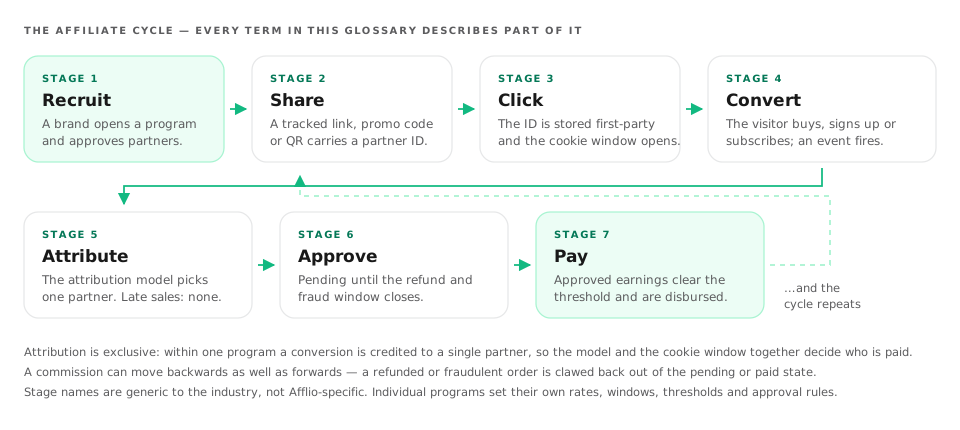
How Attribution actually works
Attribution runs in two steps that are often confused. First, identity: the system has to recognise that this conversion came from a tracked referral at all, which it does through a first-party cookie, a promo code on the order, or a server-to-server postback carrying a click identifier. Second, allocation: given every referral that qualifies, a model decides who is credited.
In affiliate programs the allocation step is nearly always exclusive — one partner receives the whole commission — because the money is real and cannot be split into fractions of a percent without the payout arithmetic becoming unworkable. That is why the choice between last-click, first-click and a multi-touch model is an economic decision rather than a reporting preference.
What Attribution means for a creator
Attribution is why identical traffic earns wildly different amounts across programs. A creator who builds awareness and hands the buyer off to a review site earns nothing under last-click and the full commission under first-click, for exactly the same work.
The practical defence is to check the model and the window before you invest in a piece of content, and to prefer formats that carry the click closer to the purchase — a direct product link in a tutorial rather than a brand mention that sends the viewer off to search.
What Attribution means for a brand
The model a brand picks is a statement about which partner behaviour it wants more of. Last-click buys conversions and concentrates spend on partners near checkout. First-click buys discovery and rewards the partners who introduced the customer. Neither is correct in the abstract; the right one depends on whether the program's problem is reach or close rate.
Whatever the model, the reliability of the identity step matters more than the elegance of the allocation step. A program with perfect multi-touch logic and a tracking layer that misses a fifth of conversions pays less accurately than a simple last-click program that never misses one.
Common mistakes with Attribution
Confusing the attribution model with the attribution window
The model decides WHO gets credit among qualifying referrals; the window decides WHICH referrals still qualify. Changing one does not do the job of changing the other.
Double-counting across a network and an in-house tracker
Running both without deduplication credits the same sale twice and pays it twice. A shared order identifier and an idempotency key on the conversion event is the standard fix.
Blaming attribution for a tracking failure
Missing sales are usually an identity problem — a stripped query parameter, a blocked script, a checkout on a different domain — not a model problem. Diagnose identity before touching the model.
Changing the model retroactively
Re-running attribution over conversions that have already been approved moves commission between partners who have already been told what they earned. Model changes belong at a stated date going forward, announced before they take effect, or the programme spends the next month arguing about statements rather than selling.
Attribution: common questions
Why did my sale attribute to a coupon site I never heard of?
Almost always a browser extension. Coupon extensions offer to hunt for a discount at checkout, and the act of applying one can register a click that lands after yours — so under last-click it takes the commission for a customer you brought. It is the single most common attribution dispute in consumer programmes, and the reason some brands exclude extension traffic in their terms or pay it at a reduced rate.
What happens if two affiliates refer the same customer?
The program's model decides. Under last-click the more recent referral inside the window takes the whole commission; under first-click the earlier one does. Affiliate programs almost never split a commission between them.
Does a promo code override a cookie?
In most programs yes, because a code on the order is stronger evidence than a cookie that may have been set by a later click. Programs that do this publish the precedence rule, and partners should check it.
Can attribution work without cookies at all?
Yes. Unique promo codes and server-to-server postbacks both attribute without any browser storage, which is why programs facing cookie restrictions lean on them.
See also
- Last-Click Attribution
Last-click attribution credits the entire commission to the final affiliate or link the customer clicked before converting.
- First-Click Attribution
First-click attribution credits the commission to the first affiliate or link that introduced the customer, even if other partners were involved later.
- Cookie Window
A cookie window (or cookie duration) is the length of time after a referral click during which a resulting conversion will still be credited to that affiliate.
- S2S / Postback Tracking
Server-to-server (S2S) postback tracking records conversions by sending an event directly from the merchant's backend to the affiliate platform, without relying on browser cookies.
Turn the theory into a live program
Afflio handles tracking, commissions, and payouts so you can run the program these terms describe — start free in an afternoon.