S2S / Postback Tracking
Updated July 2026
Server-to-server (S2S) postback tracking records conversions by sending an event directly from the merchant's backend to the affiliate platform, without relying on browser cookies.
With S2S tracking, when a conversion happens the merchant's server fires a postback (a server-side HTTP request) containing the click identifier and conversion details. Because nothing depends on the customer's browser, it is immune to ad-blockers, Safari ITP, and third-party cookie loss.
S2S is the most reliable attribution method, especially for revenue events. Pairing it with an idempotency key prevents retries and webhook replays from double-counting a sale, keeping partner earnings accurate.
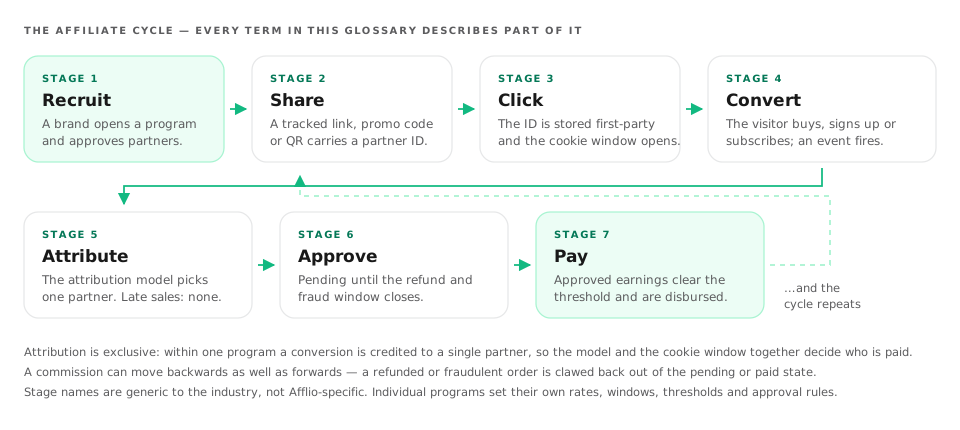
Where S2S / Postback Tracking sits in the affiliate cycle
Server-to-server postback is how the convert stage reports itself when no browser is involved and no cookie can be relied on.
How S2S / Postback Tracking actually works
On the click, the tracking layer generates a unique click identifier and passes it to the merchant, which stores it against the session or the order. When the conversion happens, the merchant's own server calls the tracking endpoint with that identifier, the order identifier and the value. No browser, no pixel, no cookie takes part in the conversion half of the exchange.
That is why it survives conditions a pixel does not: ad blockers, privacy browsers, cookie restrictions, in-app webviews and a checkout hosted on a different domain all break client-side tracking and none of them touch a server call. The cost is integration work, because the merchant has to persist the click identifier through its own checkout and fire the call from its backend.
What S2S / Postback Tracking means for a creator
A partner rarely configures a postback, but it is worth knowing which programs use one. Programs on server-side tracking lose far fewer conversions, which shows up as a conversion rate that does not mysteriously collapse on mobile traffic.
If your audience is heavily mobile or in-app, this is the single technical detail most likely to separate a program that pays you properly from one that silently drops a fifth of your sales.
What S2S / Postback Tracking means for a brand
For a brand, a postback is the difference between a program that pays accurately and one that underpays invisibly. Underpayment does not generate a support ticket; it generates partners who quietly stop promoting because the numbers never made sense.
Two implementation details carry most of the risk: the click identifier must survive the whole checkout, including any redirect to a hosted payment page, and the endpoint must be idempotent on the order identifier so a retried call does not create a second commission.
Common mistakes with S2S / Postback Tracking
Losing the click identifier at a hosted checkout
Redirecting to a payment provider on another domain drops query parameters and browser storage alike. Persist the identifier server-side against the order before the redirect.
Firing the postback without an idempotency key
Network retries are normal and expected. Without the order identifier as a key, each retry creates another commission on the same sale.
Posting back before the payment is confirmed
Firing on order creation rather than on payment success records conversions for abandoned and failed payments, which then all reverse and destroy partner trust in the dashboard.
S2S / Postback Tracking: common questions
Is server-side tracking more accurate than a pixel?
Materially, yes. It is unaffected by ad blockers, cookie restrictions, in-app webviews and cross-domain checkouts, all of which drop client-side conversion events routinely.
Do I need a developer to set up a postback?
Usually yes. Someone has to persist the click identifier through checkout and fire the server call on payment confirmation, which is backend work rather than a tag-manager change.
Can postbacks and cookies run together?
Yes, and most robust programs run both: the cookie handles the simple case and the postback covers everything the browser drops. Deduplication on the order identifier stops the pair double-counting.
See also
- Attribution
Attribution is the process of determining which affiliate or marketing touchpoint should receive credit — and the commission — for a conversion.
- Cookie Window
A cookie window (or cookie duration) is the length of time after a referral click during which a resulting conversion will still be credited to that affiliate.
- Conversion
A conversion is the qualifying action — such as a sale, signup, lead, or subscription — that triggers an affiliate commission.
- Affiliate Fraud (Click Fraud)
Affiliate fraud is any attempt to earn commissions illegitimately, such as fake clicks, forced cookies, self-referrals, or fabricated conversions.
Turn the theory into a live program
Afflio handles tracking, commissions, and payouts so you can run the program these terms describe — start free in an afternoon.