Last-Click Attribution
Updated July 2026
Last-click attribution credits the entire commission to the final affiliate or link the customer clicked before converting.
Last-click is the most common attribution model in affiliate marketing because it is simple and unambiguous: whoever the customer clicked through most recently within the cookie window gets the sale. It rewards partners who close — coupon sites, retargeting, and bottom-of-funnel content.
The trade-off is that it can under-credit partners who introduced the customer earlier in the journey, such as a reviewer or influencer who created the initial awareness. Some programs counter this with first-click or multi-touch models.
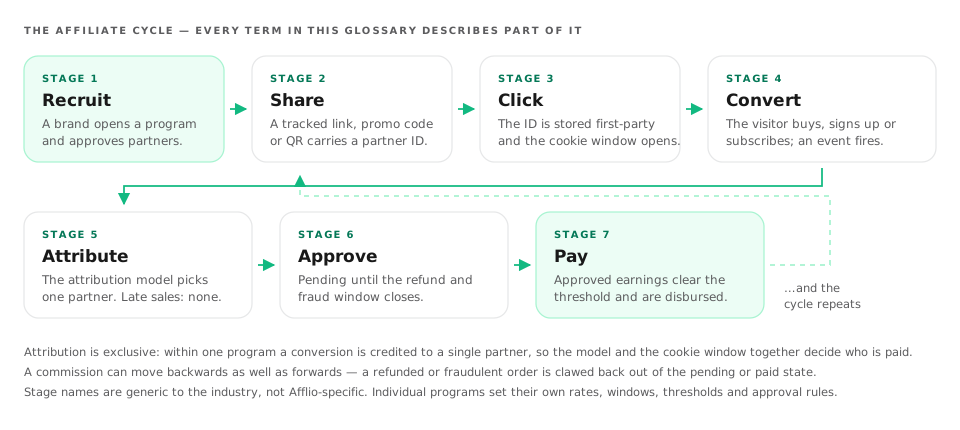
Where Last-Click Attribution sits in the affiliate cycle
Last-click is the allocation rule most affiliate programs apply at the attribute stage, and it is the default almost everywhere.
How Last-Click Attribution is calculated
credit = the most recent qualifying click inside the window, winner takes all
- most recent
- by click timestamp, not by which content was seen first
- qualifying
- inside the attribution window and from an approved channel
- winner takes all
- the whole commission, never a split
- code override
- many programs let a promo code on the order beat the cookie
Worked example (illustrative)
A buyer reads a review on day 1, watches a comparison video on day 9, and clicks a coupon site on day 12 before checking out. Under last-click the coupon site earns the entire commission and the other two earn nothing.
The figures above are a chosen illustration of the arithmetic. They are not a measured result, a typical result, or a projection of what any program pays.
What Last-Click Attribution means for a creator
Last-click is why discovery work is systematically underpaid in affiliate programs. The review that made the buyer want the product earns nothing if the buyer searches for a code before checkout, which most buyers do.
The defences are practical rather than clever: keep the click as close to the purchase as you can, give the audience a reason to use your own code, and prefer programs that either run first-click for content partners or pay a flat fee alongside the commission.
What Last-Click Attribution means for a brand
Last-click is simple, unambiguous and cheap to operate, which is why it is the default. It also concentrates spend on the partners nearest the checkout, and coupon extensions are engineered precisely to be the last click.
The usual corrective is not to abandon the model but to limit it: bar brand-name paid search, set a shorter window for coupon partners, and pay a separate content rate. That keeps last-click's simplicity while stopping it from routing the whole budget to interception.
Common mistakes with Last-Click Attribution
Assuming the last click caused the sale
It is the last touch the tracker recorded, which is a different claim. An incrementality test is the only way to know how much of that credited revenue would have arrived anyway.
Running last-click with no channel restrictions
Without rules against brand-name bidding and coupon interception, last-click reliably drifts the budget toward partners who capture demand rather than create it.
Blaming partners for a model the program chose
Coupon partners taking the last click are behaving exactly as the model rewards. Changing the outcome means changing the rule, not policing the symptom.
Last-Click Attribution: common questions
Why do most affiliate programs use last-click?
Because it is unambiguous and cheap to run. Exactly one partner qualifies, so there is no split to calculate, no fractional payout to reconcile, and very little room for a dispute about who was credited.
Does a promo code beat the last click?
In many programs yes — a code present on the order is treated as stronger evidence than stored browser state. Programs that do this publish the precedence rule, and it is worth checking which way yours runs.
Can I get credit if someone clicked a competitor's link after mine?
Under pure last-click, no. Under first-click or a multi-touch model you would; under last-click the later click inside the window takes the whole commission.
See also
- Attribution
Attribution is the process of determining which affiliate or marketing touchpoint should receive credit — and the commission — for a conversion.
- First-Click Attribution
First-click attribution credits the commission to the first affiliate or link that introduced the customer, even if other partners were involved later.
- Cookie Window
A cookie window (or cookie duration) is the length of time after a referral click during which a resulting conversion will still be credited to that affiliate.
- Commission
A commission is the payment an affiliate earns for each qualifying conversion they drive, set as a percentage of the sale or a fixed amount per action.
Turn the theory into a live program
Afflio handles tracking, commissions, and payouts so you can run the program these terms describe — start free in an afternoon.