First-Click Attribution
Updated July 2026
First-click attribution credits the commission to the first affiliate or link that introduced the customer, even if other partners were involved later.
First-click rewards discovery. The partner who first brought the customer into the funnel — often a content creator, reviewer, or influencer driving awareness — receives the credit when a sale eventually happens within the attribution window.
This model favours top-of-funnel partners but can frustrate the bottom-of-funnel partners who actually closed the deal. Programs choose first-click when they want to incentivize new-audience acquisition over conversion optimization.
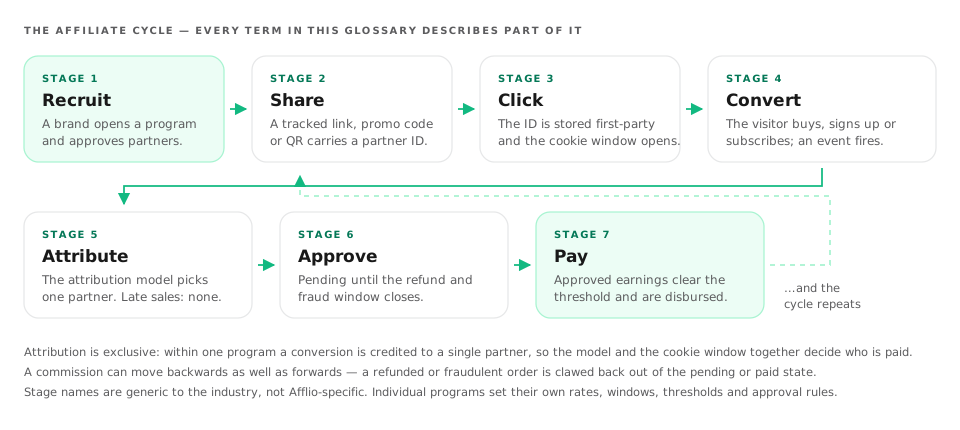
Where First-Click Attribution sits in the affiliate cycle
First-click is the opposite allocation rule at the attribute stage: the earliest qualifying touch inside the window takes the commission.
How First-Click Attribution is calculated
credit = the earliest qualifying click inside the window, winner takes all
- earliest
- the first tracked referral, even if months of other touches followed
- window
- measured from that first click, so a long window matters much more here
- later clicks
- recorded but not credited, unless the program resets on a new partner
- typical use
- programs that want more discovery and less interception
Worked example (illustrative)
The same buyer — review on day 1, comparison video on day 9, coupon site on day 12 — pays the review on day 1 the entire commission under first-click, and the coupon site nothing.
The figures above are a chosen illustration of the arithmetic. They are not a measured result, a typical result, or a projection of what any program pays.
What First-Click Attribution means for a creator
First-click is the model that makes top-of-funnel content viable. If your work is what introduced the buyer to the product, this is the rule under which you are actually paid for it.
It comes with a different discipline: under first-click the window is measured from your click, so a short window truncates exactly the long consideration cycles that discovery content serves. Check the two together, never separately.
What First-Click Attribution means for a brand
A brand chooses first-click when its constraint is reaching people who have never heard of it, rather than closing people who already have. It makes the program attractive to reviewers and educators, who are otherwise systematically outbid by interception partners.
The trade is that it under-rewards the partners who actually close, and it is more exposed to a partner banking an early cheap click on a buyer who was arriving anyway. Programs usually mitigate with a shorter window and firmer channel rules rather than by switching back.
Common mistakes with First-Click Attribution
Adopting first-click without shortening the window
Credit measured from the earliest touch, over a long window, maximises the chance of paying for a touch that influenced nothing.
Assuming partners know which model runs
First-click is rare enough that partners assume last-click unless told. Stating it plainly is one of the cheapest recruitment advantages a program has.
Mixing models across partner types without saying so
Running first-click for content and last-click for coupons is defensible; not publishing which applies to whom generates disputes that look like tracking failures.
First-Click Attribution: common questions
Is first-click better for affiliates than last-click?
Better for discovery partners, worse for conversion partners. A reviewer who introduces products gains; a coupon site or retargeting partner that closes them loses. Neither is universally better.
Why is first-click rare in affiliate programs?
It is harder to defend against a partner banking an early, cheap click, and it pays nothing to the partners who actually close the sale — who are usually the loudest constituency in a mature program.
Does a later click ever override the first one?
Only if the program says so. Some programs reset the credit when a different partner's click arrives; others hold the first one for the full window. The terms are the only authority.
How do I tell which attribution model a programme uses?
Look in the programme terms first, and if it is not stated, ask before you invest in content. It is a reasonable question and a programme that will not answer it plainly is telling you something. Where terms mention only a cookie window and never a model, assume last-click, because that is the near-universal default.
See also
- Attribution
Attribution is the process of determining which affiliate or marketing touchpoint should receive credit — and the commission — for a conversion.
- Last-Click Attribution
Last-click attribution credits the entire commission to the final affiliate or link the customer clicked before converting.
- Cookie Window
A cookie window (or cookie duration) is the length of time after a referral click during which a resulting conversion will still be credited to that affiliate.
- Affiliate
An affiliate is an individual or company that promotes another business's products in exchange for a commission on the sales or actions they generate.
Turn the theory into a live program
Afflio handles tracking, commissions, and payouts so you can run the program these terms describe — start free in an afternoon.