Cookie Window
Updated July 2026
A cookie window (or cookie duration) is the length of time after a referral click during which a resulting conversion will still be credited to that affiliate.
When a customer clicks an affiliate link, a tracking cookie is stored in their browser. If they buy within the cookie window — commonly 30, 60, or 90 days — the affiliate earns the commission. After it expires, the referral is no longer attributed.
Longer cookie windows are more generous to affiliates and important for products with long consideration cycles, like B2B SaaS. With browsers restricting third-party cookies, many programs supplement or replace cookies with first-party cookies and server-to-server tracking to keep attribution accurate.
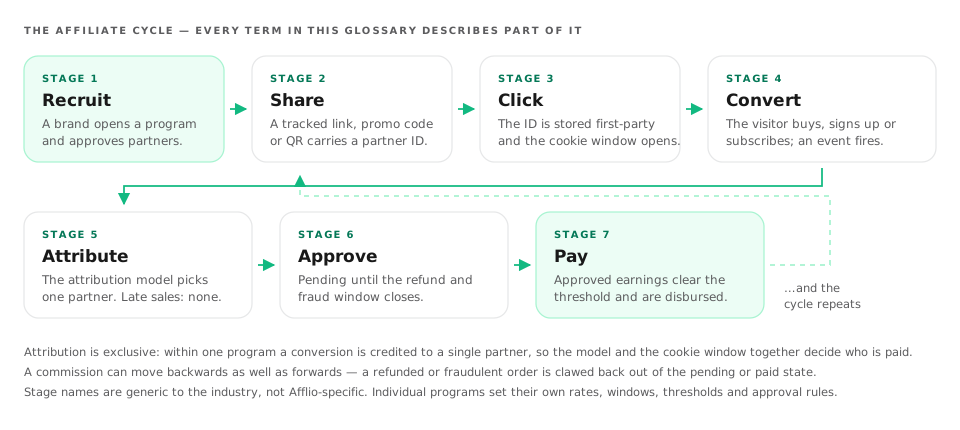
Where Cookie Window sits in the affiliate cycle
The cookie window opens at the click stage and is the clock that decides whether a later conversion can be attributed at all.
How Cookie Window is calculated
a sale counts if (conversion time − click time) ≤ cookie window
- click time
- when the referral was recorded, not when the content was published
- cookie window
- commonly 30, 60 or 90 days; SaaS programs sometimes run longer
- reset
- a fresh click from the same partner usually restarts the clock
- expiry
- past the window the referral is simply gone, not reduced
Worked example (illustrative)
A click on 1 March under a 30-day window covers a purchase on 28 March and covers nothing on 2 April. The same click under a 90-day window covers both, which is the entire difference between the two programs for a buyer who takes six weeks to decide.
The figures above are a chosen illustration of the arithmetic. They are not a measured result, a typical result, or a projection of what any program pays.
What Cookie Window means for a creator
The window matters in inverse proportion to how impulsive the purchase is. For a 20 dollar consumable a 7-day window loses almost nothing. For software a team has to evaluate, a 30-day window quietly discards a large share of the sales the content actually caused.
It also changes what content is worth making. Under a short window, content that produces an immediate click near the point of purchase wins. Under a long one, an in-depth review that a reader returns to after consulting a colleague is finally worth the effort.
What Cookie Window means for a brand
Lengthening the window is the cheapest goodwill a program can offer, because it costs nothing except on sales the program would otherwise have kept for free. It is also the change most likely to attract serious content partners, who track it closely.
The counterweight is incrementality. A very long window increases the share of conversions credited to a partner who touched the journey once, months earlier, and may not have influenced the purchase at all. Most programs settle between 30 and 90 days for that reason.
Common mistakes with Cookie Window
Confusing the cookie window with the attribution window
They are often the same number but they are different rules: the cookie window is how long the referral evidence survives, the attribution window is how long the program will accept a conversion against it.
Assuming the cookie survives the browser
Third-party cookie restrictions mean a window is only as long as the storage backing it. Programs that have not moved to first-party cookies or server-side tracking have a shorter effective window than the published one.
Ignoring it when comparing two programs
A 12 percent commission with a 90-day window regularly out-earns a 20 percent one with a 7-day window on any product that takes a week to decide on.
Cookie Window: common questions
Does clicking an affiliate link again reset the window?
In most programs yes — a new click from the same partner refreshes the timestamp. What a fresh click from a DIFFERENT partner does depends on the attribution model, and under last-click it takes the sale outright.
What is a typical cookie window?
Thirty days is the most common single value in retail, with 60 and 90 days widespread and B2B SaaS programs occasionally running much longer. Any specific program's terms are the only authority for that program.
Do promo codes expire with the cookie window?
No. A code attributes on the order itself rather than on stored browser state, so it works whenever the code is used — which is why programs facing cookie restrictions lean on codes.
See also
- Attribution
Attribution is the process of determining which affiliate or marketing touchpoint should receive credit — and the commission — for a conversion.
- Last-Click Attribution
Last-click attribution credits the entire commission to the final affiliate or link the customer clicked before converting.
- S2S / Postback Tracking
Server-to-server (S2S) postback tracking records conversions by sending an event directly from the merchant's backend to the affiliate platform, without relying on browser cookies.
- Conversion
A conversion is the qualifying action — such as a sale, signup, lead, or subscription — that triggers an affiliate commission.
Turn the theory into a live program
Afflio handles tracking, commissions, and payouts so you can run the program these terms describe — start free in an afternoon.