Brand Deal
Updated July 2026
A brand deal is a paid agreement between a brand and a creator to promote the brand's product, defined by deliverables, usage rights, exclusivity, timing, and a fee or commission.
A brand deal spells out exactly what the creator will produce — for example two Reels and three stories — plus where and how long the content runs, whether the brand can reuse it in ads, any exclusivity from competitors, and the compensation.
Deals range from one-off sponsored posts to ongoing ambassador arrangements. Increasingly they blend a flat fee with affiliate commission, so the creator earns a base plus a share of the tracked sales they generate.
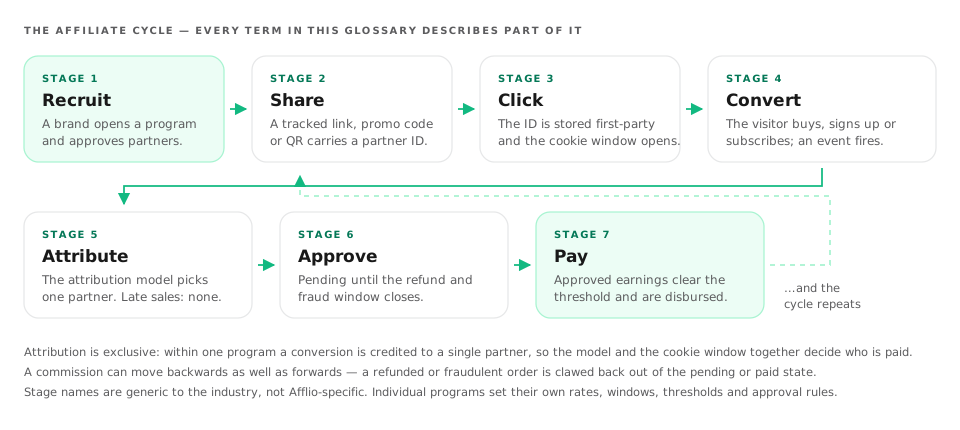
Where Brand Deal sits in the affiliate cycle
A brand deal is the contract signed at the recruit stage — the specific, bounded transaction between one brand and one creator.
How Brand Deal actually works
A brand deal is defined by its scope document, not by its friendliness. Six clauses carry almost all of the value and almost all of the risk: the deliverables and their specifications, the number of approval rounds, the usage rights and their duration, any exclusivity and the categories it covers, the payment terms, and what happens if either side cancels.
Everything else in the negotiation is downstream of those six. A generous headline fee attached to perpetual worldwide usage rights and a twelve-month category exclusivity is frequently worse than a smaller fee with neither, and the difference is invisible unless the clauses are read.
What Brand Deal means for a creator
Price the clauses, not just the post. Usage rights that let the brand run your content as paid media for a year are worth a multiple of the organic placement; category exclusivity removes every competitor in that category from your calendar for its duration.
Get the cancellation terms in writing. Work produced against a deal that is pulled before publication is the most common way creators end up unpaid, and a kill fee clause costs nothing to ask for at signature.
What Brand Deal means for a brand
The scope document is the entire relationship. Vague deliverables produce content that misses the brief, and the revision rounds spent fixing it cost both sides more than a precise brief would have.
Be explicit about usage rights up front rather than asking afterwards. Requesting paid-media rights after delivery, at the original price, is the single most common reason a creator declines the second deal.
Common mistakes with Brand Deal
Agreeing a fee before agreeing the usage rights
The rights can be worth more than the placement. Settling the price first means negotiating the expensive part from a position where the number is already fixed.
Accepting open-ended exclusivity
Exclusivity should name the categories and the duration. Unbounded, it can quietly remove a creator's entire commercial pipeline.
No kill fee for cancelled work
Production happens before publication. Without a cancellation clause, a deal pulled late leaves the creator with the cost and none of the fee.
Brand Deal: common questions
What should be in a brand deal contract?
Deliverables and specifications, the number of approval rounds, usage rights and their duration, any exclusivity and its categories, payment terms, and cancellation terms. Those six carry most of the value and most of the risk.
Can a brand deal include affiliate commission?
Yes, and hybrid structures are common: a reduced fee covering production plus a commission on the sales the content drives. It funds the work while keeping the upside.
What are usage rights worth?
Usually a multiple of the base fee, scaled by duration and by where the content will run. Paid-media usage is worth substantially more than the right to repost organically.
See also
- Sponsored Post
A sponsored post is social or blog content a creator is paid to publish promoting a brand, which must be clearly disclosed as an ad under FTC and comparable rules.
- Influencer Marketing
Influencer marketing is a strategy in which brands partner with creators who have engaged social audiences to promote products, paying through flat fees, free product, affiliate commissions, or a combination.
- Rate Card
A rate card is a creator's published pricing sheet listing what they charge for each type of deliverable — an Instagram Reel, a YouTube integration, a story, or a bundle — used as a starting point for brand-deal negotiations.
- Brand Partnership
A brand partnership is a collaborative arrangement between a brand and a creator or another brand to work together on content, campaigns, or ongoing promotion, spanning one-off deals to long-term ambassador and affiliate relationships.
- Brand Ambassador
A brand ambassador is a creator or customer who represents a brand over an ongoing period, regularly promoting it in exchange for pay, product, commissions, or perks, forming a longer-term association than a one-off post.
Turn the theory into a live program
Afflio handles tracking, commissions, and payouts so you can run the program these terms describe — start free in an afternoon.