Influencer Marketing
Updated July 2026
Influencer marketing is a strategy in which brands partner with creators who have engaged social audiences to promote products, paying through flat fees, free product, affiliate commissions, or a combination.
Rather than buying ads directly, brands enlist creators whose audiences already trust them. The creator produces content — a post, video, story, or livestream — that features or recommends the brand, lending it social proof and reach within a specific niche.
Payment models vary: a flat fee per deliverable, product gifting, affiliate commission on tracked sales, or a hybrid of fee plus commission. Affiliate-based influencer deals tie a portion of pay to performance, aligning the creator's earnings with the results they deliver.
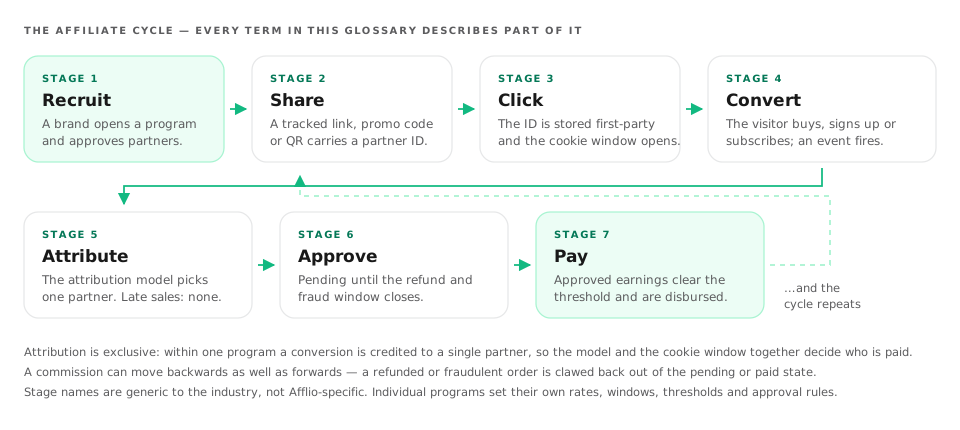
Where Influencer Marketing sits in the affiliate cycle
Influencer marketing is the share stage bought wholesale: paying for access to an audience through the person who built it.
How Influencer Marketing actually works
The channel works on borrowed trust. A brand pays a creator to put a message in front of an audience that has chosen to listen to that creator, and the message carries more weight than the same claim in an advertisement because of who is making it. That is the whole mechanism, and everything else is pricing and logistics.
The pricing models divide into three. A flat fee pays for delivery and leaves outcome risk with the brand; an affiliate commission pays for outcomes and leaves production risk with the creator; a hybrid splits both. Which one is appropriate depends entirely on how well-established the product fit is.
What Influencer Marketing means for a creator
The asset is the trust, and it is spent as well as earned. Promoting something that disappoints the audience costs more in future influence than any single fee is worth, which is why creators with long careers decline more work than they accept.
Commercially, the choice between fee and commission is a judgement about your own conversion. If you know the audience buys this category, commission usually pays more; if you do not, a fee is the honest way to fund finding out.
What Influencer Marketing means for a brand
Fit beats reach consistently in this channel, because the mechanism is trust rather than exposure. A creator whose audience is precisely the buyer converts at rates a larger, broader account will not approach.
Measure it with a tracked code rather than by sentiment. Even on a flat-fee deal a personal code costs nothing, survives the spoken and video formats a link cannot, and produces the data that decides whether the next deal should be a commission.
Common mistakes with Influencer Marketing
Buying reach instead of fit
The channel works because the audience trusts the creator about this subject. Reach without relevance is an expensive way to buy an impression.
Over-briefing the creator
Content that reads as a script loses the trust that made the placement valuable. Brief the message and the constraints, not the wording.
Running it with no tracking at all
A personal code costs nothing and turns an unmeasurable spend into a decision. Without it, every renewal is argued on impressions.
Influencer Marketing: common questions
Is influencer marketing the same as affiliate marketing?
No. Influencer marketing describes the channel — reaching an audience through the person who built it. Affiliate marketing describes a payment model. A creator paid a flat fee is doing influencer marketing and not affiliate marketing; one paid on sales is doing both.
Should I pay a flat fee or a commission?
A fee when the product fit is unproven or the creator cannot risk unpaid production; a commission when the audience is known to buy the category. Hybrids exist because most situations sit between the two.
How do I measure an influencer campaign?
With a personal promo code, which works in video, audio and in-person contexts where a link does not, and with tracked deep links where the format allows. Without one of the two, the result is not measurable.
See also
- Creator Economy
The creator economy is the ecosystem of independent creators — writers, video makers, streamers, and educators — who earn a living directly from their audiences and brand partnerships, supported by platforms and tools for content, monetization, and payments.
- Sponsored Post
A sponsored post is social or blog content a creator is paid to publish promoting a brand, which must be clearly disclosed as an ad under FTC and comparable rules.
- Brand Deal
A brand deal is a paid agreement between a brand and a creator to promote the brand's product, defined by deliverables, usage rights, exclusivity, timing, and a fee or commission.
- Influencer Affiliate (Hybrid)
An influencer affiliate blends influencer marketing with affiliate pay: a creator promotes a brand to their audience and earns commissions on tracked sales, often alongside or instead of a flat sponsorship fee.
- Affiliate Marketing
Affiliate marketing is a performance-based marketing model in which a business pays external partners a commission for each customer or sale they refer.
Turn the theory into a live program
Afflio handles tracking, commissions, and payouts so you can run the program these terms describe — start free in an afternoon.