Clawback (Chargeback)
Updated July 2026
A clawback is the reversal of a previously credited affiliate commission when the underlying sale is refunded, cancelled, or charged back.
If a referred customer returns the product, disputes the charge, or cancels within a defined period, the merchant claws back the commission so the affiliate is not paid for revenue the business did not keep. This is also called a reversal or, when triggered by a card dispute, a chargeback.
Programs reduce disputes by holding commissions in a pending state through a clearing window before approval, only paying out once the sale is final. Clear clawback rules protect the merchant without surprising honest partners.
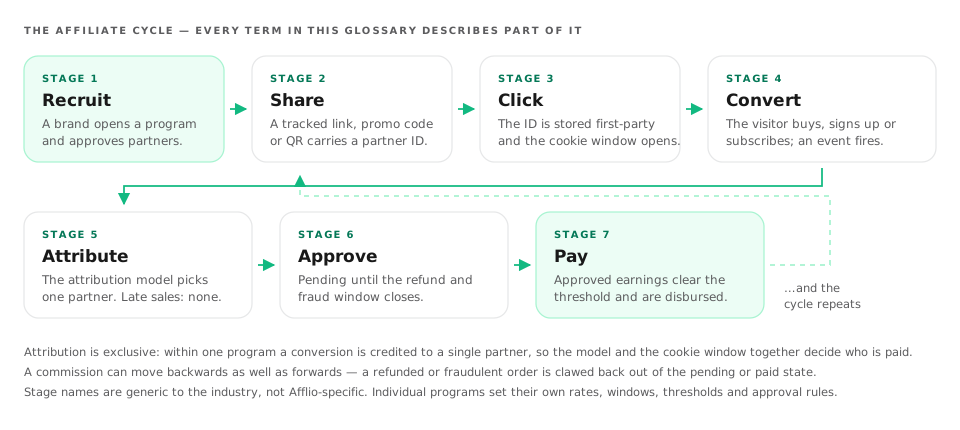
Where Clawback (Chargeback) sits in the affiliate cycle
A clawback is the approve stage running backwards — a commission already counted, and sometimes already paid, being taken back.
How Clawback (Chargeback) actually works
A clawback reverses a commission after the fact, and it is triggered by something invalidating the underlying conversion: a refund, a cancellation, a failed or charged-back payment, a subscription that lapses inside a minimum retention period, or a fraud review that rejects the order. The commission moves out of pending or approved and into reversed.
How the money comes back depends on timing. If the commission has not been paid, the program simply cancels it. If it has, the amount is almost always deducted from the partner's next payout rather than invoiced, which is why a partner can see a payout arrive smaller than the statement they read last week.
What Clawback (Chargeback) means for a creator
Clawbacks are why gross earnings are not a forecast. In categories with high return rates — apparel especially — the gap between gross and net commission is large enough that planning against gross is planning against a number that never existed.
Two habits reduce them. Set expectations accurately in the content, since overselling produces returns, and watch your own reversal rate per program: a rate far above the others is usually telling you the product does not match what your audience expects.
What Clawback (Chargeback) means for a brand
Clawbacks keep the program honest, because without them any refunded order would still be paid for. The rule should be narrow, written down, and applied identically to every partner.
What turns a fair mechanism into a churn engine is opacity. A reversal with no order reference and no reason reads as the program taking money arbitrarily, and partners respond by moving their traffic rather than by asking.
Common mistakes with Clawback (Chargeback)
Reversing without a reason and an order reference
A partner cannot reconcile a deduction they cannot trace. Every reversal should name the order and the cause.
Approving faster than the refund window
Approving on day 7 of a 30-day return policy guarantees paid commissions that later need clawing back from money already gone.
Planning against gross commission
In return-heavy categories the reversal rate can remove a meaningful share of gross earnings. Net is the only figure worth forecasting from.
Clawback (Chargeback): common questions
Can a commission be clawed back after it has been paid?
Yes. Most programs deduct the amount from the partner's next payout rather than requesting a repayment, which is why a payout can arrive smaller than the statement that preceded it.
What triggers a clawback?
A refund, a cancellation, a chargeback or failed payment, a subscription that lapses inside a minimum retention period, or a fraud review rejecting the order. The program terms should list which apply.
How can I reduce my clawback rate?
Set accurate expectations in the content, promote products that genuinely fit the audience, and compare your reversal rate across programs — a consistently high one is usually a product-fit signal rather than bad luck.
How long after a sale can a commission still be clawed back?
Usually at least as long as the brand's refund window, and longer where chargebacks or a subscription retention period are involved. A card chargeback can arrive months after the purchase, which is why some programmes reserve the right to reverse a commission well after it was approved.
See also
- Commission
A commission is the payment an affiliate earns for each qualifying conversion they drive, set as a percentage of the sale or a fixed amount per action.
- Payout Cadence
Payout cadence is how frequently an affiliate program pays out approved commissions, such as weekly, monthly, or net-30 after a sale clears.
- Affiliate Fraud (Click Fraud)
Affiliate fraud is any attempt to earn commissions illegitimately, such as fake clicks, forced cookies, self-referrals, or fabricated conversions.
- Conversion
A conversion is the qualifying action — such as a sale, signup, lead, or subscription — that triggers an affiliate commission.
Turn the theory into a live program
Afflio handles tracking, commissions, and payouts so you can run the program these terms describe — start free in an afternoon.