Payout Cadence
Updated July 2026
Payout cadence is how frequently an affiliate program pays out approved commissions, such as weekly, monthly, or net-30 after a sale clears.
A predictable cadence — for example monthly on the 1st for all commissions that have cleared the refund window — reduces support questions and makes reconciliation easier. Many programs add a clearing period (like net-30) so commissions settle before they are paid.
Cadence works with the payout threshold and approval step: commissions accrue, clear the window, are approved, and are then dispatched on schedule to the partner's chosen payout method.
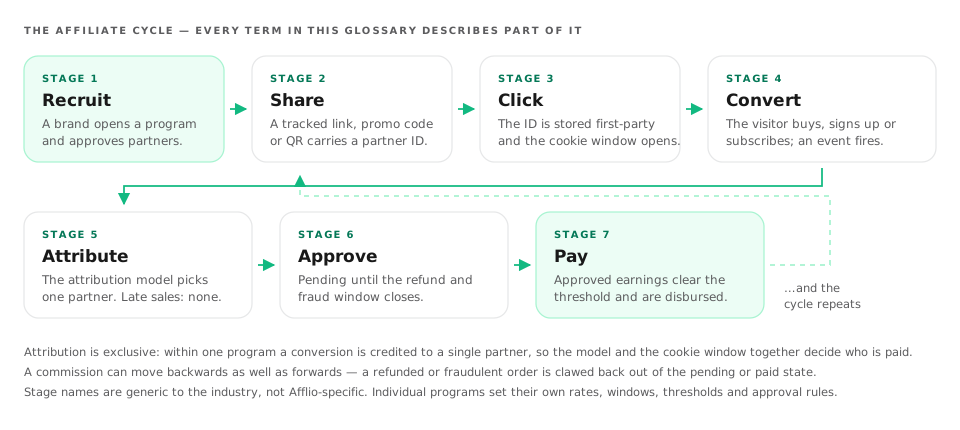
Where Payout Cadence sits in the affiliate cycle
Payout cadence sets the rhythm of the pay stage — how often the program actually runs a disbursement at all.
How Payout Cadence actually works
Cadence is one of three clocks that together decide when money arrives, and on its own it decides the least. The pending period has to close first, the approved balance has to clear the payout threshold second, and only then does the cadence determine which run the money leaves on. A monthly cadence behind a 60-day pending period pays a January sale in April.
Cadence also interacts with the rail. A domestic bank transfer settles in a day or two; an international wire can add a week and a correspondent-bank fee. The cadence is when the program sends, not when the partner's bank credits it.
What Payout Cadence means for a creator
For a partner this is a cash-flow question, not a total-earnings one. Nothing about cadence changes what you earn; it changes whether you can fund the next production before the last one pays.
The honest way to read a program is to add all three clocks together. Monthly cadence, a 30-day pending period and a threshold you clear every other month is a real-world wait of two to three months from sale to bank.
What Payout Cadence means for a brand
A faster cadence is one of the cheapest competitive advantages a program has, because partners compare it directly and it costs only working capital rather than margin.
The operational cost is real though: every run means fresh fraud review, tax-form checks and failed-payment handling. Programs that move to weekly payouts without automating those three usually move back.
Common mistakes with Payout Cadence
Quoting cadence as if it were time-to-payment
Partners experience pending period plus threshold plus cadence plus rail settlement. Advertising only the last-but-one sets an expectation the program will miss every month.
Skipping a run without notice
A missed cycle reads as insolvency to a partner who has no other signal. A dated note in the dashboard costs nothing and prevents the assumption.
Running payouts before fraud review completes
Money out is much harder to recover than a commission reversed in place, so a cadence faster than the review it depends on converts a detection problem into a loss.
Payout Cadence: common questions
What is a typical affiliate payout cadence?
Monthly is the most common, with networks often running net-30 or net-60 on top of it. Weekly and on-demand payouts exist but are much rarer and usually reserved for established partners.
Why did my payout skip a month?
Most often the approved balance did not clear the payout threshold, or a commission moved back to pending after a refund. Both look identical from the partner side, so the statement is the place to check.
Does a faster cadence mean I earn more?
No. Cadence affects when money arrives, never how much. It matters for cash flow, which for a partner funding production ahead of payment can matter a great deal.
Can I request an early payout?
Some programmes support an on-demand payout for established partners, usually with a fee or a higher minimum attached. Most do not, because every off-cycle run means repeating the fraud and tax checks. It is worth asking once you are producing consistently rather than assuming either answer.
See also
- Payout Threshold
A payout threshold is the minimum balance an affiliate must accumulate before the program will release a payment.
- Commission
A commission is the payment an affiliate earns for each qualifying conversion they drive, set as a percentage of the sale or a fixed amount per action.
- Clawback (Chargeback)
A clawback is the reversal of a previously credited affiliate commission when the underlying sale is refunded, cancelled, or charged back.
- Tax Form (W-9 / W-8BEN)
A tax form such as the W-9 or W-8BEN collects the legal and tax information a merchant needs to pay an affiliate and meet reporting obligations.
Turn the theory into a live program
Afflio handles tracking, commissions, and payouts so you can run the program these terms describe — start free in an afternoon.