Payout Threshold
Updated July 2026
A payout threshold is the minimum balance an affiliate must accumulate before the program will release a payment.
Setting a minimum payout threshold — for example $50 or $100 — keeps per-transaction fees manageable and avoids sending many tiny payments. Until an affiliate's approved earnings exceed the threshold, the balance rolls over to the next payout cycle.
Thresholds work alongside a fixed payout cadence (such as monthly) and an approval step, so payments are predictable for partners and easy to reconcile for the merchant's finance team.
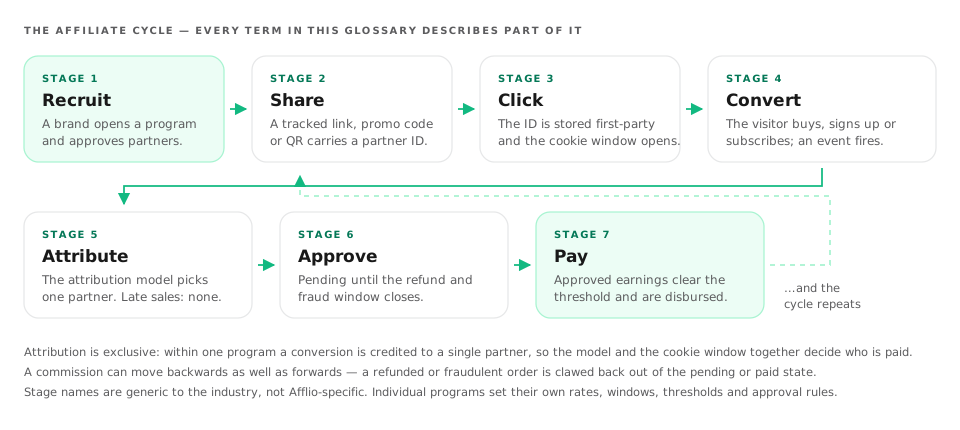
Where Payout Threshold sits in the affiliate cycle
The payout threshold is the last gate at the pay stage: approved money that has not reached it stays in the account instead of moving.
How Payout Threshold is calculated
paid this cycle = approved balance if approved balance ≥ threshold, otherwise 0
- approved balance
- commissions past the refund window, net of reversals
- threshold
- a per-program minimum, frequently 50 or 100 in the program's currency
- rollover
- a balance under the threshold carries forward, it is not forfeited
- why it exists
- transfer fees make very small disbursements cost more than they move
Worked example (illustrative)
A 100 dollar threshold against 35 dollars a month of approved commission pays nothing in months one and two and 105 dollars in month three — so the effective payment cadence is quarterly, whatever the program's stated cadence says.
The figures above are a chosen illustration of the arithmetic. They are not a measured result, a typical result, or a projection of what any program pays.
What Payout Threshold means for a creator
The threshold, not the cadence, is what usually decides when a small partner actually gets paid. Read them together: a monthly program with a threshold you clear twice a year is a twice-yearly program.
Check what happens to a balance that never reaches it. Reputable programs roll it forward indefinitely; a few forfeit dormant balances after a period, and that clause is worth finding before you accumulate one.
What Payout Threshold means for a brand
The threshold exists because a payout costs money to send. Below some amount the transfer fee and the reconciliation work exceed the commission, and for cross-border rails that floor is higher than most programs assume.
Setting it too high is a quiet partner-retention problem. A partner who has earned money they cannot withdraw for six months disengages long before they complain, and the program reads it as content that stopped performing.
Common mistakes with Payout Threshold
Publishing the cadence and hiding the threshold
Monthly payouts with an unstated high minimum is the most common reason a partner's expectation and reality diverge in the first quarter.
Forfeiting dormant balances without prominent notice
Money earned and then removed is the single fastest way to turn a quiet partner into a public complaint. If the clause exists, surface it.
Applying one threshold to every payout rail
A domestic bank transfer and an international wire have very different costs. A single global minimum is either too high for one rail or uneconomic for the other.
Payout Threshold: common questions
What happens if I never reach the payout threshold?
In most programs the balance rolls forward until you do. A minority forfeit dormant balances after a stated period, so it is worth checking the terms rather than assuming the balance is safe indefinitely.
Why do programs have a minimum payout at all?
Because sending money costs money. Below a certain amount the transfer fee and the administrative work exceed the commission itself, particularly on cross-border rails.
Can the threshold be lowered?
Sometimes, for established partners or on a cheaper local rail. It is a reasonable thing to ask about once you are producing consistently.
Does the threshold apply per programme or across a network?
Inside a network it is normally a single balance across every merchant you promote, which makes it much easier to clear than a per-programme minimum. With direct programmes each one has its own balance and its own threshold, so a partner spread across many direct programmes can hold money in several places and reach none of the minimums.
See also
- Commission
A commission is the payment an affiliate earns for each qualifying conversion they drive, set as a percentage of the sale or a fixed amount per action.
- Clawback (Chargeback)
A clawback is the reversal of a previously credited affiliate commission when the underlying sale is refunded, cancelled, or charged back.
- Tax Form (W-9 / W-8BEN)
A tax form such as the W-9 or W-8BEN collects the legal and tax information a merchant needs to pay an affiliate and meet reporting obligations.
- Payout Cadence
Payout cadence is how frequently an affiliate program pays out approved commissions, such as weekly, monthly, or net-30 after a sale clears.
Turn the theory into a live program
Afflio handles tracking, commissions, and payouts so you can run the program these terms describe — start free in an afternoon.