Cookie Stuffing
Updated July 2026
Cookie stuffing is an affiliate fraud technique that drops tracking cookies onto users' browsers without a genuine click or referral, so the fraudster is credited for sales they did not actually influence.
The fraudster loads affiliate cookies silently — via hidden iframes, image tags, or scripts — as a user browses, so that any later purchase within the cookie window is misattributed to them even though the user never engaged with a real referral.
It steals credit from legitimate partners and inflates payouts. Defenses include server-to-server tracking, anomaly detection on click-to-conversion patterns, and terms that allow clawing back commissions tied to fraudulent activity.
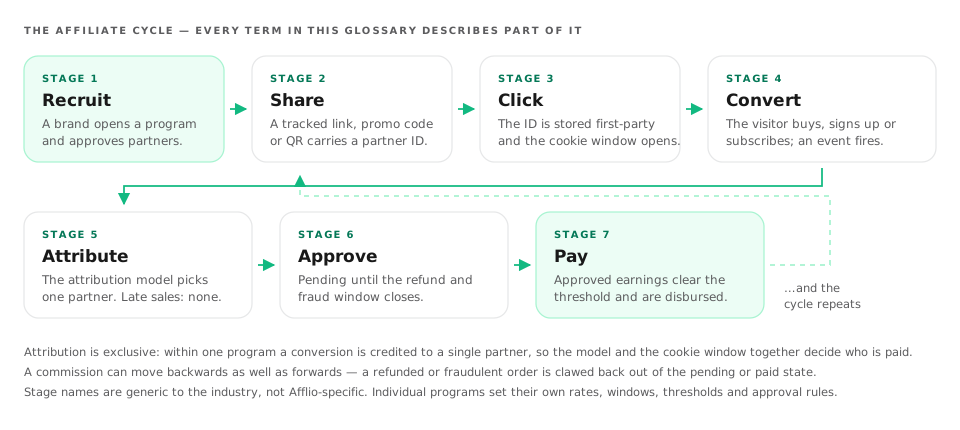
Where Cookie Stuffing sits in the affiliate cycle
Cookie stuffing attacks the click stage, forging the evidence of a referral that the rest of the cycle then trusts.
How Cookie Stuffing actually works
Cookie stuffing sets an affiliate tracking cookie on a visitor who never knowingly clicked an affiliate link. The classic methods load the tracking URL invisibly — a one-pixel image, a hidden iframe, a script firing on page load, or a browser extension injecting the parameter into pages the user visits. The visitor sees nothing; the affiliate's identifier is stored anyway.
The payoff is entirely statistical. Stuff enough browsers and some of them will buy from that merchant within the cookie window for reasons unconnected to the stuffer, and each of those purchases pays a commission. Nothing about the buyer's journey changed except who gets credited.
What Cookie Stuffing means for a creator
No legitimate promotion requires this, and the fingerprint is unmistakable in a program's data: enormous click volume against a tiny click-through rate, and conversions with no plausible content behind them.
The indirect harm to honest partners is real. Every stuffed cookie that wins under last-click takes a commission from a partner who actually influenced the buyer, which is one reason programs that police it well are worth preferring.
What Cookie Stuffing means for a brand
Stuffing is expensive precisely because the sales are real. The brand pays commission on revenue it would have earned anyway, and the program's reporting shows a high-performing partner rather than a leak.
The detection signals are distinctive: a collapsed click-to-conversion ratio, referrer data that does not match any published content, conversions spread implausibly evenly across the catalogue, and impression-like click volume from a single source.
Common mistakes with Cookie Stuffing
Judging a partner on conversions alone
A stuffer converts well by construction. The click-to-conversion ratio and the referring content are what separate them from a genuine partner.
Accepting extension-based traffic without scrutiny
Browser extensions are the modern delivery mechanism. An extension that rewrites links on pages the user was already on is interception whatever its stated purpose.
Assuming a network screens it out
Networks vary widely in how aggressively they police this, and the merchant pays the commission either way. Monitor your own program data regardless of who runs it.
Cookie Stuffing: common questions
Is cookie stuffing illegal?
It has been prosecuted as fraud in several jurisdictions, and it breaches the terms of essentially every affiliate program. It is not a grey-area tactic.
How can a merchant spot cookie stuffing?
Look for very high click volume against a very low click-through rate, conversions with no identifiable referring content, and a partner whose conversions are spread unnaturally evenly across the whole catalogue.
Do third-party cookie restrictions stop it?
They make the classic hidden-iframe method less reliable, but extension-based link rewriting is unaffected because it operates in the user's own browsing context.
Can a legitimate partner be flagged for cookie stuffing by accident?
It happens, usually when a partner's links are republished by an aggregator or embedded in a widget that loads on page view rather than on click. The pattern looks identical in the data. Keeping your own click analytics, so you can show where traffic genuinely originated, is the practical defence if a review is opened.
See also
- Affiliate Fraud (Click Fraud)
Affiliate fraud is any attempt to earn commissions illegitimately, such as fake clicks, forced cookies, self-referrals, or fabricated conversions.
- Self-Referral Fraud
Self-referral fraud occurs when an affiliate uses their own referral link or code to buy — or has friends do so — to collect a commission on their own purchase, a violation most programs explicitly prohibit and claw back.
- Cookie Window
A cookie window (or cookie duration) is the length of time after a referral click during which a resulting conversion will still be credited to that affiliate.
- Attribution
Attribution is the process of determining which affiliate or marketing touchpoint should receive credit — and the commission — for a conversion.
Turn the theory into a live program
Afflio handles tracking, commissions, and payouts so you can run the program these terms describe — start free in an afternoon.