Self-Referral Fraud
Updated July 2026
Self-referral fraud occurs when an affiliate uses their own referral link or code to buy — or has friends do so — to collect a commission on their own purchase, a violation most programs explicitly prohibit and claw back.
Sometimes the affiliate simply wants the discount their code gives; sometimes it is a deliberate scheme to harvest commissions on purchases they would have made anyway. Either way it drains the program's budget without generating genuinely new customers.
Programs counter it with terms that ban self-referrals, detection that flags matching buyer and affiliate details, and clawbacks on offending orders. Clear rules stated at onboarding prevent honest confusion while still allowing enforcement.
Where Self-Referral Fraud sits in the affiliate cycle
Self-referral is caught at the approve stage, where the program has to decide whether a partner bought from themselves through their own link.
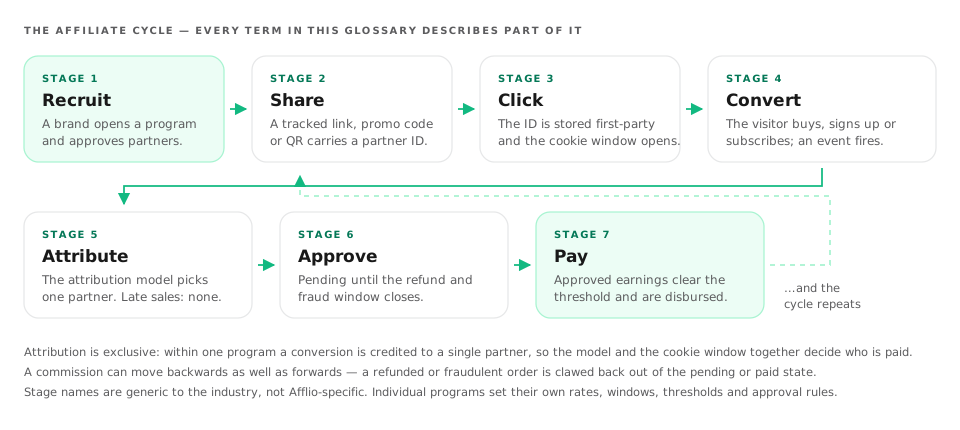
How Self-Referral Fraud actually works
Self-referral means the partner is also the buyer, using their own link to claim a commission on their own purchase — effectively a personal discount funded by the brand. At small scale it looks like an honest mistake; at large scale it becomes a systematic scheme using multiple accounts, addresses and payment methods to disguise a single person.
Most programs prohibit it outright in their terms, and a minority explicitly permit it on a first personal purchase as a recruitment perk. The practical detection signals are device fingerprints, shipping addresses, payment instruments and email patterns shared between the partner account and the orders it is credited for.
What Self-Referral Fraud means for a creator
Read the terms before buying through your own link, because the rule genuinely differs between programs and the assumption cuts both ways. Where it is prohibited, a single self-purchase is enough to justify removal under most agreements.
Where it is permitted, it is usually limited to one purchase and disclosed as such. Anything beyond that — buying for friends, running family orders through the link — is the behaviour the prohibition exists to stop.
What Self-Referral Fraud means for a brand
The direct cost is a discount the brand did not intend to offer, but the larger cost is data corruption: self-referred orders inflate a partner's apparent performance and pull budget toward a partner producing nothing.
Decide the policy explicitly and publish it. An unstated rule enforced after the fact produces disputes; a stated allowance on a first personal purchase is a cheap recruitment perk that removes most of the ambiguity.
Common mistakes with Self-Referral Fraud
Leaving the policy unstated
Partners will assume whichever reading suits them. Say plainly whether a personal purchase through your own link is allowed, and if so how many.
Detecting on email address alone
Trivially evaded. Device fingerprint, shipping address and payment instrument together are far harder to disguise across repeated orders.
Treating one self-purchase as a scheme
New partners test their own link, and some genuinely buy the product to review it. Escalate on pattern and volume rather than on a single order.
Self-Referral Fraud: common questions
Can I use my own affiliate link to buy something?
Only if the program allows it, and many explicitly do not. A minority permit one personal purchase as a perk. The terms are the only authority, and the assumption is not safe either way.
How do programs detect self-referral?
By correlating the partner account with the orders credited to it — shared device fingerprints, shipping addresses, payment instruments and email patterns are the usual signals.
What happens if it is detected?
Typically reversal of the affected commissions and, for a repeated pattern, account closure. Most program terms reserve both remedies explicitly.
Is buying through a friend's affiliate link the same problem?
It is the adjacent one, and several programmes treat it the same way. The concern is the same in both cases: a commission paid on a purchase the partner did not genuinely cause. Where the terms address it at all, they usually bar orders the partner arranged rather than earned, which covers both.
See also
- Affiliate Fraud (Click Fraud)
Affiliate fraud is any attempt to earn commissions illegitimately, such as fake clicks, forced cookies, self-referrals, or fabricated conversions.
- Cookie Stuffing
Cookie stuffing is an affiliate fraud technique that drops tracking cookies onto users' browsers without a genuine click or referral, so the fraudster is credited for sales they did not actually influence.
- Clawback (Chargeback)
A clawback is the reversal of a previously credited affiliate commission when the underlying sale is refunded, cancelled, or charged back.
- Affiliate
An affiliate is an individual or company that promotes another business's products in exchange for a commission on the sales or actions they generate.
Turn the theory into a live program
Afflio handles tracking, commissions, and payouts so you can run the program these terms describe — start free in an afternoon.