Promo Code (Coupon Tracking)
Updated July 2026
A promo code is a unique coupon assigned to an affiliate so that purchases using the code are attributed to them, even without a tracked link click.
Promo codes are essential for offline and creator-driven promotion — podcasts, videos, and live events where a clickable link isn't practical. The customer enters the affiliate's code at checkout, which both attributes the sale and often gives the customer a discount.
Codes can carry expiry dates, usage caps, and per-affiliate uniqueness. They complement link tracking and provide a reliable attribution path when cookies are blocked or the referral happened away from a browser.
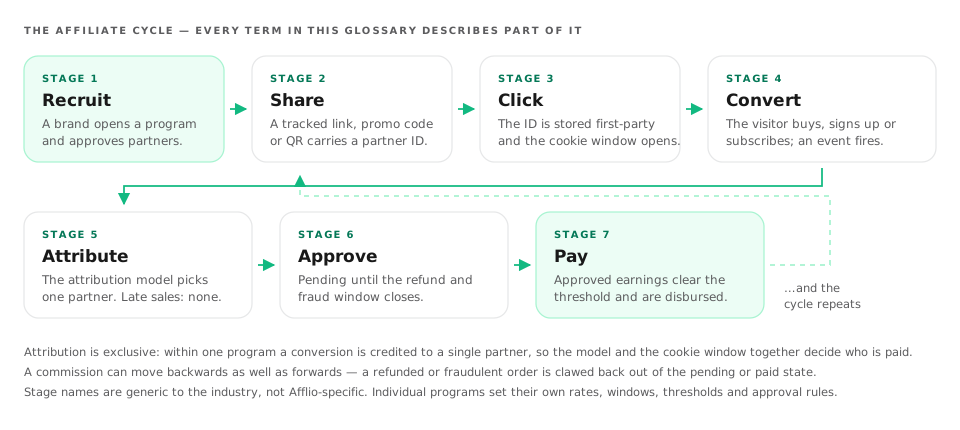
Where Promo Code (Coupon Tracking) sits in the affiliate cycle
A promo code attributes at the attribute stage using evidence carried on the order itself, with no browser state involved at all.
How Promo Code (Coupon Tracking) actually works
A unique code is issued to one partner and attached to the order at checkout. Because the evidence travels with the order rather than in the visitor's browser, attribution survives everything that breaks cookie tracking: a different device, a cleared browser, an in-app webview, a purchase made in a physical store, or a checkout on a domain the tracking script never reached.
Codes usually carry a discount as well, which is what makes them attractive to the audience and expensive for the brand. A code with no discount still attributes perfectly well and is worth considering where the goal is tracking rather than promotion.
Offline is where the mechanism earns its keep. A code read aloud on a podcast or printed on packaging is entered at a point of sale that has never heard of the affiliate programme, and the redemption arrives later in the merchant's own sales export. Attribution is then a reconciliation job rather than a real-time one: the export is matched against issued codes on a schedule, which is why offline commissions typically approve on a slower cycle than online ones.
What Promo Code (Coupon Tracking) means for a creator
A personal code is the most durable tracking a creator can have. It works in spoken formats where a link cannot — podcasts, video, live streams, in-person events — and it survives the listener buying three days later on a different device.
The cost is leakage. Codes get scraped into aggregator sites within days, and from then on a share of your redemptions come from people who never saw your content. Programs that pay codes at a lower rate than links are usually pricing exactly this.
What Promo Code (Coupon Tracking) means for a brand
Per-partner codes are the cheapest way to make attribution work for offline and spoken channels, and they cost nothing in tracking infrastructure. The discount is the real cost, and it is paid on every redemption including the leaked ones.
Two controls matter: publish the precedence rule between a code and a cookie so partners can reconcile, and monitor aggregator sites for leaked codes. A code that has leaked converts at a suspiciously high rate with no matching content.
Common mistakes with Promo Code (Coupon Tracking)
Reusing one code across several partners
Attribution becomes impossible and the commission cannot be assigned. Codes must be unique per partner to function as tracking at all.
Not publishing the code-versus-cookie precedence
When both are present on an order, one wins. Partners cannot reconcile their statements without knowing which, and the disputes look like tracking bugs.
Ignoring leakage to aggregator sites
A scraped code keeps paying commission on buyers who never saw the content. The tell is redemptions far outrunning the partner's click volume.
Issuing a guessable code
A code built from the brand name and a round number is found without ever being leaked: checkout extensions try permutations of exactly that shape on every order. This is a distinct failure from aggregator leakage — there is nothing to retire and no source to report, because the code was never published anywhere. Codes that include a partner-specific fragment are not worth guessing.
Promo Code (Coupon Tracking): common questions
Does a promo code override cookie tracking?
In most programs yes, because a code present on the order is stronger evidence than stored browser state. Programs vary, so the precedence rule should be published and is worth checking.
Do promo codes work without a discount?
Yes. The tracking function is entirely separate from the discount. A zero-discount code attributes exactly as well and costs the brand nothing in margin.
Why do some programs pay less on code sales than link sales?
Because codes leak. Once a code appears on a deal aggregator, redemptions include buyers who never encountered the partner's content, and a lower rate prices that in.
What should I do when my code leaks to a deal site?
Ask the programme for a fresh code and retire the old one. A leaked code cannot be un-leaked, and for as long as it stays live it keeps paying you for redemptions from people who never saw your content — which is precisely what makes a programme cut the rate on code sales in the first place. Some brands reissue automatically when leakage is reported; others treat it as already priced into the rate.
See also
- Deep Link
A deep link is an affiliate tracking link that sends the customer to a specific product or page on the merchant's site rather than just the homepage.
- Attribution
Attribution is the process of determining which affiliate or marketing touchpoint should receive credit — and the commission — for a conversion.
- Affiliate
An affiliate is an individual or company that promotes another business's products in exchange for a commission on the sales or actions they generate.
- Conversion
A conversion is the qualifying action — such as a sale, signup, lead, or subscription — that triggers an affiliate commission.
Turn the theory into a live program
Afflio handles tracking, commissions, and payouts so you can run the program these terms describe — start free in an afternoon.