First-Party vs Third-Party Cookies
Updated July 2026
First-party cookies are set by the website a user is visiting, while third-party cookies are set by other domains such as ad or tracking networks; browsers increasingly block third-party cookies, pushing affiliate tracking toward first-party and server-side methods.
A first-party cookie belongs to the domain in the address bar and is generally trusted and persistent. A third-party cookie is set by a different domain embedded in the page — historically how cross-site ad and affiliate tracking worked.
Because Safari, Firefox, and Chrome now restrict or block third-party cookies, affiliate programs increasingly rely on first-party cookies set by the merchant plus server-to-server tracking, which do not depend on cross-site cookies and keep attribution accurate as the cookie landscape tightens.
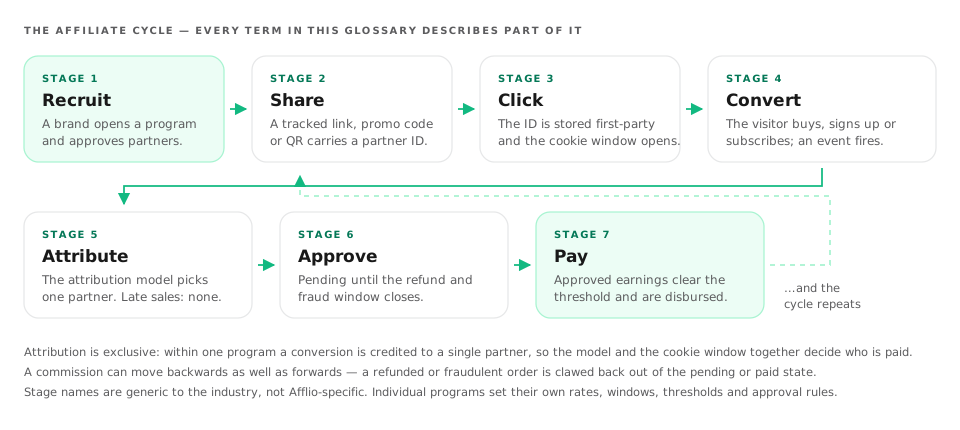
Where First-Party vs Third-Party Cookies sits in the affiliate cycle
The distinction decides whether the click stage leaves any usable evidence at all in a browser that blocks third-party storage.
How First-Party vs Third-Party Cookies actually works
A first-party cookie is set by the domain the visitor is actually on; a third-party cookie is set by a different domain embedded in that page. Browsers treat the two very differently. Safari and Firefox have blocked third-party cookies by default for years, and Chrome has spent years restricting them, while first-party cookies continue to work normally everywhere.
For affiliate tracking the consequence is direct. A program whose tracking cookie is set by a third-party tracking domain loses attribution on a large share of traffic, silently. A program that redirects the click through the merchant's own domain, or a subdomain of it, sets a first-party cookie that the browser keeps — which is why the redirect architecture matters more than the cookie duration.
What First-Party vs Third-Party Cookies means for a creator
This is the most common invisible cause of a partner earning less than their traffic should produce. Nothing looks broken: clicks are recorded, conversions simply never appear, and the partner concludes the audience did not buy.
You cannot fix it from outside, but you can notice it. A conversion rate that collapses specifically on mobile and in-app traffic, while holding up on desktop, is the classic fingerprint.
What First-Party vs Third-Party Cookies means for a brand
Moving the click redirect onto the brand's own domain converts the tracking cookie from third-party to first-party and recovers attribution that was being lost. It is usually a DNS and configuration change rather than a rewrite.
First-party cookies are not immune either — Safari caps the lifetime of some script-set cookies to days rather than months, which can silently truncate a long cookie window. Setting the cookie server-side on an HTTP response avoids that cap, and a server-to-server postback avoids the question entirely.
Common mistakes with First-Party vs Third-Party Cookies
Publishing a 90-day window backed by third-party storage
The published number describes the configuration, not what the browser keeps. On a browser blocking third-party cookies the effective window is zero.
Setting the tracking cookie from JavaScript
Some browsers cap the lifetime of script-set cookies to a few days regardless of the expiry requested. Setting it server-side on the response avoids the cap.
Assuming a tracking domain alias makes it first-party
It has to be a domain the visitor is genuinely on. A CNAME to the merchant's domain helps; an unrelated tracking domain does not, whatever it is aliased to.
First-Party vs Third-Party Cookies: common questions
Do third-party cookie restrictions break affiliate tracking?
They break the parts that depend on third-party storage. First-party cookies, unique promo codes and server-to-server postbacks are all unaffected, which is why programs have been migrating onto them.
How do I tell which kind a program uses?
Follow the click and look at which domain sets the cookie. If it is the merchant's own domain or a subdomain of it, it is first-party; if it is a separate tracking domain, it is not.
Is server-side tracking a complete replacement for cookies?
For the conversion half, effectively yes. Something still has to carry the click identifier from the click to the order, but once it is stored server-side against the session the browser is no longer part of the chain.
See also
- Cookie Window
A cookie window (or cookie duration) is the length of time after a referral click during which a resulting conversion will still be credited to that affiliate.
- S2S / Postback Tracking
Server-to-server (S2S) postback tracking records conversions by sending an event directly from the merchant's backend to the affiliate platform, without relying on browser cookies.
- Attribution
Attribution is the process of determining which affiliate or marketing touchpoint should receive credit — and the commission — for a conversion.
- Incrementality
Incrementality measures how many conversions a marketing channel or partner truly caused that would not have happened otherwise, separating genuinely driven sales from those that would have occurred anyway.
Sources
Turn the theory into a live program
Afflio handles tracking, commissions, and payouts so you can run the program these terms describe — start free in an afternoon.