Incrementality
Updated July 2026
Incrementality measures how many conversions a marketing channel or partner truly caused that would not have happened otherwise, separating genuinely driven sales from those that would have occurred anyway.
Attribution asks who to credit for a conversion; incrementality asks whether that conversion was actually additional. It is usually tested with holdout or geo experiments that compare groups exposed to a channel against those that were not.
In affiliate marketing, incrementality is central to evaluating coupon, loyalty, and cashback partners: if a customer was already going to buy and simply searched for a code at checkout, that sale may not be incremental. Understanding incrementality helps merchants pay for genuinely new revenue rather than skimmed existing sales.
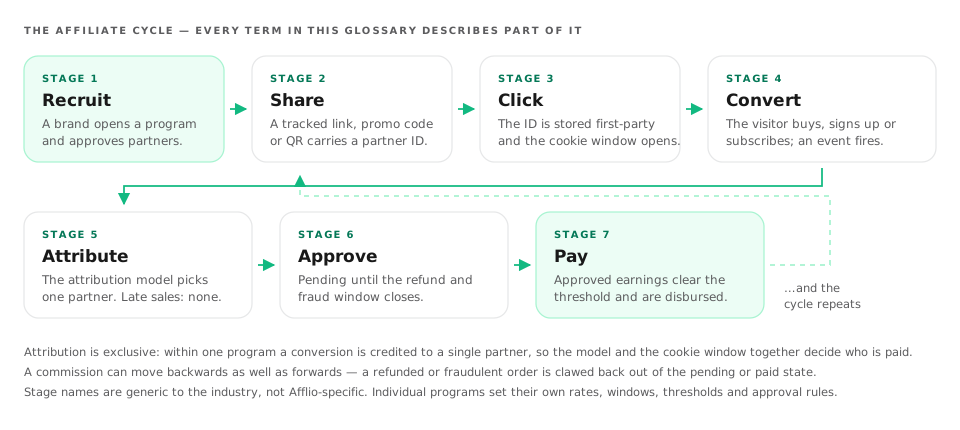
Where Incrementality sits in the affiliate cycle
Incrementality is the question attribution cannot answer: of the revenue credited at the attribute stage, how much would have happened anyway.
How Incrementality is calculated
incremental revenue = test group revenue − control group revenue
- test group
- the audience or region where the partner activity runs
- control group
- a comparable holdout where it does not
- why a holdout
- attribution measures correlation; only a holdout isolates causation
- common designs
- geographic holdouts, partner-type pauses, and time-based on-off tests
Worked example (illustrative)
Two comparable regions, one with coupon partners active and one without, differing by 3 percent in revenue while coupon partners are credited with 14 percent of it, implies most of that credited revenue was not incremental.
The figures above are a chosen illustration of the arithmetic. They are not a measured result, a typical result, or a projection of what any program pays.
What Incrementality means for a creator
Incrementality is why programs treat partner types differently, and understanding it explains rate structures that otherwise look arbitrary. A partner who creates demand is incremental almost by definition; one who intercepts buyers at checkout frequently is not.
It is also a useful argument in a rate negotiation. A content partner who can show that their traffic arrives before the buyer had decided is describing incrementality, which is the property the brand is actually trying to buy.
What Incrementality means for a brand
Attributed revenue always overstates the channel's contribution, because attribution credits every conversion it can see rather than every conversion it caused. The size of the gap is unknown until it is measured.
The tests are cheaper than they sound. Pausing one partner type in one region for a few weeks, or holding out a matched geography, produces a usable answer without instrumenting anything — and it routinely changes where the budget goes.
Common mistakes with Incrementality
Treating attributed revenue as incremental
It is the upper bound, not the estimate. Any partner positioned near checkout is credited with sales that were already in motion.
Running a test too short to clear the cookie window
With a 30-day window, a two-week holdout is still paying out conversions from clicks before the test began. The measurement period has to outlast the window.
Concluding a partner type is worthless from one test
Incrementality varies by category, season and price point. One result is a finding about one context, not a general law.
Incrementality: common questions
How do I measure affiliate incrementality?
With a holdout. Pause a partner type in one comparable region or audience segment while leaving it running elsewhere, run it longer than the cookie window, and compare total revenue rather than attributed revenue.
Is attributed revenue the same as incremental revenue?
No. Attributed revenue counts every conversion the tracking layer can credit, including sales that would have happened without any partner involvement. It is an upper bound.
Which partner types tend to be least incremental?
Those positioned closest to checkout — coupon extensions, brand-name paid search and retargeting — because they most often intercept buyers who had already decided.
Can a small programme measure incrementality at all?
Not reliably with a holdout test — the volume needed for a statistically meaningful split is larger than most programmes have. What a small programme can do is read the shape of each partner's traffic: redemptions with no matching content, conversion rates far above the programme norm, and activity that appears only at the checkout step are all signs of interception rather than created demand.
See also
- Attribution
Attribution is the process of determining which affiliate or marketing touchpoint should receive credit — and the commission — for a conversion.
- Multi-Touch Attribution
Multi-touch attribution distributes credit for a conversion across the several marketing touchpoints a customer interacted with, rather than giving all credit to the first or last click, aiming for a fairer view of each partner's contribution.
- Last-Click Attribution
Last-click attribution credits the entire commission to the final affiliate or link the customer clicked before converting.
- CPA (Cost Per Action)
CPA, or cost per action (also cost per acquisition), is a pricing model where the advertiser pays only when a specific action — a sale, signup, or lead — is completed, aligning cost directly with results.
Turn the theory into a live program
Afflio handles tracking, commissions, and payouts so you can run the program these terms describe — start free in an afternoon.