GMV (Gross Merchandise Value)
Updated July 2026
GMV, or gross merchandise value, is the total sales value of goods sold through a channel or platform over a period, before deducting fees, refunds, or costs — a common headline metric for marketplaces and creator commerce.
GMV sums the value of everything transacted, giving a top-line sense of scale. It is popular for marketplaces, e-commerce platforms, and creator-commerce channels because it shows total volume flowing through the system.
GMV is not revenue or profit: a platform typically keeps only a fee or commission on that volume, and refunds and cancellations reduce the net figure. In affiliate and creator commerce, GMV attributed to partners shows how much sales volume the program drives.
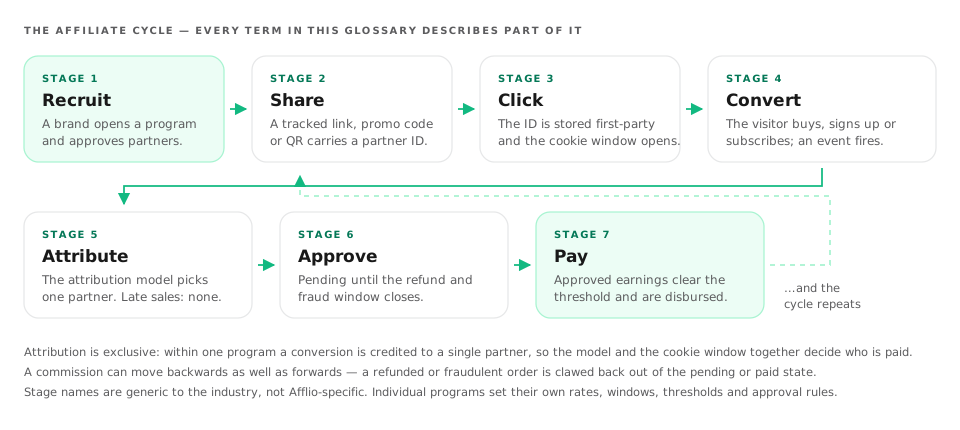
Where GMV (Gross Merchandise Value) sits in the affiliate cycle
GMV totals the convert stage across a whole platform: the value of everything transacted, before anyone has taken a cut of it.
How GMV (Gross Merchandise Value) is calculated
GMV = Σ (order value) across all orders in the period
- gross
- before fees, refunds, cancellations and discounts are deducted
- take rate
- the share a platform actually keeps; revenue = GMV × take rate
- net GMV
- the same total after refunds and cancellations, and the honest one
- affiliate use
- partner-attributed GMV shows how much volume a program moves
Worked example (illustrative)
A marketplace reporting 4 million dollars of GMV on a 9 percent take rate has 360,000 dollars of revenue. If 8 percent of orders are refunded, the honest revenue figure is closer to 331,000 — which is why gross and net GMV should never be quoted interchangeably.
The figures above are a chosen illustration of the arithmetic. They are not a measured result, a typical result, or a projection of what any program pays.
What GMV (Gross Merchandise Value) means for a creator
GMV is the number a creator-commerce platform quotes about itself, and it tells you almost nothing about what a creator earns. Earnings come from the commission rate applied to the creator's own attributed share, not from the platform's headline.
Where it is useful is scale-checking a program. A marketplace with meaningful GMV in your category has buyers in it; one that quotes GMV without a category breakdown is quoting a number that may have nothing to do with your audience.
What GMV (Gross Merchandise Value) means for a brand
Partner-attributed GMV is a reasonable measure of how much commercial volume a program moves, and it is the right unit for comparing partner types on scale. It is the wrong unit for comparing them on value, because a high-GMV partner on a thin margin can cost more than they bring.
Always pair it with the net figure. Categories with high return rates show a gap between gross and net GMV large enough to reverse the ranking of two partners.
Common mistakes with GMV (Gross Merchandise Value)
Treating GMV as revenue
A platform keeps only its take rate. Quoting GMV where revenue is meant overstates the business by whatever the inverse of the take rate is.
Quoting gross GMV in a returns-heavy category
Refunds and cancellations can remove a substantial share. Net GMV is the only figure that describes money that stayed.
Ranking partners on GMV alone
Volume is not margin. A partner driving large discounted orders can produce more GMV and less contribution than one driving fewer full-price ones.
GMV (Gross Merchandise Value): common questions
Is GMV the same as revenue?
No. GMV is the total value of goods transacted; revenue is what the platform actually keeps, which is GMV multiplied by its take rate. The two differ by an order of magnitude for most marketplaces.
Does GMV include refunds?
Gross GMV does not deduct them. Net GMV does, and in categories with high return rates the difference is large enough that the two should never be quoted interchangeably.
Why do affiliate programs report attributed GMV?
Because it shows how much commercial volume partners moved, independent of the commission rate. It is a scale measure, not a value measure, and needs pairing with margin to be actionable.
See also
- AOV (Average Order Value)
AOV, or average order value, is the average amount spent each time a customer places an order, calculated as total revenue divided by number of orders.
- LTV (Customer Lifetime Value)
LTV, or customer lifetime value, is the total revenue a business expects to earn from a customer over the entire relationship.
- Creator Storefront
A creator storefront is a personalized shop page where a creator curates and links the products they recommend — often earning affiliate commissions on sales — turning their recommendations into a shoppable, trackable destination.
- Conversion
A conversion is the qualifying action — such as a sale, signup, lead, or subscription — that triggers an affiliate commission.
Turn the theory into a live program
Afflio handles tracking, commissions, and payouts so you can run the program these terms describe — start free in an afternoon.