Multi-Touch Attribution
Updated July 2026
Multi-touch attribution distributes credit for a conversion across the several marketing touchpoints a customer interacted with, rather than giving all credit to the first or last click, aiming for a fairer view of each partner's contribution.
Where last-click and first-click assign 100% of the credit to a single interaction, multi-touch models spread it — linear (equal weight), time-decay (more to recent touches), or position-based (more to the first and last). This better reflects journeys involving several partners.
Multi-touch is harder to implement and reconcile, so most affiliate programs default to last-click for simplicity. But brands that want to reward top-of-funnel partners — reviewers and influencers who create awareness — lean toward multi-touch or hybrid credit rules.
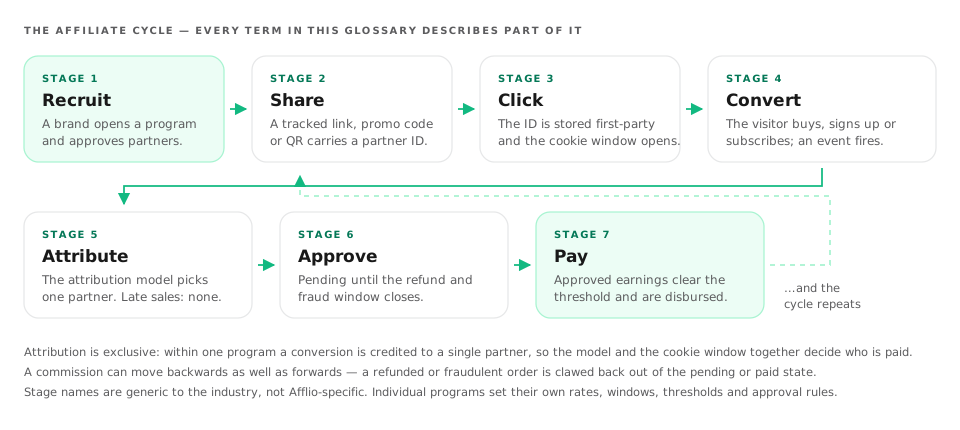
Where Multi-Touch Attribution sits in the affiliate cycle
Multi-touch is the attempt to allocate credit across several touches at the attribute stage rather than handing it all to one.
How Multi-Touch Attribution actually works
Multi-touch splits credit across the touches in a journey using a rule: linear gives every touch an equal share, time-decay weights the touches nearest the conversion, and position-based models typically give the first and last touch a large fixed share with the middle splitting the remainder. Data-driven models derive the weights statistically instead of fixing them by hand, which requires far more conversions than most affiliate programs have.
It is common in analytics and rare in affiliate payouts, and the reason is arithmetic rather than philosophy. Splitting a 40 dollar commission four ways produces payments small enough to sit under every payout threshold in the program, and a single refund then has to be clawed back across four partners.
What Multi-Touch Attribution means for a creator
Where a program does run multi-touch, discovery content stops earning zero and starts earning a fraction — which is usually a large improvement on last-click for anyone producing reviews or tutorials.
The catch is predictability. Under last-click you know whether you won; under a weighted model your share depends on touches by other partners that you cannot see, which makes it much harder to judge whether a piece of content was worth making.
What Multi-Touch Attribution means for a brand
Multi-touch is most useful to a brand as a measurement lens even when payouts stay last-click. Running it in reporting alone shows which partners appear early in journeys that convert, and that is the list worth protecting when budget moves.
Paying on it is a bigger commitment: thresholds, clawbacks, partner statements and dispute handling all get materially harder, and partners generally dislike a model whose output they cannot reconstruct.
Common mistakes with Multi-Touch Attribution
Paying fractional commissions under the payout threshold
Split enough ways, every partner's share falls below the minimum and nobody is paid at all, which is worse for partner trust than a model they merely dislike.
Using a data-driven model on thin data
Weights derived from a few hundred conversions are noise. With low volume, a fixed rule everyone can verify beats a statistical one nobody can.
Reporting multi-touch while paying last-click without saying so
Partners reconcile the dashboard against the payment. Two different models with no explanation reads as a tracking bug.
Multi-Touch Attribution: common questions
Do affiliate programs actually pay multi-touch?
Very few do. Most use it for analysis and pay on last-click, because splitting a real commission across partners collides with payout thresholds, clawbacks and reconciliation in ways a reporting model never has to face.
What is the difference between linear and time-decay?
Linear gives every touch in the journey an identical share. Time-decay gives more weight to touches nearer the conversion, on the assumption that recency correlates with influence.
Is multi-touch more accurate than last-click?
It is more complete, which is not the same thing. Every model except a properly run incrementality test is an assumption about causation; multi-touch spreads the assumption around rather than removing it.
See also
- Attribution
Attribution is the process of determining which affiliate or marketing touchpoint should receive credit — and the commission — for a conversion.
- Last-Click Attribution
Last-click attribution credits the entire commission to the final affiliate or link the customer clicked before converting.
- First-Click Attribution
First-click attribution credits the commission to the first affiliate or link that introduced the customer, even if other partners were involved later.
- Incrementality
Incrementality measures how many conversions a marketing channel or partner truly caused that would not have happened otherwise, separating genuinely driven sales from those that would have occurred anyway.
Turn the theory into a live program
Afflio handles tracking, commissions, and payouts so you can run the program these terms describe — start free in an afternoon.