Performance Marketing
Updated July 2026
Performance marketing is an umbrella term for digital marketing where advertisers pay based on measurable results — clicks, leads, or sales — rather than upfront for exposure, with affiliate marketing as a core channel.
In performance marketing, budget is tied to outcomes: CPC for clicks, CPL for leads, CPA for actions or sales. This makes spend accountable and ROI easy to measure compared with brand advertising billed by impressions.
Affiliate marketing is the classic performance channel because affiliates are paid only for the conversions they drive. Performance marketing also spans paid search, paid social, and programmatic buying optimized to a cost-per-result goal.
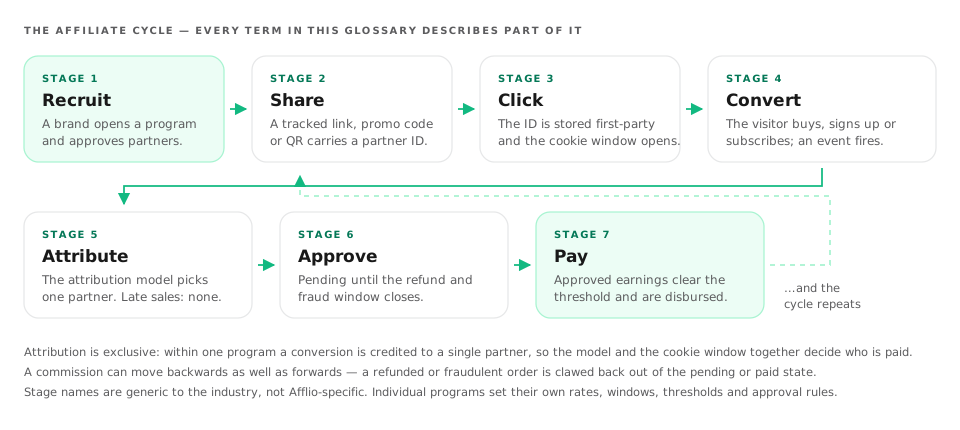
Where Performance Marketing sits in the affiliate cycle
Performance marketing is a payment principle applied at the convert stage: the advertiser pays for a measured outcome rather than for delivery.
How Performance Marketing actually works
The defining feature is the billing event. Performance channels bill on an action — a sale, a lead, an install, a qualified signup — rather than on impressions or time. Affiliate marketing is one instance of it; so are cost-per-install app campaigns, lead-generation buys and most auction-based search advertising when priced on conversions.
The consequence is that the whole discipline depends on the measurement being trustworthy. A performance channel whose conversion tracking is broken is not a cheap channel with a data problem; it is not a performance channel at all, because the billing event cannot be verified.
What Performance Marketing means for a creator
For a creator the relevant distinction is who carries the production risk. Performance pricing means the work is unpaid until it converts, which suits evergreen content and suits nobody who has to fund a production before publication.
This is why hybrid deals exist. A fee covering production plus a performance component on top is the structure that lets a creator participate in performance pricing without absorbing all of its risk.
What Performance Marketing means for a brand
The appeal is that spend is tied to outcomes, which makes the channel easy to defend internally. The discipline is remembering that attributed outcomes are not the same as caused outcomes, and that the gap between them is invisible without a holdout test.
Performance channels also concentrate naturally on demand that already exists, because that is the demand easiest to convert. A business that funds only performance channels typically discovers the ceiling when the existing demand runs out.
Common mistakes with Performance Marketing
Assuming attributed equals incremental
Performance channels credit the conversions they can see, including ones that were already going to happen. Only a holdout separates the two.
Running performance pricing on unverified tracking
If the billing event cannot be trusted, neither the advertiser nor the partner can tell whether the deal is fair. Verify the conversion path end to end before scaling.
Funding only performance channels
They harvest existing demand efficiently and create very little of it. Without upstream work the channel eventually runs out of demand to convert.
Performance Marketing: common questions
Is affiliate marketing a type of performance marketing?
Yes. Affiliate marketing is performance marketing executed through independent partners. Performance marketing is the wider principle and also covers cost-per-install, lead-generation and conversion-priced search buys.
Why is measurement so central to performance marketing?
Because the measurement is the billing event. If conversion tracking is unreliable, neither side can verify what is owed, and the pricing model has nothing to stand on.
What is the main limitation of performance marketing?
It converts demand far better than it creates it. A business relying on performance channels alone tends to find a ceiling once the existing demand in the category has been harvested.
See also
- Affiliate Marketing
Affiliate marketing is a performance-based marketing model in which a business pays external partners a commission for each customer or sale they refer.
- CPA (Cost Per Action)
CPA, or cost per action (also cost per acquisition), is a pricing model where the advertiser pays only when a specific action — a sale, signup, or lead — is completed, aligning cost directly with results.
- CPC (Cost Per Click)
CPC, or cost per click, is the amount an advertiser pays each time someone clicks their ad or link, a common pricing model in paid search and display and a key metric for PPC affiliates.
- Partner Marketing
Partner marketing is a broad discipline of growing revenue through external partners — affiliates, referrers, resellers, ambassadors, and integration partners — encompassing affiliate marketing and extending into strategic and channel partnerships.
- Conversion
A conversion is the qualifying action — such as a sale, signup, lead, or subscription — that triggers an affiliate commission.
Turn the theory into a live program
Afflio handles tracking, commissions, and payouts so you can run the program these terms describe — start free in an afternoon.