Tax Form (W-9 / W-8BEN)
Updated July 2026
A tax form such as the W-9 or W-8BEN collects the legal and tax information a merchant needs to pay an affiliate and meet reporting obligations.
In US-based programs, domestic affiliates submit a W-9 (providing their taxpayer ID) and foreign affiliates submit a W-8BEN (certifying foreign status, often to claim a reduced withholding rate under a tax treaty). The merchant uses these to report payments and apply any required withholding.
Best practice is to collect the correct form during onboarding, before the first payout, and to gate payment until it is on file — this keeps the program compliant and avoids chasing paperwork after money is owed.
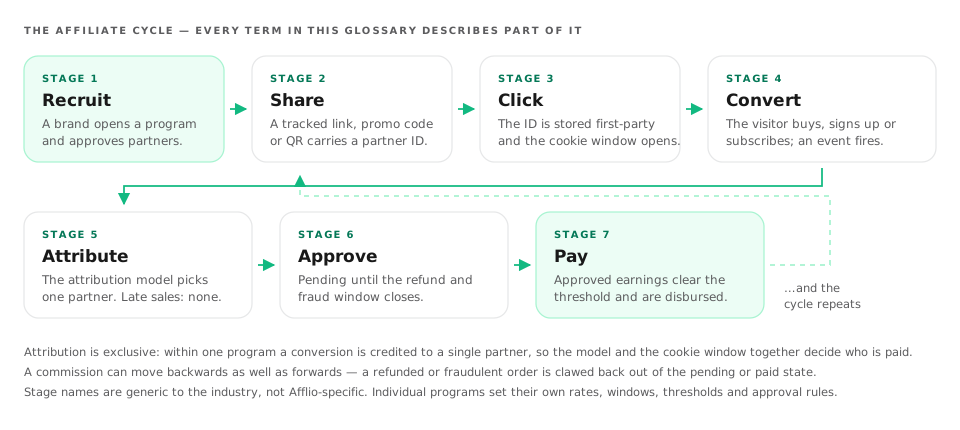
Where Tax Form (W-9 / W-8BEN) sits in the affiliate cycle
Tax forms gate the pay stage: in most programs no payout is released until the required form is on file.
How Tax Form (W-9 / W-8BEN) actually works
Programs paying partners need to know each partner's tax status before money moves. In the United States that is usually a W-9 for a US person and a W-8BEN, or W-8BEN-E for an entity, for a non-US person. The form establishes who is being paid and whether withholding applies; without it, programs commonly hold the payout or withhold at a default rate.
The obligation is the payer's, which is why the collection is non-negotiable from the partner's side. Outside the US the equivalent varies — local tax identifiers, GST or VAT registration details — but the pattern is the same: an onboarding step that blocks payout until it is complete.
What Tax Form (W-9 / W-8BEN) means for a creator
Complete the form during onboarding rather than when the first payout is due. A partner who leaves it and then clears the threshold discovers the delay at exactly the moment the money mattered.
Keep the details current. A change of country, entity or tax identifier usually requires a fresh form, and a stale one can silently stop payouts or trigger withholding that is difficult to recover.
What Tax Form (W-9 / W-8BEN) means for a brand
Collecting the right form is a payer obligation, not a courtesy, and getting it wrong creates a reporting problem the brand owns rather than the partner. Automating collection at signup removes almost all of the friction.
State plainly in the program terms that payouts are held until the form is on file. Partners accept a documented rule far better than an unexplained delay on a payment they were expecting.
Common mistakes with Tax Form (W-9 / W-8BEN)
Collecting the form only when a payout is due
It converts a routine onboarding step into a payment delay, at the moment the partner is least tolerant of one.
Assuming one form covers every partner
US and non-US partners need different forms, and entities need different ones from individuals. Collecting the wrong one is the same as collecting none.
Not re-collecting after a status change
A partner who moves country or incorporates has a different status. A stale form can cause incorrect withholding that is slow and awkward to unwind.
Tax Form (W-9 / W-8BEN): common questions
Which tax form do I need as a non-US affiliate?
Generally a W-8BEN if you are an individual and a W-8BEN-E if you are paid through a company. Programs paying from the US will tell you which they need at onboarding.
Why is my payout being held?
A missing or expired tax form is one of the most common reasons, alongside not clearing the payout threshold. The program dashboard usually shows which of the two applies.
Is this tax advice?
No. This describes the usual mechanics of affiliate payout onboarding. Tax treatment depends on your own circumstances and jurisdiction, so consult a qualified adviser.
Do I need a tax form if I never reach the payout threshold?
Most programmes collect it at onboarding regardless, because the requirement attaches to the payer's obligation rather than to any particular amount. Completing it early costs nothing and removes the delay that otherwise appears at exactly the moment your first payout becomes due.
See also
- Payout Threshold
A payout threshold is the minimum balance an affiliate must accumulate before the program will release a payment.
- Payout Cadence
Payout cadence is how frequently an affiliate program pays out approved commissions, such as weekly, monthly, or net-30 after a sale clears.
- Commission
A commission is the payment an affiliate earns for each qualifying conversion they drive, set as a percentage of the sale or a fixed amount per action.
- Affiliate
An affiliate is an individual or company that promotes another business's products in exchange for a commission on the sales or actions they generate.
Sources
Turn the theory into a live program
Afflio handles tracking, commissions, and payouts so you can run the program these terms describe — start free in an afternoon.