Reach vs Impressions
Updated July 2026
Reach is the number of unique people who saw a piece of content, while impressions count the total times it was displayed including repeat views — so impressions are always equal to or greater than reach.
If 1,000 unique people see a post and 300 of them see it twice, reach is 1,000 and impressions are 1,300. Reach answers 'how many people?' while impressions answer 'how many views?'
Both matter in influencer and content marketing: reach measures audience breadth for awareness, while impressions and frequency reveal how often the message was delivered. Pricing models like CPM are usually based on impressions.
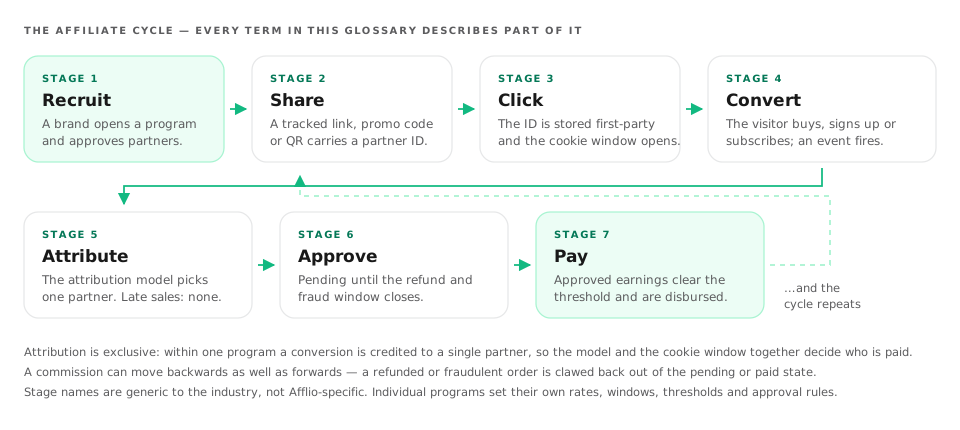
Where Reach vs Impressions sits in the affiliate cycle
The distinction governs every share-stage denominator: impressions count deliveries, reach counts people, and the ratio between them is frequency.
How Reach vs Impressions is calculated
frequency = impressions ÷ reach
- impressions
- times the content was displayed, counting repeats
- reach
- distinct people who saw it at least once
- frequency
- average views per person; above about three, returns fall sharply
- consequence
- any rate computed on impressions is lower than the same rate on reach
Worked example (illustrative)
48,000 impressions against 16,000 reach is a frequency of 3 — the same audience seeing the post three times each. A campaign reporting only impressions could be reaching 48,000 people once or 4,000 people twelve times, and the two are worth very different amounts.
The figures above are a chosen illustration of the arithmetic. They are not a measured result, a typical result, or a projection of what any program pays.
What Reach vs Impressions means for a creator
When you quote performance to a brand, say which number you are using. Impressions are always the larger figure and quoting them without labelling them reads as inflation once the brand checks.
For affiliate work reach is the more honest basis, because a person who has already seen the link and not clicked is unlikely to click on the third showing.
What Reach vs Impressions means for a brand
Frequency is the number that reveals whether a campaign is finding new people or re-showing the same ones. A rising frequency with flat reach means the spend has saturated its audience.
It also explains apparent underperformance. A creator whose impressions look strong but whose reach is small is delivering repetition, and repetition converts far worse than novel exposure for a product the viewer has already declined once.
Common mistakes with Reach vs Impressions
Quoting impressions as if they were people
Impressions include repeats. A campaign with a frequency of five reached a fifth of the people its impression count implies.
Computing engagement rate on reach and comparing with impressions
The denominators differ by the frequency factor. The two rates are not comparable numbers.
Ignoring frequency when performance plateaus
Flat conversions with rising impressions almost always means the same audience is being shown the same thing repeatedly.
Reach vs Impressions: common questions
What is the difference between reach and impressions?
Reach counts distinct people who saw the content at least once. Impressions count every display, including repeats to the same person. Impressions are always the larger number.
Which should I quote to a brand?
Quote both, and label them. Reach is the more honest basis for estimating how many new people a post can influence; impressions without context read as inflation.
What frequency is too high?
There is no universal threshold, but returns fall as frequency rises because a person who has already declined once rarely converts on a repeat. Track it and watch where your own conversions flatten.
Why does my reach drop when my follower count rises?
Reach depends on how many of your followers the platform actually shows a post to, which is a distribution decision rather than a function of audience size. An account can grow while reach falls, and for affiliate work the reach figure is the one that predicts clicks — follower count on its own predicts almost nothing.
See also
- Engagement Rate
Engagement rate is the percentage of a creator's audience that interacts with their content — likes, comments, shares, saves — relative to followers or reach, used as a key measure of audience quality and influence.
- CPM (Cost Per Mille)
CPM, or cost per mille, is the price an advertiser pays per one thousand impressions of an ad or sponsored content, a standard way to price awareness-focused campaigns and influencer posts.
- Influencer Marketing
Influencer marketing is a strategy in which brands partner with creators who have engaged social audiences to promote products, paying through flat fees, free product, affiliate commissions, or a combination.
- CTR (Click-Through Rate)
CTR, or click-through rate, is the percentage of people who click a link or ad out of those who saw it, calculated as clicks divided by impressions, measuring how compelling a link, ad, or promotion is.
Turn the theory into a live program
Afflio handles tracking, commissions, and payouts so you can run the program these terms describe — start free in an afternoon.