CTR (Click-Through Rate)
Updated July 2026
CTR, or click-through rate, is the percentage of people who click a link or ad out of those who saw it, calculated as clicks divided by impressions, measuring how compelling a link, ad, or promotion is.
CTR = clicks ÷ impressions × 100. A link shown 10,000 times and clicked 200 times has a 2% CTR. It gauges how effectively creative, copy, and placement earn a click.
In affiliate and influencer marketing, CTR reveals how persuasive a call-to-action or link placement is, and it feeds downstream economics: clicks combine with conversion rate and order value to produce earnings per click (EPC).
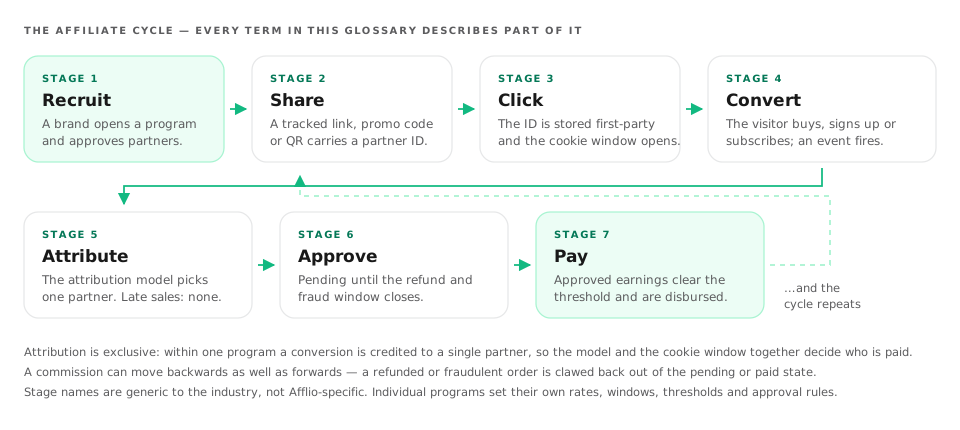
Where CTR (Click-Through Rate) sits in the affiliate cycle
Click-through rate measures the share stage: how many of the people who saw a post actually clicked the tracked link.
How CTR (Click-Through Rate) is calculated
CTR = clicks ÷ impressions × 100
- clicks
- tracked clicks on the link, deduplicated per user where possible
- impressions
- times the link or creative was displayed, not people reached
- placement matters
- the same link in a caption and in a pinned comment perform differently
- pairs with CVR
- CTR × CVR × AOV × rate is the whole earnings chain
Worked example (illustrative)
A post shown 40,000 times and clicked 600 times has a 1.5 percent CTR. Moving the link from the third paragraph to the first and reframing the anchor text is the kind of change that moves this number materially without any extra reach.
The figures above are a chosen illustration of the arithmetic. They are not a measured result, a typical result, or a projection of what any program pays.
What CTR (Click-Through Rate) means for a creator
CTR is the part of the earnings chain a creator controls most directly. Reach depends on an algorithm and conversion depends on the brand's landing page, but where the link sits, what the anchor text promises, and whether the audience knows why they should click are all yours.
Read it together with conversion rate rather than alone. High CTR with low conversion usually means the click was oversold: the link promised something the landing page did not deliver, and the traffic bounces.
What CTR (Click-Through Rate) means for a brand
Partner-level CTR tells a brand whether its creative and copy are doing any work. A program whose partners all report low CTR usually has a creative problem — unclear positioning, weak assets — rather than a partner-quality problem.
It is a poor payment basis. Paying on clicks invites click inflation and pays for traffic that never converts, which is why affiliate programs pay on outcomes and leave CTR as a diagnostic.
Common mistakes with CTR (Click-Through Rate)
Confusing impressions with reach
One person shown a post five times is five impressions and one person reached. CTR computed against reach is not comparable with CTR computed against impressions.
Optimising CTR in isolation
A curiosity-gap hook lifts clicks and collapses conversion. The metric that matters is the product of the chain, not any single link in it.
Comparing CTR across platforms
Each platform counts an impression differently. A 4 percent CTR in a newsletter and a 4 percent CTR on a feed post are not the same achievement.
CTR (Click-Through Rate): common questions
What is a good CTR for affiliate links?
There is no figure worth quoting across platforms and formats — the counting rules differ too much. The useful benchmark is your own past performance on the same format and audience.
Does CTR affect how much I earn?
Directly. Earnings are click-through rate times conversion rate times order value times commission rate, so a proportional gain in CTR moves earnings exactly as much as the same gain in conversion rate.
Why is my CTR high but my earnings low?
Look at the next link in the chain. Either the traffic is not converting, or it is converting on small orders, or the program's conversion definition excludes what your audience actually buys.
See also
- CPC (Cost Per Click)
CPC, or cost per click, is the amount an advertiser pays each time someone clicks their ad or link, a common pricing model in paid search and display and a key metric for PPC affiliates.
- CPM (Cost Per Mille)
CPM, or cost per mille, is the price an advertiser pays per one thousand impressions of an ad or sponsored content, a standard way to price awareness-focused campaigns and influencer posts.
- Conversion Rate
Conversion rate is the percentage of referred clicks or visitors that complete a qualifying action, calculated as conversions divided by clicks.
- Reach vs Impressions
Reach is the number of unique people who saw a piece of content, while impressions count the total times it was displayed including repeat views — so impressions are always equal to or greater than reach.
- Engagement Rate
Engagement rate is the percentage of a creator's audience that interacts with their content — likes, comments, shares, saves — relative to followers or reach, used as a key measure of audience quality and influence.
Turn the theory into a live program
Afflio handles tracking, commissions, and payouts so you can run the program these terms describe — start free in an afternoon.