SKAdNetwork (SKAN)
Updated July 2026
SKAdNetwork (SKAN) is Apple's privacy-preserving framework for attributing mobile app installs and conversions without exposing individual user data, central to iOS affiliate and performance tracking after Apple's privacy changes.
Introduced alongside App Tracking Transparency (ATT), SKAN lets ad networks and partners measure campaign results using aggregated, delayed, privacy-safe reports rather than user-level identifiers. This limits granularity but preserves user privacy.
For affiliate and partner programs that promote iOS apps, SKAN shapes how installs and in-app events attribute. Because it is coarser than traditional tracking, many programs pair SKAN with web and server-to-server tracking to reconstruct a fuller picture of partner performance.
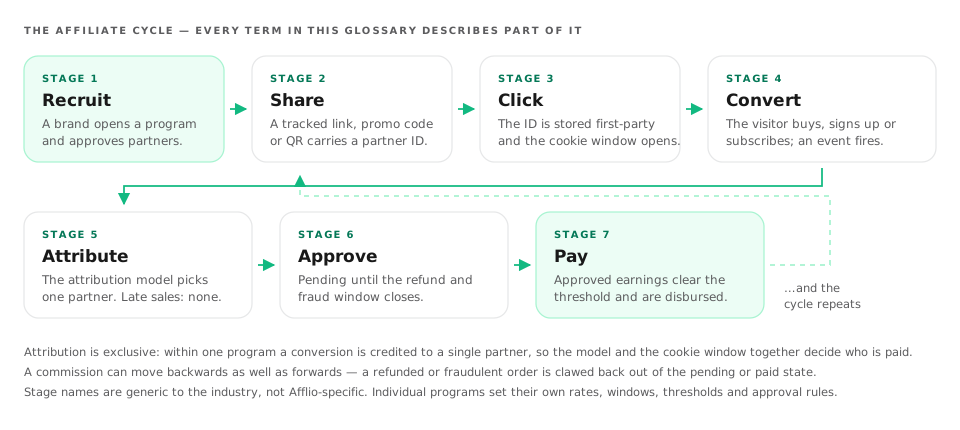
Where SKAdNetwork (SKAN) sits in the affiliate cycle
SKAdNetwork replaces the attribute stage on iOS with a privacy-preserving report that deliberately withholds the detail affiliate tracking normally relies on.
How SKAdNetwork (SKAN) actually works
SKAdNetwork is Apple's framework for attributing iOS app installs without identifying the user. The ad network registers a campaign, the App Store validates the install, and Apple sends a signed postback to the network. What it contains is deliberately limited: a campaign identifier from a small range, a coarse conversion value, and a deliberately delayed and partially randomised timestamp.
Those limits are the point. There is no device identifier, no user-level journey and no real-time reporting, so per-partner, per-click attribution of the kind an affiliate program normally performs is not available. Campaigns are measured in aggregate, and low-volume campaigns can have their conversion values withheld entirely for privacy.
What SKAdNetwork (SKAN) means for a creator
For a creator promoting an iOS app, this is why the reporting looks so much thinner than on web. Delays are built in, values are coarse, and small campaigns may show nothing at all rather than showing a small number.
A promo code or a web-based signup that precedes the app install sidesteps the limitation, because the attribution then happens on the web where ordinary tracking still works.
What SKAdNetwork (SKAN) means for a brand
An app-install program cannot be run on the same measurement assumptions as a web program. Campaign identifiers are a scarce resource that has to be allocated deliberately, and the conversion value schema has to be designed before launch because it cannot be reconstructed afterwards.
Where the business allows it, routing partners to a web signup before the app install restores ordinary attribution and is usually a better answer than trying to force affiliate mechanics through the framework.
Common mistakes with SKAdNetwork (SKAN)
Expecting per-click attribution on iOS installs
The framework does not provide it by design. A program promising per-partner install attribution on iOS is describing something the platform does not support.
Designing the conversion value schema after launch
The encoding is fixed and narrow. A schema that was not thought through cannot be retrofitted onto installs that have already happened.
Reading a delayed postback as a missing conversion
Delay and timestamp randomisation are deliberate privacy features. Reconciling on the day will always show a shortfall that later resolves.
SKAdNetwork (SKAN): common questions
Can affiliate programs track iOS app installs per partner?
Not in the way web attribution works. SKAdNetwork reports at campaign level with no user identifier, so per-click, per-partner attribution is not available on that path.
Why is the conversion data delayed and coarse?
Deliberately, to prevent the reports being used to identify individuals. Delay, timestamp randomisation and value withholding on low-volume campaigns are privacy features rather than faults.
Is there a way around it for affiliate programs?
Routing partners to a web signup before the app install keeps the attribution on the web, where ordinary first-party and server-side tracking still work. That is usually preferable to forcing affiliate mechanics through the framework.
See also
- S2S / Postback Tracking
Server-to-server (S2S) postback tracking records conversions by sending an event directly from the merchant's backend to the affiliate platform, without relying on browser cookies.
- First-Party vs Third-Party Cookies
First-party cookies are set by the website a user is visiting, while third-party cookies are set by other domains such as ad or tracking networks; browsers increasingly block third-party cookies, pushing affiliate tracking toward first-party and server-side methods.
- Attribution
Attribution is the process of determining which affiliate or marketing touchpoint should receive credit — and the commission — for a conversion.
- Conversion
A conversion is the qualifying action — such as a sale, signup, lead, or subscription — that triggers an affiliate commission.
Sources
Turn the theory into a live program
Afflio handles tracking, commissions, and payouts so you can run the program these terms describe — start free in an afternoon.