UGC (User-Generated Content)
Updated July 2026
User-generated content (UGC) is content — photos, videos, reviews, and posts — created by customers or creators rather than the brand itself, valued in marketing because it feels authentic and trustworthy.
UGC spans everything from an organic customer review to a paid creator video shot to look like a genuine recommendation. Brands use it because audiences trust peer content far more than polished brand advertising, and it is cheaper and faster to produce at scale.
It helps to distinguish organic UGC — unpaid content from real customers — from a UGC creator's work, which is paid content produced specifically for a brand to reuse in ads and on social. In influencer and affiliate programs, brands often commission UGC-style content that showcases a product naturally alongside a tracked link or code.
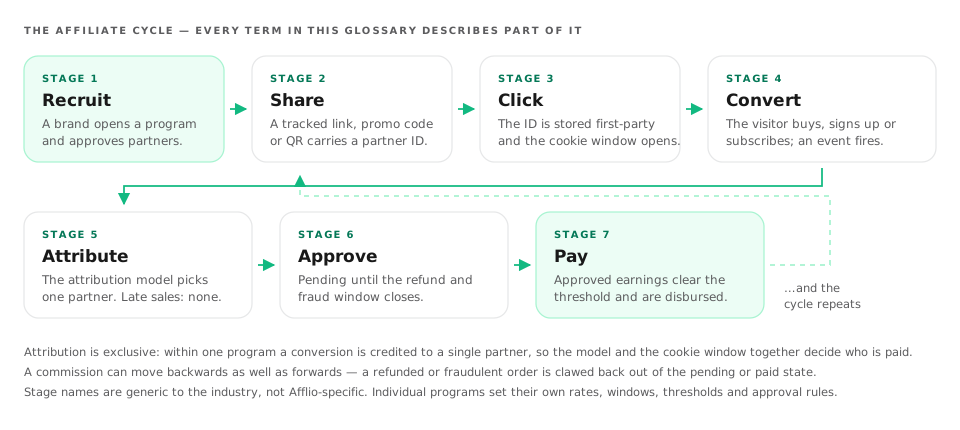
Where UGC (User-Generated Content) sits in the affiliate cycle
UGC changes what is shared at the share stage: content created by people rather than by a studio, used because it reads as authentic.
How UGC (User-Generated Content) actually works
The term covers two genuinely different things, and conflating them causes most of the confusion. Organic user-generated content is made by customers unprompted and posted on their own channels. Commissioned UGC is made to order by a creator, paid for, and run on the brand's own channels as advertising — it looks user-generated and is not.
The second is a production service rather than an audience buy. A commissioned UGC creator is being paid for the asset, frequently with no requirement to post it at all, which is why their pricing looks nothing like an influencer's and why reach is not part of the negotiation.
What UGC (User-Generated Content) means for a creator
Commissioned UGC is a viable income stream that does not depend on having an audience, which makes it the most accessible paid creator work. It is priced per asset, with usage rights as a separate and significant line.
Price the rights deliberately. An asset the brand will run as paid media for a year is worth a multiple of one used in a single organic post, and bundling the two is the most common way UGC work is underpriced.
What UGC (User-Generated Content) means for a brand
Commissioned UGC is usually cheaper per asset than studio production and frequently outperforms it in feed environments, because it matches the format the audience is already scrolling.
Where it is run as advertising it must be disclosed as such, and where genuine customer content is reused the brand needs permission. Reposting a customer's content without asking is both a rights problem and a trust problem.
Common mistakes with UGC (User-Generated Content)
Conflating organic UGC with commissioned UGC
One is unpaid customer content, the other is paid production that resembles it. They have different costs, different rights and different disclosure obligations.
Bundling perpetual usage rights into a per-asset price
Rights are where most of the value sits. An asset licensed for a single organic post and one licensed for unlimited paid media are different products.
Reusing genuine customer content without permission
Posting publicly does not grant a brand a licence to advertise with it. Ask, and keep the record of the answer.
UGC (User-Generated Content): common questions
Do UGC creators need an audience?
Not for commissioned work. They are paid for the asset rather than for distribution, which is what makes it accessible to creators without a following — and why it is priced per asset rather than by reach.
Does commissioned UGC need to be disclosed?
When it runs as advertising on the brand's channels it is advertising and is labelled as such. When a paid creator posts it on their own channel, the ordinary disclosure obligations apply.
Can a brand repost a customer's content?
Only with permission. Content being public does not give a brand a licence to use it commercially, and asking is both the safe and the better-received option.
See also
- Influencer Marketing
Influencer marketing is a strategy in which brands partner with creators who have engaged social audiences to promote products, paying through flat fees, free product, affiliate commissions, or a combination.
- Sponsored Post
A sponsored post is social or blog content a creator is paid to publish promoting a brand, which must be clearly disclosed as an ad under FTC and comparable rules.
- Creator Economy
The creator economy is the ecosystem of independent creators — writers, video makers, streamers, and educators — who earn a living directly from their audiences and brand partnerships, supported by platforms and tools for content, monetization, and payments.
- Brand Deal
A brand deal is a paid agreement between a brand and a creator to promote the brand's product, defined by deliverables, usage rights, exclusivity, timing, and a fee or commission.
Turn the theory into a live program
Afflio handles tracking, commissions, and payouts so you can run the program these terms describe — start free in an afternoon.