Attribution Window
Updated July 2026
An attribution window (or conversion window) is the period after a click or interaction during which a resulting conversion is credited to that referral; it generalizes the cookie window to cover code- and server-tracked conversions too.
Where the cookie window specifically refers to cookie-based tracking, the attribution window is the broader concept: the eligible time span for crediting a conversion regardless of whether tracking used a cookie, a promo code, or a server-to-server event.
Common windows range from a few days to 90 days or more, depending on the product's consideration cycle. A longer window credits partners for slower purchase decisions but increases the chance of over-crediting; programs balance the two based on how customers actually buy.
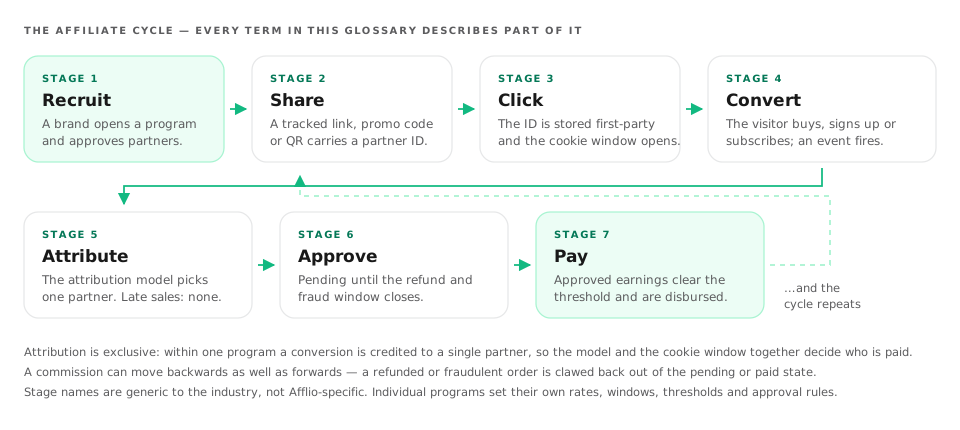
Where Attribution Window sits in the affiliate cycle
The attribution window is the rule applied at the attribute stage: how long after a touch the program will still accept a conversion against it.
How Attribution Window is calculated
eligible = conversion falls inside the window measured from the qualifying touch
- qualifying touch
- a click in most programs; an impression in some paid channels
- window length
- set per program, and sometimes per partner type
- view-through
- a separate, usually much shorter window for impressions
- post-window sale
- attributed to nobody, and the brand keeps the margin
Worked example (illustrative)
A program running a 30-day click window and a 1-day view-through window credits a buyer who clicked three weeks ago, and credits nobody for a buyer who only saw a banner last Tuesday and bought today.
The figures above are a chosen illustration of the arithmetic. They are not a measured result, a typical result, or a projection of what any program pays.
What Attribution Window means for a creator
For a partner the window is the difference between being paid for influence and being paid for timing. It is the second thing to check after the rate, and the one most often missing from a program's public page.
Where a program publishes different windows for different partner types, read which bucket you are in. Content partners and coupon partners frequently run on different windows in the same program, and the shorter one is rarely the content partner's.
What Attribution Window means for a brand
The window is the brand's main instrument for controlling how much credit flows to touches that may not have caused anything. Shortening it moves budget toward partners near the purchase; lengthening it moves budget toward partners who create demand.
Running separate windows by partner type is the more precise tool: a long window for content and review partners, a short one for coupon and retargeting partners, so each is paid on the behaviour the program actually wants from them.
Common mistakes with Attribution Window
Publishing one window and configuring another
Partners reconcile against the published figure. A mismatch produces disputes the brand always loses, and it is trivially checkable by firing a test conversion near the boundary.
Applying a click window to view-through credit
Impressions are far weaker evidence than clicks. Giving them the same window hands large amounts of credit to touches with no demonstrated influence.
Changing it silently
A shortened window reduces earnings for identical work with no visible cause, which partners read as broken tracking and respond to by leaving.
Attribution Window: common questions
Is the attribution window the same as the cookie window?
They are usually set to the same number but they are different rules. The cookie window is how long the referral evidence survives in storage; the attribution window is how long the program will accept a conversion against a touch. Codes and server-side tracking have an attribution window with no cookie at all.
What happens to a sale that falls outside the window?
Nobody is paid for it. It is recorded as a direct or organic sale and the brand keeps the full margin — which is part of why shortening the window reduces program cost.
Can different partners have different windows?
Yes, and better-run programs do exactly that, giving content partners a longer window than coupon or retargeting partners because the two are doing different work.
See also
- Cookie Window
A cookie window (or cookie duration) is the length of time after a referral click during which a resulting conversion will still be credited to that affiliate.
- Attribution
Attribution is the process of determining which affiliate or marketing touchpoint should receive credit — and the commission — for a conversion.
- Last-Click Attribution
Last-click attribution credits the entire commission to the final affiliate or link the customer clicked before converting.
- S2S / Postback Tracking
Server-to-server (S2S) postback tracking records conversions by sending an event directly from the merchant's backend to the affiliate platform, without relying on browser cookies.
- Conversion
A conversion is the qualifying action — such as a sale, signup, lead, or subscription — that triggers an affiliate commission.
Turn the theory into a live program
Afflio handles tracking, commissions, and payouts so you can run the program these terms describe — start free in an afternoon.